Future of Wedding Technology Trends For Modern Couples
20 min
Future of Wedding Technology Trends For Modern Couples
Author
The ItsaYes TeamAuthor
The future of wedding tech isn't about adding more apps to your phone. It's about integration and intelligence. Instead of juggling spreadsheets, Pinterest boards, and scattered notes, you can now step into a single, calm, intuitive workspace that connects your vision, budget, and timeline. It’s about turning that initial overwhelming chaos into a clear, manageable process from day one.
The New Era of Wedding Planning
Let’s be honest. For years, "wedding planning" was just a nice way of saying you were wrestling with spreadsheets, drowning in Pinterest boards, and trying to decipher notes scrawled in a dozen different notebooks. The whole process felt scattered and stressful, leaving most couples feeling completely overwhelmed before they’d even booked a venue.
But that’s changing. We’re seeing a massive shift away from that manual, piecemeal approach and toward an empowered, creative journey.
This change is being driven by a new wave of smart, intuitive tools designed to act as your co-pilot, not just your checklist. Think of them less as complex software and more as a personal assistant that helps translate your inspiration into a clear, actionable plan. The goal isn’t just to keep lists anymore; it’s about giving you clarity and confidence right from the start so you can actually enjoy the process.
From Scattered Notes to a Central Hub
Modern planning solutions are built to solve the real problems couples face. Instead of juggling spreadsheets and scattered notes, you can now use a centralized hub to pull every single element of your wedding together into one calm, intuitive workspace. This is the core idea behind platforms like ItsaYes, which brings your vision, tasks, budget, and timeline together to turn inspiration into a fully structured plan.
Here’s a look at some of the key innovations making this possible:
AI Assistants: These tools help you define your style, suggest priorities, and organize tasks, keeping everything moving forward without overwhelm.
Virtual Venue Tours: Augmented and virtual reality let you explore potential locations from the comfort of your couch, saving you a ton of time and travel costs.
Smart Budget Trackers: Integrated financial tools give you real-time updates as you spend, helping you make informed decisions and stay on track without the spreadsheet headaches.
The big idea here is to move beyond mere organization and toward true orchestration. Technology now provides a single source of truth, connecting your vision, tasks, and budget in one intuitive workspace.
The wedding technology market is absolutely exploding. Projections show the sector will skyrocket from $7.1 billion in 2026 to an incredible $15.2 billion by 2033. This massive growth isn't just a fad; it reflects a fundamental shift in how couples plan, with digital tools becoming the heart of the entire process. You can discover more insights about the wedding technology market here.
To help you get a handle on all these changes, we've put together a quick overview of the biggest trends and how they can make your planning journey smoother.
Key Wedding Technology Trends at a Glance
Technology Trend
How It Solves Planning Stress
Best For
AI Planning Assistants
Cuts through the noise by defining your style, suggesting vendors, and automating tedious tasks.
Couples who feel overwhelmed by endless choices and want a clear starting point.
AR/VR Try-Ons & Tours
Lets you "visit" venues or try on attire virtually, saving time and eliminating guesswork.
Long-distance couples or those with busy schedules who can't travel for every decision.
Livestreaming & Hybrid Events
Ensures no one misses out, seamlessly including guests who can't attend in person.
Couples with international family, guests with health concerns, or those wanting a more inclusive event.
Contactless Everything
Simplifies payments, RSVPs, and information sharing with QR codes and digital wallets.
Tech-savvy couples who want a streamlined, modern experience for themselves and their guests.
Vendor Automation
Automates inquiries, scheduling, and communication, making vendor management faster.
Couples planning on a tight timeline or who want to reduce administrative back-and-forth.
Sustainability Tech
Helps you find eco-friendly vendors and track your wedding's environmental impact.
Eco-conscious couples who want to plan a beautiful wedding that's also kind to the planet.
These aren't just futuristic concepts; they are practical tools you can start using right now to make planning feel less like a chore and more like the exciting, creative process it should be.
Imagine having a personal assistant on call 24/7, whose only job is to organize your wedding. That’s no longer science fiction, it’s the new reality of AI-powered wedding assistants. These tools are quickly becoming one of the biggest future of wedding technology trends, and they go way beyond simple checklists to act as a genuine partner in your planning.
Think of it like this: instead of spending hours scrolling through thousands of photographers on Pinterest, your AI assistant gets to know your style. You begin by defining your style and ideas, and the platform then helps you turn inspiration into a clear plan. It can analyze your preferences and hand you a curated shortlist of vendors who nail that specific aesthetic and fit your budget.
This intelligent filtering is a game-changer. It cuts through the noise, turning what used to be hours of mind-numbing research into a few simple, confident choices.
This shift toward smart assistance is a huge reason digital wedding planning is exploding. The internet wedding market is expected to hit a massive $231.3 billion by 2033, with North America leading the charge. You can read the full research about the internet wedding market to see just how much these platforms are shaping the industry.
Turning Inspiration Into Action
The real magic of a personal AI assistant is how it translates your abstract vision into a concrete, step-by-step plan. Platforms like ItsaYes are built entirely around this idea. You start by defining your style and sharing what inspires you, and the AI immediately gets to work.
It breaks the next 6 to 12 months into simple, manageable steps. Your personal AI assistant is available 24/7 to suggest priorities, organize tasks, and keep everything moving forward without overwhelm. It’s the proactive guidance that prevents the decision fatigue that hits so many couples.
An AI assistant doesn't plan your wedding for you. It clears away the administrative clutter so you can focus your energy on the creative, personal touches that truly matter, like writing your vows or designing the perfect tablescape.
How AI Simplifies Key Planning Tasks
A dedicated AI assistant takes on the logistical heavy lifting in a few key areas, creating a calm, intuitive space where you can actually feel in control.
Personalized Recommendations: It learns your unique style to suggest vendors, color palettes, and decor ideas that feel like you from the very beginning.
Real-Time Budget Optimization: The system can flag a choice that might push you over budget and suggest smart alternatives, keeping your finances on track as you go.
Automated Task Management: Your AI keeps your timeline straight, sending reminders for upcoming deadlines and keeping all your vendor communications organized.
By pulling your vision, budget, and to-do list into a single, smart hub, an AI wedding planner becomes absolutely essential. It’s the organized, intelligent partner every newly engaged couple needs to actually enjoy the process and build their dream wedding with total clarity.
Virtual Tours With AR and VR Technology
Let’s be honest: one of the biggest time-sucks in early wedding planning is the venue hunt. It can feel like a part-time job, sacrificing weekend after weekend to drive between locations, trying your best to imagine your ceremony in a cavernous, empty room.
Immersive tech like Virtual Reality (VR) and Augmented Reality (AR) is completely flipping that script. It’s turning a logistical headache into something you can tackle from your couch.
Think of it as a digital dress rehearsal for your venue. With a VR headset, you can “walk through” a dozen potential venues in a single afternoon. You get a real sense of the scale, the layout, and the overall vibe without burning a tank of gas or a whole Saturday. For long-distance couples or anyone with a demanding schedule, this is a game-changer.
Augmented Reality, on the other hand, works a little differently by layering digital magic over the real world through your phone or tablet. This is where your unique vision really starts to click into place.
Bringing Your Vision to Life With AR
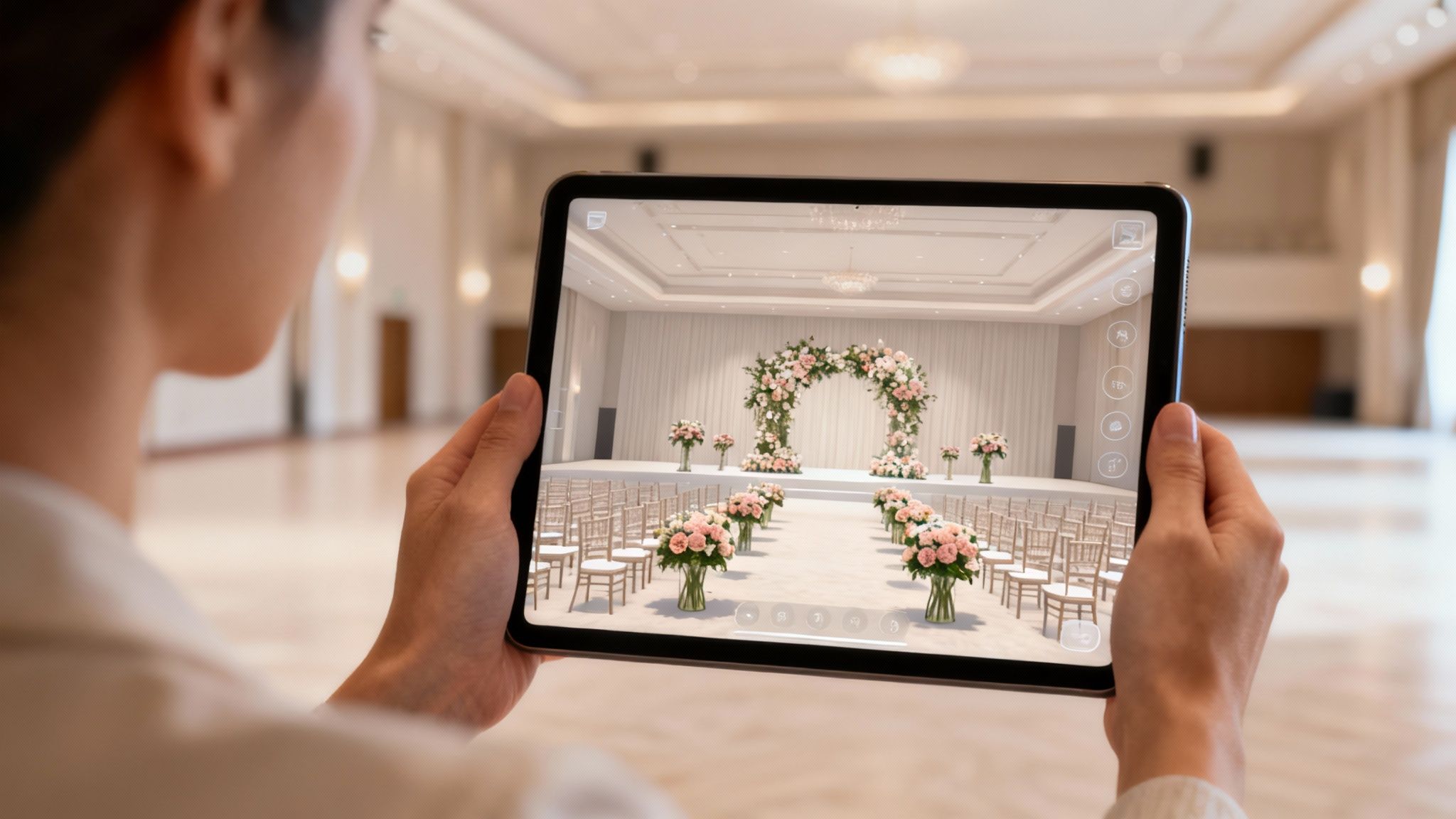
AR apps let you stand in a completely empty venue space, hold up your device, and start placing virtual decor. You can instantly see how different floral arrangements would look on the tables or test out various lighting schemes before you've even hired a single vendor. It takes all the guesswork out of the equation.
This is where AR gets really practical for wedding planning:
Virtual Decor Placement: See how that grand floral arch or those specific rental chairs will actually look in your venue. No more crossing your fingers and hoping for the best.
Attire Previews: Use AR filters to "try on" wedding dresses, suits, or accessories from home. It's a fantastic way to narrow down styles before you ever set foot in a boutique.
Cake Visualization: Preview different cake designs and sizes to see how they’ll fit with your reception's aesthetic and scale.
Immersive tech isn't about replacing in-person visits. It's about making them more meaningful. By using AR and VR to shortlist your top choices, your physical tours become final confirmation steps, not initial fact-finding missions.
This approach is brilliant for cutting down on decision fatigue. But there’s a catch: managing all these new digital assets, VR tour links, AR design screenshots, video walkthroughs, can become just as chaotic as a mountain of paper brochures.
This is where having a central planning hub becomes non-negotiable. A platform like ItsaYes gives you a dedicated space to organize and compare your virtual walkthroughs and AR mockups. You can attach notes, weigh the pros and cons, and share your top contenders with your partner or family, all in one calm, intuitive workspace.
It turns a flood of digital information into a clear, actionable shortlist, making your final decision feel a whole lot less stressful.
Enhancing the Guest Experience With Livestreaming
A wedding is all about celebrating with the people you love. But what happens when some of your most important guests can't be there in person? Life happens, distance, health issues, last-minute obligations. For years, the solution was a shaky smartphone video call, which felt more like a compromise than a celebration.
Not anymore.
Today, livestreaming has grown up. It's no longer just about pointing a camera at the altar. The real shift is toward creating a truly inclusive, hybrid event where remote guests feel just as celebrated and involved as everyone in the room. This focus on connection is a huge part of the future of wedding technology trends.
Professional streaming services now offer multi-camera setups that capture your day from beautiful, cinematic angles. Remote guests get a front-row seat, sometimes even a better one, making them feel like they’re right there with you. The goal isn’t just to let people watch your wedding; it’s to let them participate in it.
Beyond the Broadcast: Creating an Interactive Experience
Here’s where things get really interesting. True innovation in wedding livestreaming is all about interaction. Instead of being passive viewers, your remote guests can now be woven directly into the fabric of your celebration.
Modern streaming platforms have built-in features designed to bridge the physical gap and make everyone feel like a valued part of your community, not just an observer.
Digital Guestbooks: Imagine your cousin from overseas leaving a heartfelt video message that you can watch and cherish forever, right alongside the signatures from your in-person guests.
Virtual Photo Booths: Guests at home can snap fun pictures using custom wedding filters and digital backdrops, then add them to a shared online gallery. It’s a brilliant way for them to mingle virtually.
Interactive Chat and Toasts: A live chat lets remote friends send their love and congratulations in real-time. Some services even let a designated virtual guest give a toast that’s broadcast to the entire reception.
This isn't just about a one-way broadcast anymore. It's about emotional inclusion. It’s about making sure that every single person who matters to you can share in the joy of your day, no matter where they are in the world.
Of course, managing the logistics for both in-person and virtual attendees can feel like you're planning two separate events. You're sending different instructions, collecting digital content, and trying to make sure nobody feels left out.
That's where having a central planning hub like ItsaYes becomes your secret weapon.
Our platform gives you a calm, intuitive space to organize everything for both groups without losing your mind. You can manage separate guest lists, send tailored updates, and keep all your event details neatly in one place. This ensures your hybrid celebration runs without a hitch, creating one unified, memorable experience for everyone you love.
Taming the Budget and Vendor Beast
Behind every gorgeous wedding lies a mountain of not-so-glamorous logistics. We're talking vendor contracts, payment schedules, and the constant battle to keep your budget from spiraling out of control. For years, this meant wrestling with chaotic spreadsheets and digging through endless email chains. It was a chore.
But the next wave of wedding technology is flipping the script, turning these complex headaches into simple, automated tasks.
The big idea here is to give you total clarity and control over your finances and vendor relationships. Instead of treating your budget like a scary document you're afraid to open, modern tools transform it into a living, breathing dashboard. You can see, in real-time, how splurging on that incredible photographer affects your floral allowance, letting you make smart, informed trade-offs on the fly.
And that kind of clarity is more important than ever. The global wedding services market is set to grow by a staggering $153 billion between 2026 and 2030. That growth isn't because couples are suddenly spending more; it's because they're demanding smarter ways to manage their resources and navigate the planning process. You can read more about these wedding market growth projections to see why efficient tools are no longer a luxury, but a necessity.
A Single, Calm Workspace for Everything
The real magic happens when all these tools talk to each other. An integrated platform like ItsaYes acts as your "single source of truth," connecting your budget, vendor list, and to-do list in one unified space. No more jumping between five different apps and hoping the numbers match up. Everything is connected.
When a quote from a caterer comes in, you log it directly into the system, and your budget updates instantly. This gives you a crystal-clear, transparent view of your financial health at every single stage. It's the kind of seamless control you get with a truly integrated wedding budget app.
The goal is to shift from reactive problem-solving to proactive decision-making. When your budget, vendors, and tasks are all in sync, you gain the confidence to build the wedding you actually want, without the constant fear of missing a critical detail or blowing your budget.
Making Sustainable Choices Effortless
Technology isn't just about managing money; it's also making it way easier to plan an eco-conscious wedding without adding more stress to your plate. These features are quickly becoming standard in modern planning systems.
Digital Invitations and RSVPs: Cut down on paper waste and simplify guest management with beautiful digital stationery and automated tracking.
Local Vendor Sourcing: Many platforms can now help you find and prioritize local suppliers, which dramatically reduces your wedding’s carbon footprint from travel and shipping.
Waste Reduction Planners: Some tools even offer checklists and guides specifically for minimizing waste, from sourcing compostable dinnerware to helping you plan for leftover food donations.
By bringing all these logistical, financial, and even ethical pieces into one organized system, technology smooths out the friction of planning. It takes what used to be a series of complicated, disconnected chores and turns it into a single, manageable, and dare I say, enjoyable process.
Your Wedding Tech Implementation Plan
Jumping into all this new wedding technology doesn't mean you have to throw your whole planning process out the window. It’s more about smartly layering in tools that bring a little more clarity and a lot more calm to your journey, right from day one. This isn't about adding complexity; it's about building a solid foundation to support every decision you make.
The single best first step is creating a central hub for everything. Instead of letting brilliant ideas get scattered across a dozen Pinterest boards and random notes on your phone, an AI-powered system like ItsaYes gives you an intuitive, organized workspace. It’s where you can actually define your style, nail down a realistic budget, and let an AI assistant break down the next 6 to 12 months into simple, manageable steps. This creates the structure you need to bring in other tech without feeling overwhelmed.
Integrating Tech at the Right Time
Once you have that foundational plan in place, you can start weaving in more specialized tools at the perfect moments. This way, you’re not trying to do everything at once.
12-9 Months Out: As you start shortlisting venues, this is the perfect time to ask for VR tours. Use them to narrow your list down to a top three before you ever get in the car. It saves an incredible amount of time and energy.
8-6 Months Out: While you're finalizing the guest list and getting ready to send invitations, start looking into hybrid streaming options. Figuring out the costs and technical needs early makes it so much easier to include remote guests without any last-minute stress.
5-3 Months Out: As you begin booking vendors like your florist or decor rentals, this is when you break out the AR tools. See how their work will actually look in your venue. This is huge for making sure your entire aesthetic vision is coming together seamlessly.
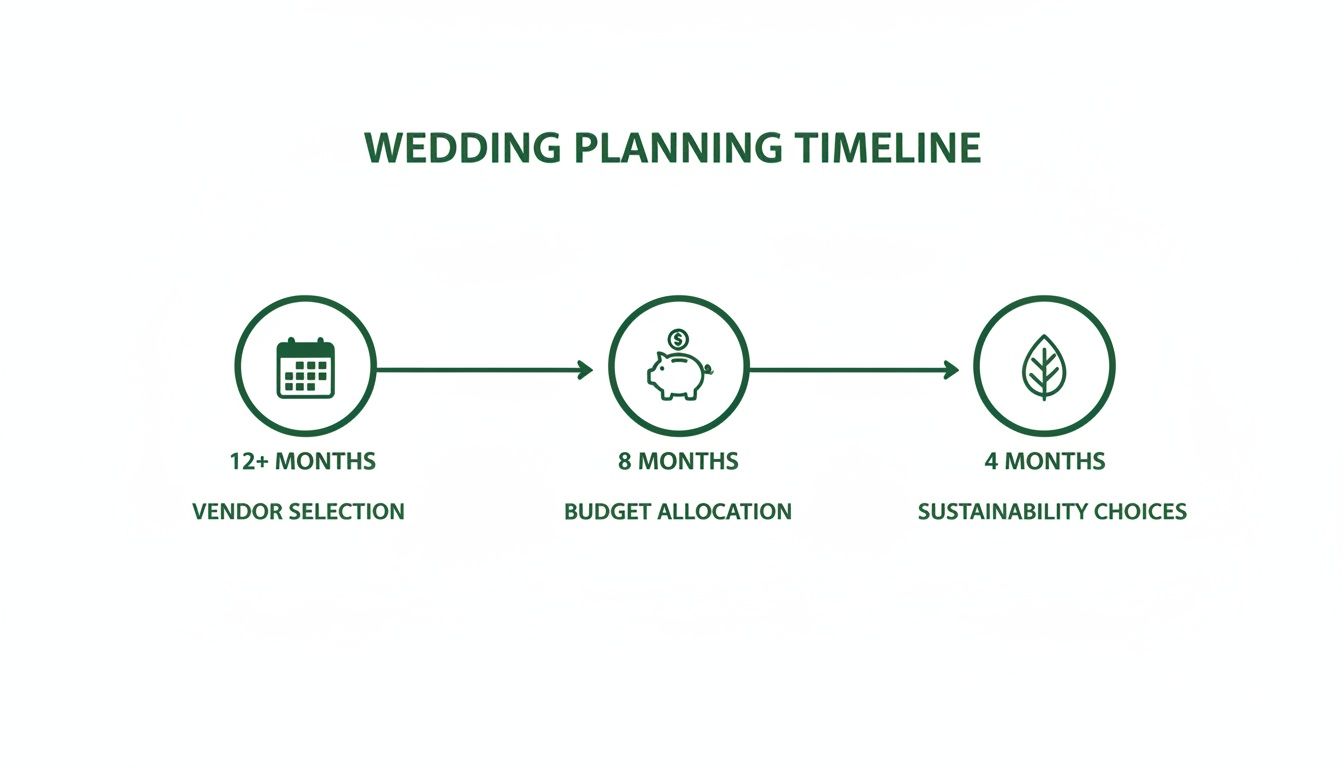
The timeline below gives you a clear roadmap for phasing in different technologies, ensuring each tool is adopted right when it will help you the most.
This visual guide shows how things like vendor management, budget tracking, and even making sustainable choices can be woven into key stages of your planning. By timing your adoption of these tools, you turn a cloud of inspiration into a fully structured, totally achievable plan. For a little more help getting organized, check out our guide on using a wedding day timeline generator to keep every detail on track.
Your 12-Month Wedding Tech Adoption Timeline
Knowing when to adopt a new tool is just as important as knowing what the tool does. You don't need everything on day one. Here’s a practical look at how to introduce these technologies month by month.
Planning Stage (Months Out)
Key Technology to Adopt
Action Step
12+ Months
AI Wedding Planner (e.g., ItsaYes)
Create your core wedding plan, set your budget, define your style, and generate an initial vendor shortlist and timeline. This is your foundation.
9-11 Months
VR Venue Tours
Request virtual walkthroughs from your top 3-5 venue choices. Use these to narrow the field before scheduling in-person visits.
6-8 Months
Livestreaming/Hybrid Event Platforms
Research and get quotes for livestreaming services. Decide on your virtual guest experience and include details in your invitations.
4-5 Months
AR Visualization Tools
Use AR apps to preview floral arrangements, decor, and furniture rentals within your actual venue space. Make final aesthetic choices.
2-3 Months
Contactless Payment & Gifting
Set up your digital gift registry and confirm contactless payment options with your on-the-day vendors (e.g., bar, photo booth).
1 Month
Vendor Automation & Communication Hub
Finalize your day-of timeline and share it with all vendors through a centralized platform. Automate final payment reminders.
Think of this timeline as your guide to making smart, timely decisions. By introducing the right tech at the right moment, you stay in control and avoid the last-minute scramble, letting you focus on what really matters.
Your Wedding Tech Questions, Answered
Jumping into the world of wedding tech is exciting, but let's be real, it also brings up some questions. You’re probably wondering about the cost, how complicated it all is, and most importantly, how to keep your wedding feeling like your wedding.
This isn’t about adding another layer of stress to your plate. It’s about finding smart shortcuts so you can focus on the fun stuff. Let’s tackle the big questions couples ask when they start exploring this new way of planning.
Is All This Wedding Technology Expensive To Use?
Not necessarily. While you can definitely find high-end services like a cinematic multi-camera livestream that are a real investment, a lot of the most helpful tools are surprisingly affordable, or even free. The whole point of this tech is to deliver value, not just rack up costs.
Take an AI planning platform like ItsaYes, for example. It's built to give you a solid framework right from the start. That structure can actually save you money down the line by helping you avoid costly budget mistakes and connecting you with vendors who are a perfect fit for your price range. Plus, things like digital invitations and basic streaming services are almost always cheaper than the old-school alternatives.
Do I Need to Be a Tech Expert to Use These Tools?
Absolutely not. The best wedding tech is designed to be intuitive and easy to use, often feeling as simple as the social media apps you use every day. These platforms are built to take complexity off your plate, not add more to it.
The whole point of this technology is to make your life easier. It should feel like a guide, walking you through the process with clear, simple steps that turn a massive project into something you can actually enjoy.
Think of it this way: these tools are made for newly engaged couples who just want to feel organized and in control, no matter their tech skills.
How Do I Use Technology Without Making My Wedding Feel Impersonal?
This is the most important question of all. The secret is to think of technology as your personal "behind-the-scenes" crew. Let it handle all the logistical heavy lifting, the budgets, timelines, vendor emails, and payment reminders that create the most stress.
When you do that, you free up your time and mental energy to pour into what actually matters: the personal touches that make your wedding uniquely yours. You’ll have more headspace to write your vows, obsess over the perfect playlist, or spend an afternoon designing meaningful centerpieces with your partner.
Technology provides the scaffolding that holds up your vision; it never replaces it. It takes care of the "what" and "when" so you can put your whole heart into the "why."
Ready to stop juggling spreadsheets and start building your wedding with clarity? ItsaYes is an AI-powered planning system that brings your vision, budget, and timeline into one calm, intuitive workspace. Start planning with confidence at ItsaYes.