So, how much does a wedding planner actually cost? It's the million-dollar question or at least, the several-thousand-dollar one.
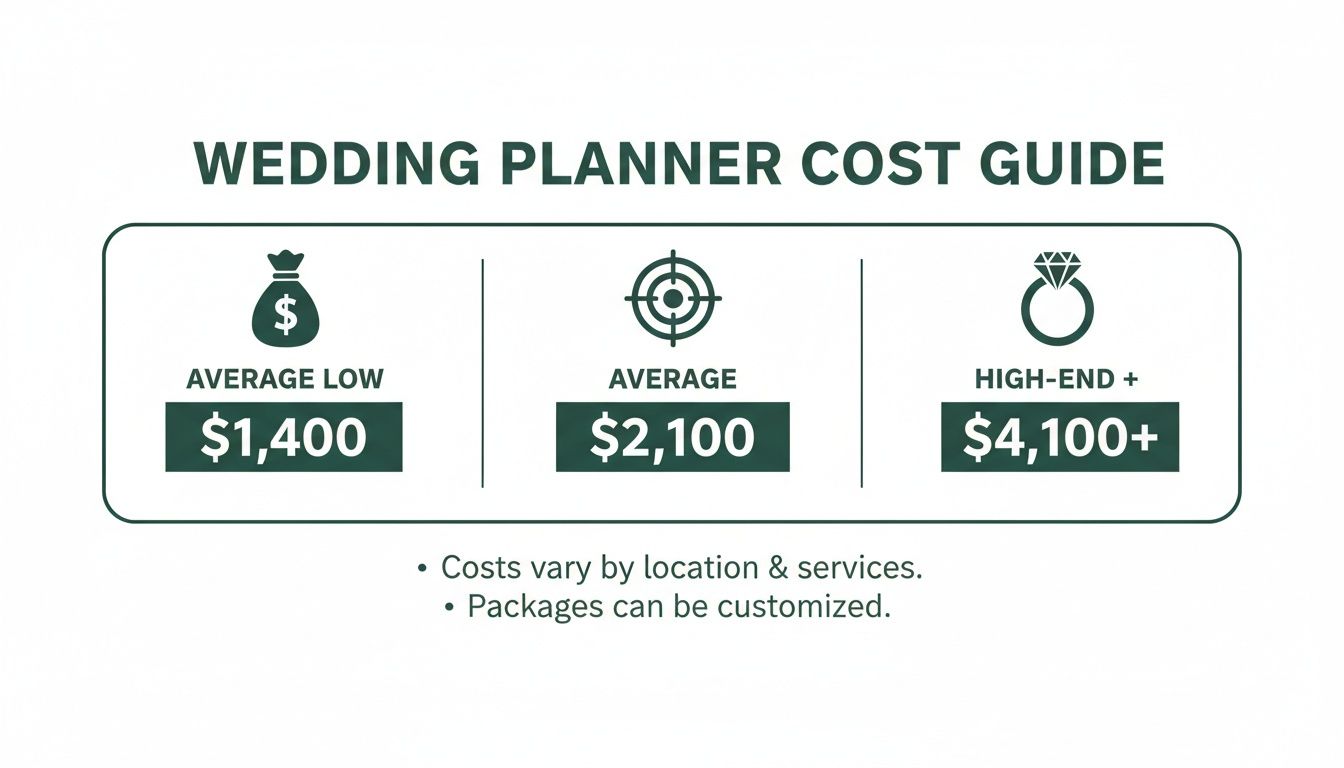
The quick answer is that the average cost of a wedding planner is $2,100 nationally, but that number can swing wildly from $1,400 to over $4,100. Think of this not as just another line item on a spreadsheet, but as an investment in a calm, organized, and genuinely enjoyable wedding planning experience.
The Real Cost of a Wedding Planner Explained
Let's be honest, navigating wedding expenses can feel like trying to hit a moving target. The price of a wedding planner is a perfect example of this. You'll see a huge range of numbers, and it's easy to get confused.
It helps to think of it like travel. You could book a pre-set package tour, or you could hire a private guide who customizes every single stop of a once-in-a-lifetime trip. Both get you to your destination, but the experience and the price tag are completely different. A wedding planner's cost works the same waym it’s a spectrum of options designed for different needs and budgets.
Ultimately, this investment is about buying back two of your most valuable assets: your time and your peace of mind. Planning a wedding can easily turn into a part-time job, filled with hundreds of hours of research, back-and-forth emails, and tough decisions. A professional planner steps in to manage all that complexity, turning a potential source of stress into a creative and exciting journey.
Understanding the National Average
Let's look at the hard numbers. According to The Knot's 2026 Real Weddings Study, which surveyed nearly 10,000 U.S. couples who married last year, the average cost of a wedding planner landed at $2,100.
But that average hides the real story. The typical range is much wider, from $1,400 on the lower end to $4,100 or more, depending on where you live and the level of service you need. It’s also worth noting that this usually only accounts for 5-6% of the total average U.S. wedding budget.
This image breaks down what you can generally expect at different price points, from basic coordination to full-service, hands-on planning.
As you can see, the price aligns directly with the level of support you get. It helps you start to see where your own needs might fall on the spectrum.
To help you quickly compare your options, here's a simple breakdown of the most common service levels.
Wedding Planner Services at a Glance
Planner Type
Typical Cost Range
Best For Couples Who...
Day-Of Coordinator
$800 – $2,000
Have planned everything but want a pro to execute the wedding day.
Month-Of Planner
$1,800 – $3,500
Need help finalizing details and managing vendors in the final weeks.
Partial Planner
$2,500 – $6,000
Want to be involved but need expert help with specific areas (e.g., vendor sourcing).
Full-Service Planner
$4,000 – $12,000+
Want a comprehensive, hands-off experience from start to finish.
This table should give you a solid starting point for figuring out which type of planner might be the right fit for both your wedding vision and your wallet.
Hiring a planner is like adding an expert project manager to your team. Their entire job is to protect your vision, your budget, and your timeline, making sure every single detail comes together just as you imagined.
For couples who want that same sense of clarity and structure without the premium price tag, there are some great modern alternatives. For example, ItsaYes is an AI-powered wedding planning system designed for couples who want clarity from the very start.
Instead of juggling spreadsheets, Pinterest boards, and scattered notes, ItsaYes brings your vision, tasks, budget, and timeline into one calm, intuitive workspace. It's built for newly engaged couples who want to enjoy the process, stay organized, and feel confident, from first inspiration to a fully structured plan. In the end, the goal is the same: a beautiful, memorable wedding day, achieved without all the stress.
Decoding Wedding Planner Services and Packages
You’ve seen the titles everywhere: full-service, partial, day-of. But what do you actually get for your money? The average cost of a wedding planner is tied directly to how much they do. Picking the right package means paying for the help you genuinely need, not a dollar more, not a service less.
To make sense of it all, think of planners in one of two roles: the architect or the stage manager.
The architect designs the entire event from your initial vision, blueprinting everything from the ground up. The stage manager steps in for opening night, making sure the show you already produced runs without a hitch. Both are crucial, but they serve completely different needs.
Let's break down exactly what each service level involves, so you can figure out which pro fits your style.
Full-Service Planner: The Architect of Your Wedding
A full-service planner is your partner from the moment you say "yes" until the last guest leaves the reception. They are the architects who take your scattered ideas, Pinterest boards, and daydreams and build them into a cohesive, beautifully executed event. This is the all-in, most hands-on option you can get.
Their job is massive, covering every detail you can imagine. They don't just execute your vision; they help you define and sharpen it in the first place.
Vision & Budget Creation: They start by helping you build a realistic budget based on what matters most to you, then translate your personal style into a tangible design concept.
Vendor Sourcing & Management: This is a huge part of the job. They find, vet, and negotiate with every single vendor, from the venue and caterer to the florist and photographer.
Logistical Mastery: This covers everything from managing guest RSVPs and mapping out seating charts to arranging transportation and hotel blocks for your guests.
Total Wedding Day Oversight: On the day itself, they're the first to arrive and the last to leave, making sure every single moment unfolds just as it was planned.
A full-service planner is for the couple who wants an expert guide for the entire journey. Their expertise not only saves you hundreds of hours but also provides priceless peace of mind, knowing a seasoned pro is handling every last detail.
Partial Planner: The Collaborative Partner
So you’ve already booked your dream venue and photographer, but now you’re staring at a to-do list a mile long and feeling stuck. This is where a partial planner shines. They step in to fill the gaps. This flexible service is perfect for couples who enjoy being hands-on but need expert guidance on the more overwhelming parts of planning.
You get to lead the charge while leaning on a professional for support where it counts. Maybe you handle the creative stuff you love, while they tackle vendor contracts and build out a complex timeline.
Common tasks for a partial planner include:
Vendor recommendations for your remaining categories.
Help with styling, decor, and creating a functional floor plan.
Reviewing vendor contracts you’ve already signed to spot any red flags.
Creating a detailed wedding day timeline and production schedule.
This collaborative approach keeps you in the driver's seat without forcing you to become an expert on every single aspect of the wedding industry.
Day-Of Coordinator: The Stage Manager
Here's a little industry secret: the "day-of" coordinator doesn't just show up on the day of your wedding. Their work typically starts four to six weeks out. You do all the creative planning, booking, and design work on your own. Then, you hand over your meticulously crafted plans to the coordinator, who steps in to run the show.
They are your wedding's stage manager. You've written the script and cast the actors; their job is to make sure the performance is flawless.
Key responsibilities include:
Final Vendor Coordination: They become the main point of contact for all your vendors, confirming arrival times and final details so you aren’t fielding a dozen calls while you’re getting your hair done.
Timeline Management: They create and manage a minute-by-minute schedule for the rehearsal, ceremony, and reception.
On-Site Problem Solving: When a boutonnière goes missing or the cake is delayed, they're the ones who fix it, quietly and professionally, so you and your family can just enjoy the day.
For couples using a tool like ItsaYes, which helps you structure your plan and vendors from the start, hiring a day-of coordinator is the perfect final piece of the puzzle. You can use an integrated wedding vendor manager to keep all your contracts and communications neatly organized, then confidently hand everything over to your coordinator to bring it to life. This combo of smart planning tools and day-of execution is a modern, efficient, and seriously cost-effective way to plan.
What Factors Influence Wedding Planner Prices
Ever get a quote from one wedding planner that’s double the price of another for what feels like the exact same service? It's baffling, but it’s more common than you’d think. Here’s the secret: the average cost of a wedding planner isn't some fixed number. It’s a dynamic price shaped by a handful of key variables.
Think of it like hiring an architect. The cost to design a cozy, simple cabin in the countryside will be worlds apart from designing a sprawling, custom mansion in Beverly Hills. The core skill is the same, but the location, complexity, and level of expertise required send the price in completely different directions.
Wedding planners work the exact same way. Let’s pull back the curtain on the three big factors that really drive the final number on your proposal: where you're getting married, who you're hiring, and how complex your vision is.
Location and Market Rates
Geography is probably the single biggest factor in wedding costs, full stop. A planner based in New York City or Los Angeles has sky-high business expenses, from insurance to marketing to just keeping the lights on. They’re also operating in a market where the best venues and vendors command premium rates.
That overhead inevitably gets baked into their pricing. It has to.
On the flip side, a planner in a smaller city or a more rural area will have lower operating costs. Their fees will naturally align with the local market. This difference in geography can easily swing the final price by 30-50% or more for the same level of service. It’s a classic case of supply, demand, and the cost of doing business.
Planner Experience and Reputation
When you hire a planner, you’re not just paying for their time; you’re investing in their experience. A seasoned pro with a decade under their belt and a portfolio of stunning weddings brings an invaluable network, crisis-management skills that can salvage any disaster, and hard-won negotiation expertise.
They’ve seen it all. They know how to prevent problems you don’t even know exist yet.
Newer Planners (1-3 years): Often charge less as they build their portfolio. They can be a fantastic value if you connect with their style and are willing to grow with them.
Established Planners (5+ years): Come with a proven track record and rock-solid vendor relationships. They can often secure discounts or perks that help offset their own fees.
Luxury Planners (10+ years): Specialize in complex, large-scale, and high-budget events. They have an exclusive network of elite vendors and are masters of logistics.
You’re paying for the peace of mind that comes from having a true professional in your corner.
Wedding Complexity and Scope
The scale of your event is a direct driver of your planner’s workload. An intimate, 50-person dinner at a single restaurant requires a completely different level of coordination than a 300-guest, multi-day affair with a welcome party, rehearsal dinner, and farewell brunch.
Think about all the moving parts that add to a planner's to-do list:
Guest Count: More guests mean more time spent on RSVPs, seating charts, meal tracking, and communication.
Multiple Venues: Juggling logistics for transportation, setup, and teardown between different locations is a huge task.
Custom Installations: Want a custom-built floral arch or a unique lighting rig? That requires intensive project management.
Destination Weddings: These are a whole other ballgame, involving travel, accommodations, and navigating an entirely different vendor market.
The more moving parts your wedding has, the more time, expertise, and mental energy it requires from your planner and their fee will reflect that.
Comparing Wedding Planner Pricing Models
Finally, it’s important to know how planners charge, because the structure of their fees can impact your total cost. Understanding the common models helps you compare apples to apples and pick a structure that feels right for you. To keep all these numbers straight, a dedicated wedding budget app can be a lifesaver, letting you track every single expense in one place.
Many planners use one of three main pricing models, each with its own set of pros and cons for you as a couple.
Pricing Model
How It Works
Pros
Cons
Flat Fee
A set price for a specific package of services, agreed upon upfront.
Simple, predictable, and incredibly easy to budget for. No surprises.
Less flexible if your needs change or you end up needing fewer services than the package includes.
Percentage-Based
The planner charges a percentage (typically 15-20%) of your total wedding budget.
The fee scales with your event's size, and it incentivizes the planner to manage your budget effectively.
The final cost isn't locked in until your budget is, and it can increase if you add more elements to the wedding.
Hourly Rate
You pay for the exact number of hours the planner works on your wedding.
Perfect for very specific, limited tasks like a one-off consultation or vendor recommendations.
The total cost can be hard to predict and might lead to unexpected bills if tasks take longer than anticipated.
Understanding these pricing structures, along with the factors that influence them, empowers you to have a much clearer conversation with potential planners. You’ll be able to ask the right questions, compare quotes intelligently, and confidently choose the perfect partner for your big day.
Is a Wedding Planner Actually Worth It?
Okay, we've broken down the costs and what planners actually do. Now for the million-dollar question: Is hiring one really worth the money?
The answer has very little to do with the initial price tag. Think of it less like an expense and more like a strategic investment, an investment in your wedding's success, and maybe more importantly, your own sanity.
A great planner's return on investment (ROI) isn't just about a pretty wedding day. It’s measured in two critical ways: real, tangible financial savings and the priceless emotional benefit of not tearing your hair out for a year.
It sounds counterintuitive, but a good planner can often save you more money than their fee costs. How? They live and breathe this industry. They have deep connections, get access to vendor discounts you’ll never see, and are masters at negotiating contracts. They know the market cold, so you’ll never overpay. They can point you to the hidden gem vendors who deliver incredible quality without the inflated price tag.
That financial savvy is huge, but it's only half the story.
The Real ROI: Your Time and Your Sanity
Honestly, the biggest return you'll get is in time saved and stress avoided. Planning a wedding is famously compared to taking on a part-time job, and for good reason. It can easily eat up 200-500 hours of your life. For busy professionals, that time is your most valuable asset.
A wedding planner doesn't just manage tasks; they manage complexity. They absorb the logistical chaos, field the hundreds of emails, and put out fires before you even smell smoke. They give you back the freedom to actually enjoy being engaged.
This is especially true for the DIY crowd who fire up Notion or Canva, determined to organize their vision. These tools are fantastic for brainstorming, but they can quickly turn into a digital ball-and-chain of overwhelming to-do lists.
Recent industry insights back this up, showing that planners help couples trim guest lists by an average of 29 people to manage costs. And while 64% of couples say their vendors helped them stick to a budget, a massive 48% still felt they were flying blind on their finances—a problem that gets even worse with destination weddings. You can dive deeper into these numbers and explore the full wedding industry analysis here.
A Quick Gut-Check: Should You Hire a Planner?
Still on the fence? Let's run through a quick checklist. Be honest with yourself—there's no right answer, only what's right for you and your partner.
1. Your Time Commitment:
How many hours a week can you realistically give to wedding planning? 1-2 hours? 3-5? More?
Does your job make it tough to take vendor calls or meetings during normal business hours?
2. Your Budget Confidence:
How do you feel about creating and managing a spreadsheet with 50 different line items and moving parts?
Are you a confident negotiator, or does the thought of haggling over contracts make you sweat?
3. Your Planning Style:
Does the idea of researching 20 florists and comparing their proposals energize you, or does it sound like a nightmare?
Are you a big-picture person who would rather have an expert handle the thousand tiny details?
4. Your Stress Levels:
How do you and your partner typically handle high-stakes, stressful projects together?
Is your number one priority to minimize stress and just enjoy this season of your life?
If your answers are leaning toward "I have no time," "budgets scare me," and "please, no stress," then a planner could be your single best investment.
But if you feel confident in your organizational skills and just need a clear, calm roadmap to follow, an AI-powered system like ItsaYes can provide that structured workspace. You begin by defining your style and ideas, and the platform helps you turn inspiration into a clear plan, breaking the next 6 to 12 months into simple, manageable steps.
The Modern Alternative: Planning with AI Clarity
For a lot of couples today, the perfect planning experience falls somewhere between handing over a blank check to a full-service planner and getting lost in a chaotic mess of spreadsheets. You're probably organized, comfortable with tech, and you want to be in the driver's seat of your own vision. But the sheer volume of tasks? It can get out of hand, fast.
This is exactly where a new approach to planning comes in, bridging that gap between "all" and "nothing."
What if you could have the structure, clarity, and calm of a professional planner without the five-figure price tag? Imagine finally taking all those scattered Pinterest boards, saved Instagram posts, and random notes and pulling them into one single, intuitive workspace. This is the promise of an AI-powered planning system built for couples who want confidence from day one.
Turning Inspiration into an Actual Plan
Let’s be honest: the biggest challenge in DIY planning isn't a lack of ideas, it's the total absence of a roadmap. You have the vision, but figuring out how to turn that vision into a logical sequence of manageable steps is where the stress starts to creep in.
Instead of staring at a blank spreadsheet wondering where to even start, you begin by defining your style and priorities. The system then takes that input and helps you structure the next 6 to 12 months into simple, actionable tasks. It creates a calm, organized environment where your plan unfolds naturally, killing the guesswork and that nagging feeling that you're forgetting something important.
The goal here is to give you planner-level organization and confidence at a fraction of what a human planner costs. It's all about empowering you to actually enjoy the process, not just survive it.
This approach puts you firmly in the director's chair, but with an expert assistant working quietly behind the scenes.
Your Personal AI Assistant
Think of it like having a personal planning assistant on call 24/7. Your personal AI assistant is available to suggest priorities, organize tasks, and keep everything moving forward without overwhelm.
This kind of intelligent support is designed to prevent the overwhelm that plagues so many couples. Instead of juggling a dozen different apps and documents, your entire wedding, from the initial vision to the final vendor payment, lives in one calm, cohesive space.
This method delivers some pretty powerful benefits:
Clarity from Day One: You can instantly see your entire planning journey laid out in manageable phases. No more "what's next?" anxiety.
Reduced Overwhelm: The system is designed to break down huge, scary tasks (like "find a venue") into small, achievable steps.
Total Organization: Your vision, tasks, budget, and timeline are all connected in one place, so you can see how one decision impacts another.
Full Control: You’re still in charge of every single decision, but you're making them within a powerful framework that keeps you on track.
For couples who want a structured, modern, and genuinely less stressful way to plan, exploring how an AI wedding planner works can be a total game-changer. It offers that perfect blend of DIY control and expert-level organization, making sure you feel confident and prepared for your big day.
Common Questions About Wedding Planner Costs
As you get closer to a decision, the big picture fades and the practical questions pop up. And honestly, navigating the hiring process can feel just as complicated as planning the wedding itself.
Let's tackle those questions head-on. We'll give you clear, straightforward answers to help you understand the financial details and bust a few myths about what a planner really costs.
The goal here is to give you the confidence to move forward, whether that means hiring a pro or exploring a more modern path to get the same level of clarity.
Does a Wedding Planner's Fee Come Out of My Total Wedding Budget?
Yes, it absolutely does. The smartest way to approach this is to treat the planner's fee as a core line item in your overall budget, right alongside the venue and catering. It’s not an add-on; it’s part of the foundation.
Most financial experts recommend setting aside 10-15% of your total budget for a full-service planner. The key is to factor this in from the very beginning. Doing so gives you a realistic view of your spending power from day one.
A great planner works within your total budget and often saves you money elsewhere through their vendor network and negotiation skills. In many cases, they can offset a good chunk of their own fee. The best strategy? Be completely transparent about your total spending limit from the first conversation.
Can I Negotiate the Price with a Wedding Planner?
While you probably can't haggle down the price on a pre-set package from an established planner, negotiation is still on the table, it just looks a bit different. Instead of asking for a discount, the better move is to ask if they can create a custom package that fits your budget.
This is where you find the flexibility. You might be able to shave off services you’re comfortable handling yourself, like managing RSVPs or designing stationery, which brings down the total cost.
Planners also tend to have more wiggle room for off-season or weekday weddings when their demand is lower. The most productive way to start the conversation is by being upfront about your budget and asking, "What level of service can you provide for this amount?" It’s a much better approach than just asking for a flat discount.
What Is the Difference Between a Planner and a Venue Coordinator?
This is one of the biggest points of confusion for couples, and getting it right is crucial. Understanding this distinction ensures you have the support you actually need on your wedding day.
It boils down to this: A venue coordinator works for the venue. A wedding planner works exclusively for you.
Think of it this way: The venue coordinator is responsible for the building and its staff. The wedding planner is responsible for your entire wedding experience, from start to finish.
Let's break down their separate roles:
Venue Coordinator: Their loyalty is to the venue. They handle venue-specific logistics—making sure the space is clean, the in-house catering is on schedule, and the lights are on. They won’t help you manage your overall budget or track down your florist who’s running late.
Wedding Planner: They are your personal advocate. They help you build your budget, hire all your vendors (photographer, band, florist), create the master timeline for the entire day, and put out any fire that pops up, whether it involves the venue or not.
A venue coordinator is an essential part of the team, but they are absolutely not a substitute for a dedicated planner whose only focus is your vision and best interests.
When Is the Best Time to Hire a Wedding Planner?
If you want to get the absolute most value from a full-service planner, hire them as soon as possible after you get engaged. The sweet spot is before you book a venue or sign any other vendor contracts.
Bringing a planner on board from the beginning allows them to help with the most critical, foundational decisions. They'll help you build a realistic budget from scratch, find a venue that actually fits your guest count and vision, and snag the best vendors for your style before they get booked up. This proactive approach helps you avoid costly mistakes, like picking a venue that’s too small or forgetting to budget for key items.
If you're going for partial planning or month-of coordination, you can hire them later. For these services, a good rule of thumb is to lock them in 3 to 6 months before the wedding. This gives them enough time to get up to speed on your plans and take over vendor communication without a hitch.
Feeling organized and in control is the real goal, whether you hire a planner or choose a more modern path. If you're a couple who wants clarity from the start, a structured plan, and the confidence to manage your own wedding without the chaos, ItsaYes was built for you. Our AI-powered system transforms your vision into a calm, intuitive workspace, breaking down the entire process into simple, manageable steps.