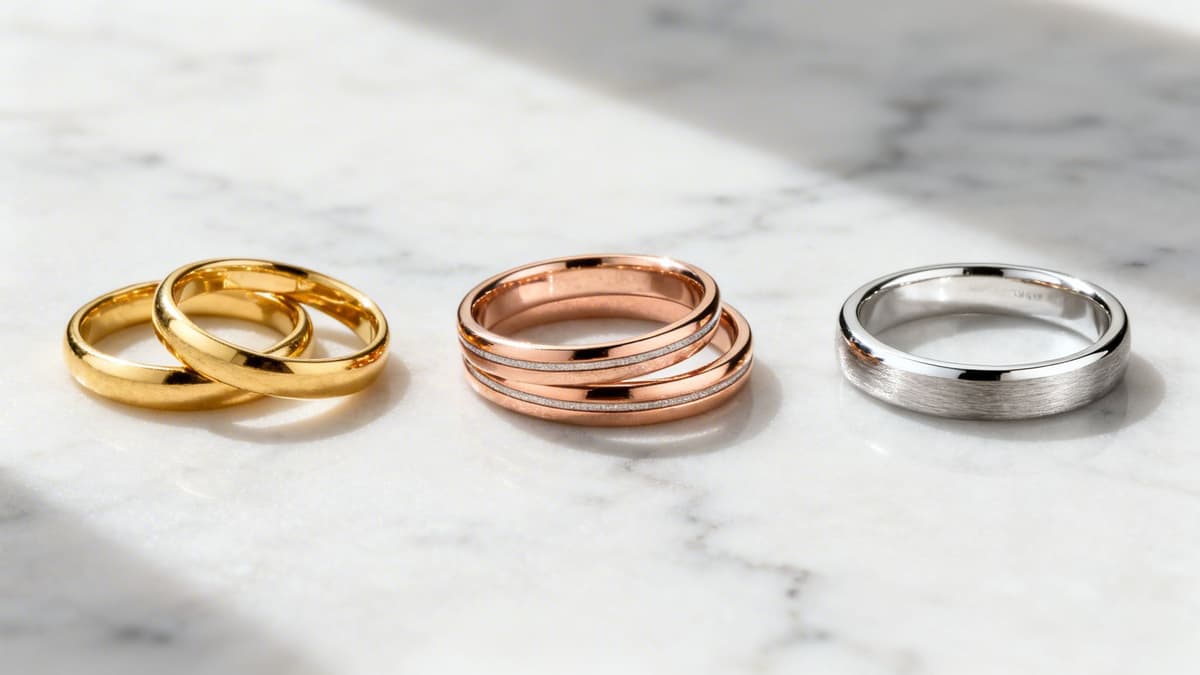
Let's settle this question once and for all: No, your wedding rings absolutely do not have to match. The old-school tradition of identical bands is making way for something far more personal. Today, modern couples are putting personal style, daily comfort, and individual expression first, and uniformity is taking a backseat.
Think of this as your official permission slip to skip the stress and find rings you'll both genuinely love to wear for a lifetime.
Why Your Rings Don’t Have to Match
The idea that matching wedding bands symbolized a couple's union really took hold in the mid-20th century. It’s a lovely thought, but let's be honest: a strong partnership comes from shared commitment, not identical jewelry. Your wedding rings should feel like a natural part of who you are, both as individuals and as a couple.
Planning a wedding can feel like juggling spreadsheets, Pinterest boards, and scattered notes. Here at ItsaYes, we believe in turning that potential overwhelm into clarity from the very start. Choosing your rings is a perfect example. Instead of feeling boxed in by tradition, you have the freedom to find symbols that actually tell your unique story.
Finding Your Ring Style
Think of your rings as a team, they don't need to wear the same uniform to play for the same side. The real goal is to find rings that you both love putting on every single day.
Most couples today land in one of three camps:
Perfectly Matched: This is the classic route. Both rings are identical in metal, width, and finish. It’s a timeless choice that creates a very clear, visual statement of your shared identity.
Coordinated: The rings aren't twins, but they're clearly related. You might choose the same metal but in different widths, or rings that share a similar design element like a hammered finish or an engraved detail.
Completely Unique: This approach celebrates your individual tastes. One of you might fall for a sleek, modern platinum band while the other wants a vintage-inspired rose gold ring with intricate details. And that’s perfectly fine.
To make it even clearer, here’s a quick rundown of these three approaches.
Ring Styles at a Glance
This quick comparison can help you figure out which ring style best reflects your relationship and individual personalities.
Ring Style
Core Concept
Best For Couples Who...
Perfectly Matched
Identical bands symbolizing unity and shared identity.
...love tradition, have similar personal styles, and want a classic, unified look.
Coordinated
Different rings that share a common design element (e.g., same metal, same finish).
...have different tastes but want their rings to feel connected and complementary.
Completely Unique
Each partner chooses a ring that reflects their individual style, with no matching elements.
...are independent, have very distinct styles, and value personal expression above all.
Each path is a valid and beautiful way to symbolize your commitment.
The most important factor is that you both truly love the rings you choose. These are daily, tangible reminders of your marriage, so comfort and personal style should always trump any old-fashioned "rule."
Choosing your rings should be one of the most exciting parts of your wedding journey, not another stressful to-do. It's a chance to define what your partnership looks like, moving from initial inspiration to a fully structured plan, a philosophy we bake into every step of the ItsaYes planning experience.
How Wedding Ring Traditions Have Changed
To really get why you have total freedom with your rings today, it helps to rewind a bit. Where did this whole "matching rings" idea even come from?
The tradition of identical wedding bands really took off in the mid-20th century. It became this powerful symbol of two people becoming one unified team. For generations, buying a matching set was just what you did, a simple, elegant way to show the world you were building a life together.
Honestly, it was also a product of the times. Jewelry options were way more limited back then, especially for men. Picking up a pre-designed "his and hers" set was just easier. It was a straightforward choice that fit a culture focused on togetherness above all else. But just like our relationships have evolved, so have the symbols we use to represent them.
A Modern Shift Toward Personal Expression
Today, we celebrate our individuality just as much as our partnership. A great marriage isn’t about two people melting into one identical person; it’s about two unique individuals choosing to build something amazing together. This shift in thinking has completely changed the answer to the question, "do wedding rings have to match?"
Modern couples are ditching the rigid rulebook and making choices that feel authentic to them. This isn't just about looks, it's about making sure the ring you wear every single day actually fits your personal style and your lifestyle.
The most meaningful symbols are the ones you define for yourselves. Your rings are a daily reminder of your personal commitment, not an obligation to follow an outdated tradition.
This freedom is empowering. Maybe one of you has a hands-on job that calls for a super-durable tungsten band, while the other has always dreamed of a delicate, diamond-studded ring. In the past, this might have been a problem. Today? It’s just a beautiful reflection of your unique lives coming together. It's the same logic behind writing your own vows, your rings should tell your story, too. If you need a little inspiration on that front, check out our guide on how to write wedding vows that feel truly personal.
The Market Reflects This New Reality
This isn't just a vibe shift; you can see it in the market data. The global wedding ring market is booming, not just because people are getting married, but because couples are investing more in high-quality, personalized rings that tell their story. This resilience proves that customization and individual expression are what people truly value now, far more than standardized sets. You can actually explore the research on wedding ring market trends to see how this focus on personalization is reshaping the entire industry.
And that's fantastic news for you. It means jewelers are offering more variety than ever before, making it easier to find or create rings you both geninely love, even if they don't match. It’s all part of a larger movement in wedding planning, shifting from a mess of scattered expectations to a clear, structured plan that feels like you. ItsaYes is built for newly engaged couples who want to enjoy the process, stay organized, and feel confident every step of the way.
Should You Choose Matching Wedding Rings?
With all the freedom in the world to choose your wedding rings, you might still find yourself wondering: is the traditional route, a perfectly matched set, right for us? It's a classic for a reason, and there are some pretty compelling benefits to sticking with this timeless choice.
For a lot of couples, matching rings are a powerful, visual symbol of their union. They become this tangible, daily reminder that you're two individuals who have chosen to form a single, cohesive partnership. It’s a classic, elegant look that, frankly, will never go out of style.
Plus, let's be honest, opting for a matched set can make the shopping process so much simpler. Instead of hunting for two separate rings that feel "right," you're making one decision together. Amidst the million choices you're making for your wedding, that kind of clarity can be a welcome relief. It boils the whole thing down to one calm, manageable task, a core philosophy championed by ItsaYes.
The Symbolism and Simplicity of Matching
The appeal of matching rings really boils down to their clear, undeniable symbolism. When your bands are identical, they tell a straightforward story of unity.
A Shared Identity: Matching rings are a visual shorthand for your shared life and future. In a simple, elegant way, they say, "we are a team."
Timeless Tradition: This style connects your marriage to generations of tradition, which can be a deeply meaningful touchstone for many couples.
Simplified Decisions: Choosing a pre-designed set just removes the guesswork. It helps you focus on what really matters, the commitment you're making to each other.
Matching rings are a beautiful choice for couples who value tradition and want a clear, physical representation of their shared journey. It frames the decision around unity, turning the ring-shopping process into a collaborative and straightforward experience.
Potential Downsides to Consider
But, the "one-size-fits-all" approach isn't for everyone. Before you commit to a matching set, it’s really important to have an honest conversation about your individual needs and styles.
What works for one of you might not work for the other. For instance, maybe one of you works with your hands, as a mechanic, an artist, or a healthcare professional. A durable, simple band like tungsten might be a necessity. Meanwhile, the other partner might have their heart set on a more delicate, detailed design. Forcing a match here could lead to one person compromising on either style or pure practicality.
Personal taste is another huge factor. Your rings should feel like a natural extension of who you are. If your styles are night and day, choosing unique rings that you both genuinely love is a much better reflection of your relationship than settling for a match that feels inauthentic. For couples who want a unified look but with a unique pop of color, exploring options like emerald pair rings can be fantastic inspiration.
Ultimately, deciding on your wedding rings is a personal choice, not an obligation. The goal is to find rings that celebrate your union in a way that feels true to both of you.
Coordinated and Unique Ring Styles
If matching sets feel a little too traditional for you, this is where your creativity can really take center stage. Choosing non-matching rings doesn’t mean a total free-for-all; it opens up two beautiful and deeply personal alternatives: coordinated rings and completely unique rings.
Both paths let you honor your partnership while celebrating the individual styles that make you who you are.
How to Coordinate Your Rings
Think of coordinated rings like siblings, they’re not identical, but the family resemblance is undeniable. They share a common thread that ties them together, creating a look that’s harmonious without being a carbon copy. This middle ground is perfect for couples who want their rings to feel connected but have different tastes or practical needs.
Creating that cohesive look is all about picking a single, shared element. It’s like a secret nod between your two rings. This gives you endless flexibility while making sure your bands look intentional and complementary when seen together.
Some popular ways to coordinate include:
Shared Metal Type: You both decide on platinum. But while one of you goes for a wide, simple band, the other picks a delicate, diamond-studded ring. The consistent color and material create a clear, elegant link.
Similar Finish: Maybe you both love a modern, matte finish. One ring could be a dark tungsten and the other a warm yellow gold, but that shared texture makes them a deliberate pair.
Repeating Motif or Detail: An engraved pattern, a milgrain edge, or a specific design element can be a subtle link. A floral engraving on one band could echo a vine-like detail on the other, for instance.
To make this easier, here are a few practical ideas for how you can tie your ring styles together without getting identical bands.
Ideas for Coordinating Your Rings
Coordinating Element
How It Works
Example Combination
Metal Type
You both choose the same metal, but in different styles or widths.
A wide, simple yellow gold band and a thin, diamond-studded yellow gold band.
Finish
Both rings share the same texture, like matte, hammered, or high-polish.
A brushed white gold ring and a brushed titanium ring.
Design Motif
A shared detail, like a milgrain edge or an engraved pattern, appears on both rings.
One ring has a full vine engraving, while the other has the same vine detail on the inner band.
Stone Shape
Both rings incorporate the same cut of gemstone, even if the stones are different.
A band with small, round diamonds and a band with a single, bezel-set round sapphire.
This approach allows you to create a look that feels connected and personal, reflecting your shared journey and individual tastes.
Coordinating your rings is a beautiful compromise. It says, "We are connected," while also saying, "We are individuals." This approach beautifully reflects a modern partnership built on both shared values and mutual respect for each other's identities.
Embracing Completely Unique Ring Styles
The most liberating option? Choosing completely unique or "mismatched" rings. This approach is a bold celebration of your individuality and is perfect for couples with distinctly different personal styles. There are no rules here, just the shared goal of finding a ring you each absolutely adore.
For example, one partner might choose a rugged, hammered titanium band that speaks to their love of the outdoors. Meanwhile, the other might fall for an ornate, vintage-inspired rose gold ring that feels timeless and romantic. These rings tell two different stories that are part of one larger narrative, your marriage.
This is where defining your personal style becomes a key part of your wedding planning. ItsaYes helps you turn that inspiration into a clear plan, breaking the process into simple, manageable steps, a process you can explore in the ItsaYes Wedding Design Studio.
Choosing unique rings doesn't diminish your connection; it reinforces that your unity is built on the love between two whole, distinct people. The commitment isn't in the jewelry, it's in the vows you make. Your rings are simply the daily, personal symbols of that promise, and they should bring you joy every single time you look at them.
Alright, you've figured out whether you're a matching-rings couple or going your own way. Now for the fun part: actually shopping for them.
This part of the process should feel exciting, not like a chore. The secret is to zero in on a few key details. Once you nail those, you can turn your big-picture vision into a concrete shopping plan and find rings you'll both absolutely love wearing for the rest of your lives.
Your biggest decisions will come down to three things: the metal, the finish, and the fit. Each one plays a huge role in the ring's final look, how it feels on your hand every day, and how it holds up over time. Getting these right is the key to finding something that truly reflects your style and fits your lifestyle.
Key Decisions for Your Wedding Rings
Breaking down the shopping process makes it so much more manageable. Just start with the fundamentals.
Metal Choice: This is the foundation of your ring. Gold (in all its colors, yellow, white, rose), platinum, tungsten... each has its own vibe, durability, and cost. Platinum, for example, is incredibly durable and hypoallergenic, while something like tungsten is super scratch-resistant and more budget-friendly.
Finish Style: This is all about the texture and shine. A polished finish is that classic, mirror-like shine. A matte or brushed finish gives you a more modern, subtle look. Or you could go for a hammered finish for something unique and textured.
Comfortable Fit: This is completely non-negotiable. Your ring has to be snug enough that it won’t fly off, but just loose enough to slide over your knuckle without a fight. Getting professionally sized is a must to make sure it's comfortable from day one.
If you have an engagement ring in the mix, coordinating the wedding band is another crucial piece of the puzzle. The goal is a band that complements the engagement ring, not one that competes with it. Think about how they'll sit together. Do you want them to be perfectly flush, or is a little gap okay? For a really great breakdown of all the things to consider, check out this guide on how to choose a wedding band.
Navigating the Modern Shopping Experience
Let's be honest, the way we shop for rings has totally changed. E-commerce has opened up a world of options, giving couples way more variety and convenience than ever before. You can now explore endless styles right from your couch, with some brands even offering cool features like virtual try-ons to help you visualize. This digital shift has made it incredibly easy for couples to find or create rings that are uniquely "them," moving way beyond the old-school tradition of identical sets.
With your personal AI assistant available 24/7, ItsaYes helps you suggest priorities, organize tasks, and keep everything moving forward without overwhelm. You can create a dedicated space to compare different metals, finishes, and jewelers side-by-side in one calm, intuitive workspace.
This kind of organized approach makes all the difference. Whether you're stuck on the "do our rings have to match?" question or trying to decide between platinum and gold, you can make your choices with confidence. And by keeping all these details in check, you can make sure your spending stays on track, too. If that's on your mind, you'll want to take a look at our complete guide to planning a wedding on a budget.
7. Making the Final Decision Together
Alright, let's bring this all together. After exploring all the traditions, trends, and metal options, the journey to your wedding rings comes down to one simple thing: making a choice that feels completely, authentically you as a partnership.
This isn't just about picking out jewelry; it's about deciding on the symbol that will represent your marriage for decades to come. These rings will be on your hands every single day, so above all else, they should make you both happy when you look at them.
The best way forward? A good, old-fashioned, honest conversation.
The Key Questions to Ask Yourselves
To get the conversation started, here are a few prompts to walk through as a couple. Don't rush it. Grab a coffee or a glass of wine and really dig in.
How much does tradition matter to us? Talk it out. Does the classic, unified look of matching rings feel more meaningful, or does the idea of celebrating your individual styles feel more genuine to who you are?
Does this ring feel like me? This is huge. Each ring should be a comfortable, natural expression of the person who wears it every day. If it doesn't feel right, it's not the one.
What do our rings need to survive? Get practical. Think about your jobs, your hobbies, your day-to-day life. A ring has to be tough enough to handle your reality.
What story do we want our rings to tell? Are they a symbol of perfect unity? Of two individuals joining forces? Or a beautiful blend of both?
If you're still working through the more technical side of things, this decision tree can help you map out the choices for metal, finish, and getting the perfect fit.
Think of it as a simple visual guide to break down the shopping process into clear, manageable steps.
The question of do wedding rings have to match is ultimately answered only by you. The "right" choice is the one you arrive at together, free from outdated rules and anyone else's expectations.
Your rings are a celebration of your unique union. If you're looking for a way to keep all these conversations, choices, and inspirations in one place, a tool like ItsaYes can help bring your vision, tasks, budget, and timeline into one calm, intuitive workspace.
Common Questions About Wedding Rings
You’ve got the big decisions sorted, but now you’re getting into the nitty-gritty of wedding rings. Let's walk through some of the most common questions couples have at this stage, so you can handle these final details with total confidence.
Should Our Rings Be the Same Metal?
It’s a popular choice for a cohesive look, but it’s definitely not a hard-and-fast rule. In fact, sometimes it’s more practical for them not to match. For instance, some people prefer a super-durable metal like platinum for their daily-wear wedding band, even if their engagement ring is white gold.
The main thing to keep in mind is metal hardness. You generally want to avoid having a much harder metal ring constantly rubbing up against a softer one, as it can cause wear and tear over time. A good jeweler can always give you the rundown on the best and safest pairings for everyday life.
How Do We Budget for Two Different Rings?
First things first: agree on a total ring budget as a couple. Once you have that number, you can divvy up the funds based on what matters most to each of you. This is where open, honest communication is everything.
If one of you has your heart set on a diamond eternity band while the other wants a simple, affordable tungsten ring, that’s completely fine! Your budget can easily be split 70/30, 60/40, or whatever breakdown makes sense for your specific priorities.
The goal is to land on a financial plan that honors both of your tastes without adding any stress. Your budget should reflect your priorities, not force one of you into a compromise on a style you don't genuinely love.
What if We Have Completely Different Tastes?
Honestly? That's a fantastic reason to choose unique, non-matching rings! You're each going to wear this ring every single day, so it’s absolutely essential that it reflects your personal style and feels comfortable on your hand.
Instead of trying to force a match, lean into your differences and celebrate them. The unity in your marriage comes from the commitment you're making, not from having identical pieces of jewelry. Shopping for your individual rings can still be a shared, fun, and meaningful experience that honors both of your personalities.
Feeling confident about your ring choices is just one small part of a stress-free wedding plan. By beginning with your style and ideas, ItsaYes helps you turn inspiration into a clear plan, breaking the next 6 to 12 months into simple, manageable steps. Get clarity from the very start.