Flowers in Hair for Wedding: Ultimate Styling Guide
17 min
Flowers in Hair for Wedding: Ultimate Styling Guide
Author
The ItsaYes TeamAuthor
You’ve probably done what almost every newly engaged person does. You saved a few dreamy photos of brides with tiny blooms tucked into braids, then a few more with loose garden roses, then a full flower crown, then a minimalist bun with one perfect stem. Suddenly your inspiration board feels less inspiring and more like 47 versions of someone else’s wedding.
That’s where flowers in hair for wedding planning can get tricky. The look feels effortless in photos, but on an actual wedding day it has to survive heat from your scalp, movement, hugs, wind, and a schedule that rarely runs as smoothly as Pinterest suggests. A floral hairstyle only feels romantic if it still looks good when you walk down the aisle, take portraits, and make it through dinner.
The good news is that this style is absolutely workable. It just needs the same thing every strong wedding decision needs. A clear aesthetic, realistic flower choices, and a plan for how those flowers get from florist bucket to finished hairstyle without turning into a last-minute problem.
From Pinterest Dream to Wedding Day Reality
A common scenario looks like this. A bride loves the idea of flowers woven into her hair because it feels softer than a veil and more personal than a headband. She pins airy braids with baby's breath, polished chignons with orchids, and wild curls with scattered blooms. Then the practical questions start. Which flowers won’t wilt? Will the look overwhelm a simple dress? Will it work on fine hair, thick curls, or a shorter cut?
That tension is normal. Flowers in hair for wedding styling sit right at the intersection of beauty and logistics. They’re symbolic, timeless, and emotional, but they’re also fragile materials placed into a hairstyle that has a job to do for a full day.
The tradition itself is old. Flowers in hair for weddings trace back to ancient civilizations, evolving through Greek and Roman bridal customs and later gaining new meaning during the Victorian era, when flower symbolism became part of bridal styling. A recent summary of that long history also notes that a 2026 projection from The Knot reports 28% of 5,000 U.S. couples plan hair flowers, with #WeddingHairFlowers reaching 3.2 million Instagram posts as of 2025 in the same source’s overview of the trend’s modern reach, as discussed by Dazed’s piece on the symbolism of wearing flowers in your hair.
Flowers in your hair can feel spontaneous. The planning behind them should not.
The shift that helps most is this. Stop asking, “Which floral hairstyle is prettiest?” Start asking, “Which floral hairstyle fits my hair, my dress, my venue, and my day?”
What a usable vision looks like
A workable floral hair idea usually has three parts:
A clear silhouette: soft braid, low bun, half-up style, cropped cut, or full crown.
A flower direction: barely-there fillers, medium clustered accents, or statement blooms.
A wearability test: indoor or outdoor, humid or dry, formal or relaxed, short timeline or full-day event.
Once you make those decisions, the options narrow fast. That’s a relief, not a loss. Most wedding overwhelm comes from trying to keep every beautiful idea open at the same time.
The goal isn’t more inspiration
The goal is a look that still feels like you when the pins are in and the photographer is standing there.
That’s when floral hair stops being a mood board fantasy and starts becoming a real wedding-day choice you can trust.
Finding Your Signature Floral Hair Style
The best floral hairstyle doesn’t sit on top of your wedding look like an extra decoration. It should feel like it belongs with your dress, your venue, your makeup, and the way you naturally like to wear your hair.
Match the flowers to the mood
If your wedding style is relaxed and textural, flowers can feel organic and slightly imperfect. Think scattered sprigs, smaller clustered blooms, or a loose braid with movement. If you’re leaning into a softer free-spirited aesthetic, this bohemian wedding inspiration is a strong reference point for the overall mood your hair should echo.
If your wedding is classic, the floral element usually works better when it’s controlled. A low bun with one floral comb or a few wired pieces near the nape often photographs as polished instead of overly busy. For a minimalist wedding, restraint matters even more. One or two carefully placed stems can do more than a whole crown.
A useful gut-check is simple. If your dress already has heavy embellishment, your flowers should probably get quieter. If your dress is clean and understated, your flowers can carry more visual romance.
Match the style to your hair texture and tone
This is the part many guides skip. A floral look that works beautifully on loose waves may need a completely different pinning strategy on curly, coily, or very fine hair.
Inclusivity surveys from The Knot in 2025 and 2026 found that 35% of multicultural brides seek tone-specific palettes, including warm ivories for olive skin and jewel-toned blooms for deeper skin tones, yet few tutorials show how to adapt floral placement for curly or kinky textures, as noted in this discussion of flowers, skin tone, and hair texture matching.
That matters in real life. Color reads differently against dark hair than against blonde hair. White flowers can look crisp and editorial on dark hair, but can disappear against lighter tones unless there’s greenery or tonal contrast around them. Deep plum, coral, soft peach, and warm ivory often feel richer once they’re tested next to your actual hair and makeup plan.
Practical rule: Don’t choose flower color from bouquet photos alone. Test it against your hair color, skin tone, and lip color.
A simple decision filter
If you’re stuck between styles, use this:
Wedding vibe
Floral approach
Usually works best with
Boho or garden
scattered pieces, soft asymmetry
braids, half-up styles, textured waves
Classic romance
compact cluster or floral comb
chignons, low buns, tucked updos
Modern minimal
one clean accent
sleek buns, tucked side styles, short cuts
The strongest choice usually isn’t the boldest one. It’s the one that looks finished without competing with everything else.
Choosing Flowers That Will Actually Last
Fresh flowers can be perfect in wedding hair. They can also become the weakest part of the whole look if you choose them the way people choose bouquet flowers. Hair flowers have to handle heat, movement, and time. Pretty isn’t enough.
Durability matters more than romance
Your scalp runs warm, and flowers sit close to it for hours. Practical wedding hair guidance notes that fresh flowers need to be lightweight and hardy to last 8 to 12 hours against body heat, with florists recommending dahlias and spray roses, used in 65% of 2024 U.S. wedding hair designs. The same source warns that heavy peonies have a 30% wilting rate and can cause updos to sag within 4 hours, according to Twisted Bramble’s wedding hair flower guide.
That’s the trade-off in one sentence. The lush flower you love in a centerpiece may be exactly the wrong flower for your head.
Weight changes everything
When flowers are too heavy, they pull. When they pull, pins loosen, braids distort, and polished updos start to look tired long before your ceremony is over.
Smaller flowers and filler flowers usually perform better because they distribute weight more evenly. This is one reason professionals often reach for baby's breath, waxflower, spray roses, lisianthus, freesia, or tiny orchid pieces instead of using one oversized bloom as the whole focal point.
Here’s a practical comparison:
Flower type
What usually works
What often goes wrong
Spray roses
small, structured, durable
can look too dense if overused
Baby's breath
airy, easy to layer
can read too rustic if not styled carefully
Orchids
elegant, long-lasting in the right conditions
need clean handling and thoughtful placement
Peonies
beautiful in theory
too heavy and more likely to wilt in hair
Large roses and garden roses
romantic look
often too bulky for secure all-day wear
Season should guide your design
You’ll save yourself stress if you build the hair plan around what your florist can source well for your season, instead of forcing a specific bloom into a bad month.
That doesn’t mean your look gets less beautiful. It usually gets better because the flowers look fresher and your florist can prep them more confidently. If you want a soft botanical look, it helps to start from palette and texture rather than one exact hero flower. This kind of botanical garden wedding palette can anchor the conversation without locking you into a flower that won’t behave in hair.
A strong floral hairstyle is usually built from smaller reliable elements, not one dramatic bloom that everyone has to babysit.
Fresh, silk, or hybrid
There’s no universal right answer here. Fresh flowers give movement, scent, and a just-cut softness that many brides love. Silk or hybrid pieces can be the smarter call when the design depends on larger shapes, difficult weather, or a very long day.
If you’re DIYing, this matters even more. A mixed approach often gives the nicest result with the least stress. Use fresh where closeness and delicacy matter. Use high-quality artificial elements where structure matters.
The florist conversation worth having
Ask direct questions:
Which flowers hold best in hair: not bouquets, not centerpieces, hair.
Which flowers are lightweight enough for my hairstyle: especially if you have fine hair.
Which blooms look similar to my favorites but last better: Florists earn their keep by providing such insights.
Can the hair flowers be prepped as separate wired pieces: that makes styling smoother and cleaner.
The best wedding hair flowers aren’t just lovely in a flat lay. They’re the ones still intact in your final dance photos.
Styling Options From Crowns to Individual Pins
How you wear the flowers matters as much as which flowers you choose. Placement changes the whole personality of the look. The same blooms can feel editorial, romantic, or relaxed depending on whether they’re built into a crown, grouped into a comb, or scattered in individual pieces.
Full crowns
A full floral crown makes the strongest statement. It suits outdoor ceremonies, garden settings, and brides who want the flowers to be a central visual feature rather than a detail.
The upside is obvious. It creates shape instantly and looks intentional from every angle. The downside is that it can take over your entire styling story if your dress, earrings, and makeup are already doing a lot. Crowns also need proportion. On a petite frame or with a highly detailed gown, they can feel like too much.
A crown often works best when the rest of the styling is soft. Loose waves, a simple dress line, and lighter jewelry keep it from becoming costume-like.
Floral combs and clustered accents
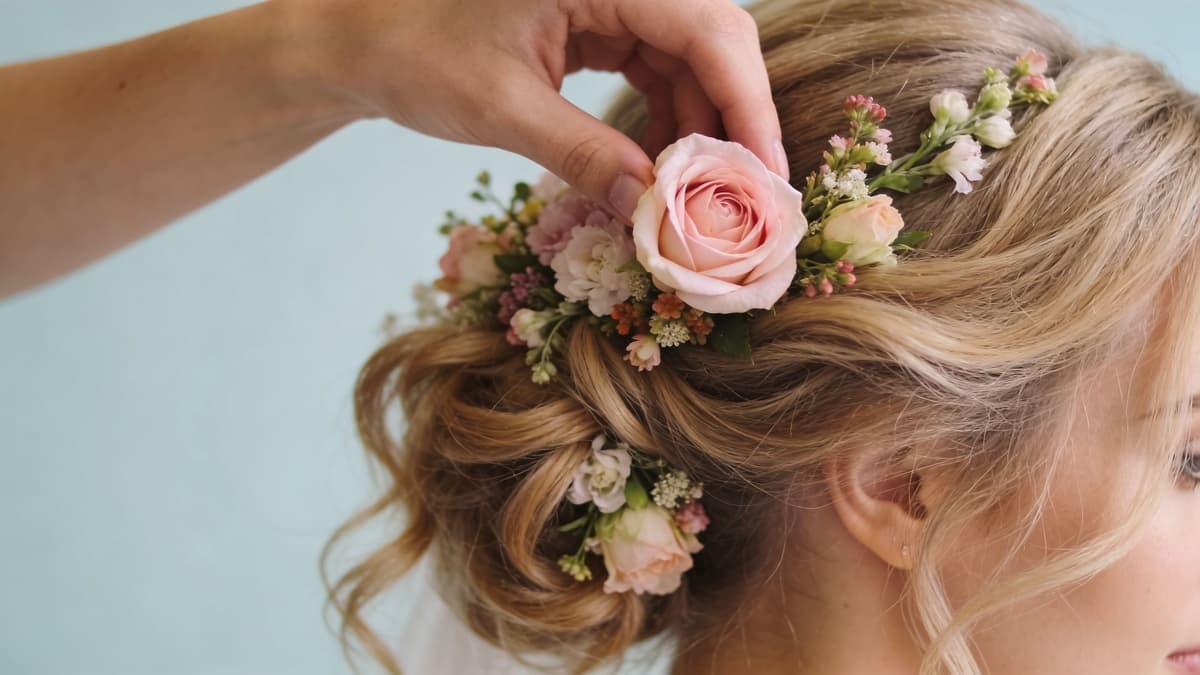
This is the option I recommend most often because it gives you control. A floral comb or a few clustered wired blooms can tuck into a low bun, side sweep, or half-up style without hijacking the whole look.
It’s especially useful if you want flowers in hair for wedding photos but don’t want to commit to a flower-forward silhouette. A cluster can sit above the ear, into the back of a chignon, or at the edge of a braid. It reads polished and usually stays more stable than a full crown.
For brides using added volume or length, placement becomes even more important. If your stylist is blending added texture into the hairstyle, understanding integrating wavy extensions for professional stylists can help you see how extension placement affects where floral pieces can sit securely.
Individual pins and scattered blossoms
Individual floral pins are the lightest, softest option visually. They work beautifully in braids, textured updos, and curls because they let the hairstyle keep its own shape.
They’re also forgiving. If one piece shifts, the whole design doesn’t collapse. That makes them ideal for brides who want movement and softness without a rigid floral structure.
Scattered flowers should look intentional, not random. Place them where the hairstyle already has shape.
Here's a good way to consider it:
Choose a crown if you want flowers to be the headline.
Choose a comb or cluster if you want balance.
Choose individual pins if you want the hairstyle itself to stay center stage.
Which style suits which haircut
Hair setup
Best floral option
Why it works
Long loose waves
crown or scattered pins
enough room for visible floral movement
Low bun or chignon
comb or side cluster
clean anchor point
Half-up style
cluster or small pinned accents
keeps openness without losing structure
Bob or shorter cut
one-sided accent or mini comb
scale stays proportional
Curly or coily updo
individual wired pieces or compact cluster
respects natural texture and shape
The prettiest style on paper isn’t always the one that feels best on your head. Comfort matters. If you spend the whole day checking whether your flowers shifted, the look was wrong, no matter how nice it looked at the trial.
A Practical Guide to Prepping and Placing Your Flowers
Floral hair either works beautifully or fails fast. Most problems don’t come from the flower choice alone. They come from prep mistakes, bad timing, or trying to pin fresh stems into finished hair as if they were regular accessories.
Start with properly prepared pieces
Fresh flowers should be turned into hair-ready units before they go anywhere near your hairstyle. Professional florists wire lightweight flowers through the calyx, wrap them in tape to reduce weight by 30% to 50%, and secure them with bobby pins at 45-degree angles. Bridal trials found that wired pieces maintain position 95% better than unpinned clusters, according to Blooms by the Box’s tutorial on wedding flower hair designs.
That’s the technique behind why professional floral hair looks effortless. The flowers aren’t being shoved into the hair at the last second. They’ve been engineered for placement.
The order matters
Hair first. Flowers last.
If flowers go in before finishing spray, texturizing product, or final smoothing, they’re at risk. Product residue can dry petals and make delicate edges brown faster. The finished hairstyle should already be secure before any floral piece is added.
Placement note: If the flowers are the final step, the stylist can respond to the actual finished shape of the hair instead of guessing earlier.
How to place them so they stay put
Different hairstyles need different anchoring points. Don’t pin into the loosest, fluffiest section and hope for the best.
Try this sequence:
Build the hairstyle completely
Use your normal styling process first. The updo, braid, wave set, or half-up structure should already be locked in.
Identify the strongest anchor area
Buns, braid seams, and denser sections near the crown or behind the ear usually hold best.
Insert wired pieces with crossed support
The floral piece goes in first, then bobby pins support from opposing angles so the flower can’t rock forward.
Check balance
One floral cluster on only one side can be perfect. It can also make the hairstyle feel visually lopsided if the rest of the hair is very sleek. Step back and look at the whole silhouette.
Hair-type differences that matter
Fine hair: Keep clusters smaller. Too many flowers create drag faster than you think.
Thick straight hair: Build grip before placement with structure in the hairstyle itself. Smooth hair can reject pins if the base is too slippery.
Curly or coily hair: Let the flowers work with the texture, not against it. Smaller wired pieces often nestle better than one dense comb.
Short hair: Use fewer pieces, but place them with precision. On shorter cuts, every bloom reads larger.
Questions to ask your florist or stylist
If you’re hiring pros, ask these plainly:
Will the flowers be pre-wired for hair placement
Which blooms are being used because they’re durable, not just pretty
Who is responsible for bringing the hair pieces on the day
Can we test exact placement at the hair trial
Will there be a few spare wired pieces
That last question matters. Spares are what make small wedding-day fixes feel easy instead of dramatic.
Your Wedding Day Floral Logistics Plan
A floral hairstyle becomes easy when it has a timeline attached to it. Most stress comes from treating hair flowers as a tiny decorative detail instead of a live floral element that needs sourcing, prep, transport, timing, and backup.
Build it into your planning timeline
The floral hair decision should happen early enough that it can shape conversations with both your florist and hair stylist. If you wait until the final week, you usually end up choosing from what’s available rather than what suits the hairstyle.
A simple planning rhythm works well:
Early planning stage: decide whether you want fresh, silk, or hybrid flowers.
Hair trial stage: test placement, size, and how much floral detail feels right.
Final vendor confirmation: confirm exact flower varieties or approved substitutes.
Day-before prep: make sure pieces are wired, stored correctly, and assigned to the right person.
Wedding morning: flowers stay out until the hairstyle is fully finished.
For couples who like structure, a wedding day timeline generator can help make sure floral delivery, hair styling, and final placement don’t overlap in a chaotic way.
Plan for weather, especially humidity
Outdoor weddings need an extra layer of realism. A key challenge is humidity. Fresh flowers can lose vibrancy in 70% to 80% humidity, which is common in summer weddings, and studies noted in one industry roundup report a 40% shorter lifespan without anti-transpirant sprays. The same source adds that under 10% of online guides provide humidity-tested securing techniques or vendor prep checklists, according to Wedding Makeup and Hair’s review of fresh flower hairstyle challenges.
That’s why a logistics plan matters as much as taste.
If your wedding is outdoors, ask:
Situation
Better choice
Humid ceremony
smaller hardy blooms, fewer pieces
Windy venue
compact clusters instead of airy tall stems
Very long day
fresh plus backup pieces, or hybrid design
Multiple hair changes or veil removal
simpler floral placement with stable anchors
If the weather is working against you, simplify the design before you force the flowers to perform.
Budget with realism
Hair flowers can be a small accent or a full design feature. The cost difference usually comes down to labor and complexity more than the flowers alone. A few wired sprigs are one thing. A full custom crown is another.
Keep the budget conversation practical:
Ask for hair flowers as a separate line item: it prevents confusion with bouquet pricing.
Coordinate with bouquet ingredients: if the same filler flowers can be used across both, sourcing is often simpler.
Decide whether statement or subtle matters more: a refined small placement often looks more expensive than a bulky overfilled one.
Pack a floral mini-emergency kit
Keep it close to the bridal suite or with your planner:
Extra bobby pins
A few spare wired floral pieces
Blotting paper for scalp and forehead
A small mirror
Clear communication about who handles touch-ups
This is what makes the whole thing feel calm. Not luck. Not perfect weather. Just good planning done early.
Bringing Your Floral Vision to Life with Confidence
Flowers in hair for wedding styling can be one of the most romantic choices you make. It’s soft, personal, and full of character. It also asks for more thought than people expect.
The brides who enjoy this look most aren’t the ones who picked the prettiest pin on social media. They’re the ones who chose a style that fits their face, their hair texture, their dress, their venue, and the actual conditions of the day. They chose flowers that could hold up. They tested placement. They made a plan.
That’s why floral hair works so well when it’s approached like a design decision instead of an afterthought. You don’t need to lower the vision. You just need to support it with better choices.
When beauty and logistics agree with each other, the result feels effortless. And that’s exactly how wedding hair should feel.
If you want a calmer way to turn inspiration into an actual wedding plan, ItsaYes helps you organize your style ideas, timeline, tasks, and priorities in one place. Instead of juggling saved posts, notes apps, and spreadsheets, you can map out decisions like floral hair with clarity from the start and keep the whole process moving without overwhelm.