ItsaYes
22 min

How Much Should a Wedding Planner Cost? A Clear Budget Guide

Author

The ItsaYes TeamAuthor
How Much Should a Wedding Planner Cost? A Clear Budget Guide

So, how much should you actually set aside for a wedding planner? This is one of the first, and biggest, questions couples ask, and for good reason. Nailing down this number early on is the key to building a realistic budget and making confident decisions right from the start. Without it, you're just guessing.

The national average cost for a wedding planner is $4,047, with most couples spending somewhere between $3,200 and $4,900. Think of this as roughly 8-11% of your total wedding budget, a solid investment for having a seasoned pro in your corner.

But a planner's fee isn't a one-size-fits-all price tag. It's a spectrum that depends entirely on how much help you actually need. It’s like hiring a contractor: you can bring them in to build the whole house from the ground up, or just have them handle the final walkthrough. Planners work the same way, offering different levels of service so you can find the perfect fit.

A couple analyzing wedding planner costs and budget percentages on a laptop with a calculator.

Different Service Levels Explained

To really get a handle on pricing, you first have to know what you’re paying for. The industry breaks down into three main types of service, each with its own price point. Are you the super-organized type who just needs a pro to run the show on the big day? Or are you a busy professional who wants an expert to manage every single detail from "yes" to "I do"?

Your total wedding spend plays a huge role here, too. For 2026, the average wedding cost in 2026 is projected to land between $36,000 and $42,000. Knowing this helps put the planner's fee into perspective, especially since many charge a percentage of that total.

The key takeaway? Find the service level that matches your needs and your budget. This ensures you're paying for the exact support you need to bring your vision to life without the stress.

The goal is to align your needs with the right package. That way, you get the support you need to pull off an amazing day without feeling like you’re overpaying for services you didn't really need.

Wedding Planner Services and Average Costs at a Glance

To give you a quick financial snapshot, here’s a table that breaks down the three main service tiers. Use it to get a feel for the national averages and see where your needs might fit.

Service LevelBest For Couples Who...Typical Price Range (National Average)
Full-Service PlanningWant expert guidance on every single detail, from venue scouting to post-wedding logistics.$4,500 – $12,000+
Partial PlanningHave started planning but need help locking in key vendors and managing final details.$2,500 – $6,000
Day-Of CoordinationHave planned it all themselves but need a professional to execute their vision on the wedding day.$1,200 – $2,800

This quick breakdown should help you start the conversation and figure out which direction makes the most sense for you as a couple.

So, you’re looking for a wedding planner. One of the first things you'll notice is that they don't all charge the same way. Getting a handle on how planners structure their fees is the first real step to figuring out what you can expect to pay and which model feels right for your budget.

There are three main ways planners charge in this industry, each with its own logic. Think of them as different roadmaps for hiring the project manager for the biggest party of your life. The right one for you will depend on your budget, how much certainty you need upfront, and just how much help you’re looking for.

The Percentage of Budget Model

This is the classic model, especially for full-service planners. They'll charge a set percentage, usually somewhere between 15-20%, of your total wedding spend.

It’s a bit like hiring a general contractor to build your dream home. Their fee is tied to the total cost of the project because a more complex, expensive build requires way more management. A planner works the same way here; as the scale and budget of your wedding grow, so does their workload, and their fee adjusts accordingly.

This model is great because it means your planner is invested in managing every single dollar. Just make sure you get crystal clear on what's included in that "total spend." Does their percentage apply to your wedding dress or the rings? Always get that list in writing before you sign.

The Flat Fee Model

For couples who want zero financial surprises, the flat-fee model is a godsend. Your planner quotes you one single price for a very specific list of services, and that number doesn't change, no matter what your final wedding costs are.

This is like booking an all-inclusive vacation. You know the final cost before you even pack your bags, which makes budgeting clean and simple. The planner calculates this fee based on the complexity they anticipate, the amount of work involved, and their own level of experience.

It’s a fantastic way to build a predictable budget. You can decide to add that extra floral arch or upgrade your band without worrying that your planner’s fee is going to creep up, too.

The real beauty of flat-fee pricing is the transparency. It lets you make other budget decisions freely, knowing your planner's compensation is locked in. This builds a huge amount of trust and partnership right from the start.

The Hourly Rate Model

Sometimes you don't need someone to plan the whole shebang. Maybe you just need an expert’s brain for a few key tasks—like building a rock-solid timeline, looking over vendor contracts, or just helping you brainstorm a design that feels like you. That's where paying by the hour comes in.

Think of it as hiring a consultant. You only pay for the time you actually use, which makes it an incredibly flexible and cost-effective way to get targeted help. According to 2025 data, hourly rates for planners typically fall between $75 and $275, depending on their experience and where they're located. If you’re handling most of the planning yourself, this lets you bring in a pro right when you need one most. You can see how these numbers fit into the bigger picture in the full report from Joy.

This model works best when you have a very clear, limited scope. Without firm boundaries, the hours can add up faster than you’d think. It's always a smart move to agree on a maximum number of hours upfront to keep costs under control.

Full-Service, Partial Planning, And Day-Of Coordination Compared

Okay, so you know how planners charge. Now comes the real question: what level of support do you actually need?

Choosing the right package is a huge deal. It directly sets your wedding planner cost, sure, but more importantly, it shapes your entire planning experience. The goal is to find that perfect sweet spot that matches your needs, your personality, and just how much of this wild ride you want to steer yourself.

Most planners break their services down into three main levels. Think of it like hiring a guide for a big trip: you can have someone plan every single flight, hotel, and dinner reservation from the start; you can bring in a local expert halfway through to handle a specific city; or you can just have a pro meet you at the airport to make sure you get to your hotel without a hitch.

Unlock the ItsaYes design studio inside your workspace to co-create palettes, layouts, and vendor-ready briefs with our AI copilots.

Start planning for free

The All-In Partnership: Full-Service Planning

This is the whole enchilada. Full-service planning is for the couple who wants an expert partner in their corner from "Yes!" to "I do." Your planner isn't just a coordinator; they're your creative director, budget guru, vendor curator, and logistics mastermind all rolled into one.

They handle everything. We're talking venue scouting before you've even picked a date, negotiating every vendor contract, managing the guest list, and building a minute-by-minute timeline for the big day. It's an all-access pass to their expertise.

This is a game-changer for busy professionals or couples planning a destination wedding who just don't have the time, or local contacts, to juggle a dozen vendors and a thousand details. A full planner saves you hundreds of hours, but they also act as your financial guardian. While hiring a full planner 10 or more months out can range from $3,000 to $12,000, their real value often comes from the money they save you. Seasoned pros can negotiate vendor discounts of 15-25%, which can seriously offset their own fee. For a deeper dive on how these fees work, The Knot's detailed guide is a great resource.

The Strategic Assistant: Partial Planning

What if you’ve already started but are now hitting a wall? Maybe you’ve locked in your dream venue and photographer, but the thought of sourcing a florist, a band, and a calligrapher makes you want to elope. That's where partial planning shines.

It’s the perfect middle ground for couples who enjoy being hands-on but need a professional to help them over the finish line. A partial planner usually jumps in a few months before the wedding to tackle the specific tasks you're struggling with. They provide targeted expertise right where you need it most, saving you from burnout and making sure the final stretch is exciting, not exhausting.

The infographic below breaks down how planners typically structure their fees for these different levels of service.
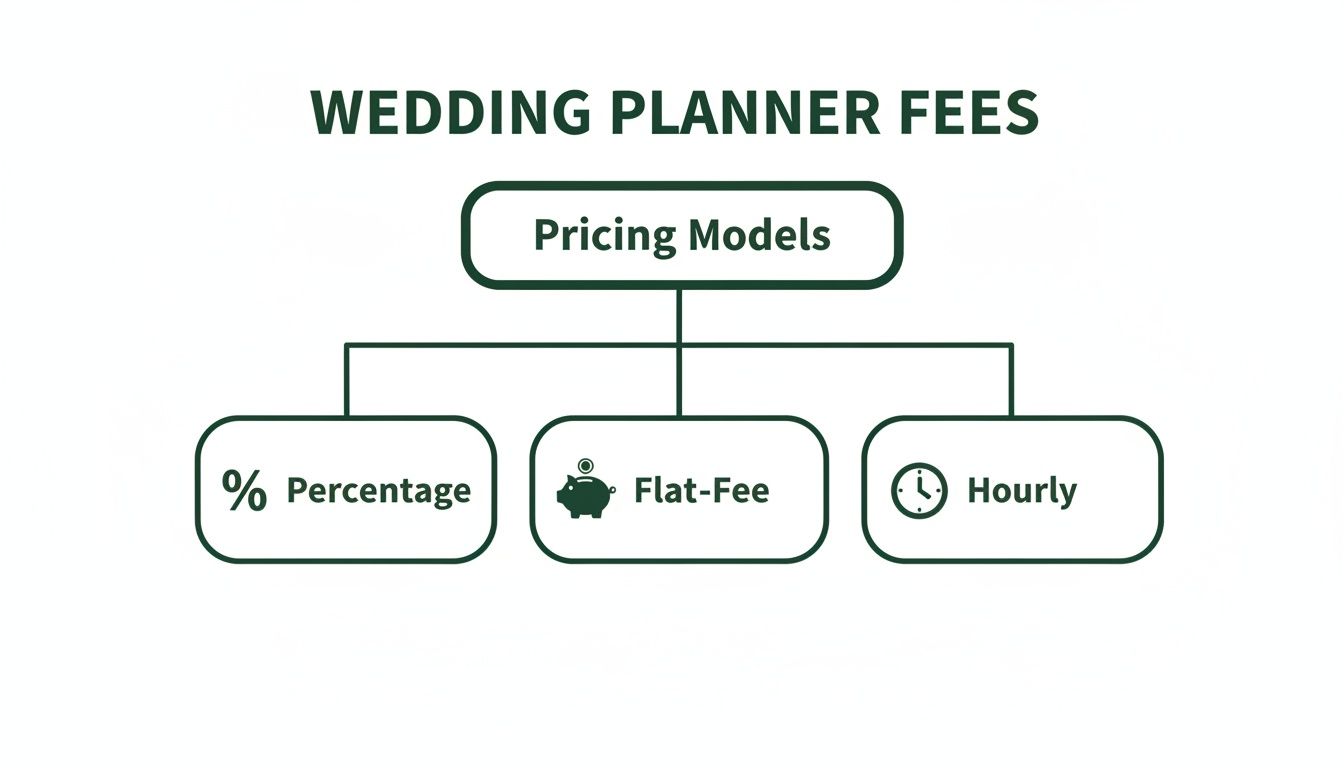
Infographic detailing wedding planner fees, showing pricing models like percentage, flat-fee, and hourly rates.

This visual shows how a planner’s pricing model, whether it's a percentage of your budget, a set flat fee, or an hourly rate, is applied across the different packages to match the amount of work involved.

The Flawless Executor: Day-Of Coordination

Let's get one thing straight: "day-of" is a bit of a misnomer. It's really "month-of coordination," and it’s the secret weapon for the organized, DIY couple. You’ve done all the heavy lifting, picked the vendors, made the design choices, and crafted your vision. Now, you need a pro to step in and execute it perfectly so you can actually enjoy the day you worked so hard to create.

A day-of coordinator typically gets involved four to six weeks out. They’ll dive into your vendor contracts, create a master timeline that syncs everyone up, and become the main point of contact for all your suppliers. On the wedding day, they are the first to arrive and the last to leave, managing everything from setup to breakdown and putting out any fires that pop up.

A day-of coordinator isn't just a luxury; they're your insurance policy for a stress-free wedding day. They ensure that the beautiful event you spent months planning comes to life exactly as you imagined it.

Comparing Wedding Planner Service Levels

To make it even clearer, let's break down what you can typically expect from each service level. Think of this as a cheat sheet to help you pinpoint exactly the kind of support you're looking for.

Feature/TaskFull-Service PlannerPartial PlannerDay-Of Coordinator
When They Start12-18+ months out; from the very beginning.3-8 months out; after you've made key decisions.4-6 weeks out; to manage the final logistics.
Budget ManagementCreates, allocates, and manages the entire budget. Tracks payments.Helps refine your existing budget and manage remaining vendor categories.Reviews vendor contracts for final payments and tips.
Vendor SelectionRecommends, vets, negotiates, and books all vendors.Helps you find specific vendors you're missing (e.g., florist, band).Confirms details with vendors you've already booked.
Wedding DesignDevelops the entire aesthetic and design concept from scratch.Helps you pull your existing ideas into a cohesive, executable design.Executes the design vision you've already created.
Timeline CreationBuilds a comprehensive planning timeline and a detailed wedding day schedule.Focuses primarily on creating the detailed wedding day schedule.Creates the wedding day timeline and distributes it to all vendors.
Guest ManagementOften assists with RSVP tracking and seating chart creation.May offer this as an add-on service.Not typically included.
Wedding Day RoleOversees every single detail from setup to breakdown. Your single point person.Oversees setup, execution, and breakdown, managing vendors on-site.Oversees setup, execution, and breakdown, managing vendors on-site.
Ideal For...Busy couples, those planning a destination wedding, or anyone wanting a stress-free, expert-led process.Couples who have handled the initial big decisions but now feel overwhelmed or need specific expertise.Highly organized couples who've planned everything but want to be guests at their own wedding.
Typical Cost ImpactHighest cost, but often provides the most value and potential savings.Mid-range cost, offering targeted support without the full-service price tag.Lowest cost, focused on flawless execution of your existing plan.

Ultimately, the right choice depends entirely on how you envision your planning journey. Being honest with yourself about your time, skills, and stress levels will lead you straight to the perfect planning partner for your day.

The Hidden Factors That Drive Up Planner Costs

So, you've got a handle on the different pricing models. But why does one planner quote you $5,000 while another, seemingly offering the same "full-service" package, comes in at $15,000?

It's not arbitrary. The price tag is a direct reflection of the scope, scale, and expertise your specific wedding demands. Let's pull back the curtain on the three big factors that can dramatically shift a wedding planner's fee.

Location, Location, Location

This isn't just a real estate cliché; it's the number one variable in wedding costs, period. A planner in New York City or San Francisco has to navigate a market with higher overhead, more competitive vendors, and a completely different cost of living than a planner in a smaller Midwestern town.

It’s all connected. Venue rentals are higher, catering costs more per person, and even labor for setup and breakdown is steeper. The planner's fee has to reflect the economic reality of the market they work in.

For instance, a comprehensive full-service planner in Tennessee might run you somewhere between $2,500 and $8,500. But for a similar level of service in a major coastal city, it’s not uncommon for the starting price to be $10,000, climbing quickly from there. Getting a feel for your local market rates is the first step to setting a realistic budget.

The Scale of Your Wedding: Complexity and Guest Count

This is pure logistics. The more moving parts your wedding has, the more work it is for a planner, and the more they will charge.

Think of it like this: planning an intimate 50-person dinner at a restaurant is one thing. Orchestrating a 250-guest, multi-day celebration with a welcome party, rehearsal dinner, ceremony, and farewell brunch is a completely different universe of complexity.

More guests automatically mean:

  • More Communication: Tracking hundreds of RSVPs, meal choices, and travel questions.

  • More Vendors to Manage: Sourcing more tables, chairs, linens, and coordinating bigger teams for catering, bar service, and transportation.

  • More Complex Logistics: Designing a seating chart for 25 tables instead of 5, managing a huge hotel room block, and ensuring 250 people move smoothly from one space to another.

A planner's fee is a direct reflection of the time and expertise required. A wedding with complex logistics, like building a reception from scratch with a tent in a backyard or planning a destination event, involves far more problem-solving and management hours than a straightforward ballroom wedding.

This is why one of the first questions a planner will ask is about your guest count and overall vision. They're not being nosy, they're mentally calculating the sheer volume of work required to pull your unique event off without a hitch.

The Planner’s Street Cred: Experience, Reputation, and Vendor Network

Finally, you’re not just paying for a person's time; you’re paying for their wisdom. A seasoned planner with a decade of experience, a portfolio of jaw-dropping weddings, and a reputation for handling crises with grace will, and should, cost more than someone just starting out.

You're investing in their proven track record. You're buying the peace of mind that comes from knowing they've seen it all before and can solve any problem that comes their way.

A huge part of that value is their vendor network. This isn't just a list of names; it's a curated collection of trusted professionals they've built relationships with over years. This network is gold.

  1. They Can Open Doors: An experienced planner can often get you in with a top-tier photographer or sought-after florist who is otherwise "fully booked."

  2. They Can Find Savings: Their long-standing relationships can sometimes unlock preferred rates, waived fees, or extra perks not available to the general public. These savings can sometimes even offset a portion of the planner's fee.

  3. They Protect Your Investment: Most importantly, they know who is reliable, professional, and delivers on their promises. They shield you from the vendors who might be flaky, unprofessional, or just not worth the money.

When you see that higher price tag from a veteran planner, remember what it represents: a deep well of expertise, a Rolodex of the best in the business, and the promise of a seamless, stress-free day.

Is a Wedding Planner a Smart Financial Investment?

When you first see the price tag for a wedding planner, it’s easy to get sticker shock. It feels like another huge line item on an already intimidating budget—a luxury you might not be able to afford.

But what if you reframed that thinking? Instead of seeing it as a cost, think of it as a strategic investment. An experienced planner isn't just there to pick out pretty flowers; they are your financial advocate, your budget's bodyguard, and your secret weapon in a complex industry.

Unlocking Savings Through Sheer Expertise

One of the clearest ways a planner pays for themselves is through their network and negotiation skills. They've spent years building solid relationships with trusted vendors, and those relationships often come with perks—and prices—that you simply can't get by yourself.

A seasoned wedding planner can often secure vendor discounts ranging from 10-25%. On a $40,000 wedding budget, that translates to $4,000-$10,000 in savings. Suddenly, their fee doesn't look so daunting, does it?

This is where their fee stops being an "expense" and starts becoming a self-liquidating investment. You're not just paying for their time and taste. You're paying for access to their exclusive network and their ability to make every dollar you spend work harder. They know the market inside and out, what's negotiable, and where vendors have wiggle room.

Dodging the Landmines of Costly Mistakes

Beyond just scoring discounts, a great planner acts as your financial gatekeeper. They're the ones protecting you from the costly mistakes that are all too common when you're navigating this process for the first time. Every decision, from the venue contract to the catering proposal, is loaded with financial tripwires.

A planner helps you sidestep common pitfalls like:

  • Overbooking Services: Paying for an extra hour of photography you don't need or ordering too much cake.

  • Hidden Fees: They'll scrutinize every contract for those sneaky charges for overtime, setup, or unexpected taxes that can blow up a budget.

  • Poor Budget Allocation: They stop you from splurging on something trendy that you don't actually care about, ensuring your money goes toward your real priorities.

Think of them as the project manager who knows exactly where all the budget traps are buried. Their guidance prevents you from making emotional, in-the-moment decisions that you'll regret later, ensuring every dollar is spent with purpose. While you get to focus on the fun parts, they handle the financial reality, keeping everything in balance.

A Modern Tool for Financial Clarity

Of course, this kind of financial oversight starts with having a clear picture of your budget from day one. Even before you hire a planner, getting your numbers straight is the most important first step you can take.

This is where a dedicated wedding budget app can be a game-changer. It helps you lay the groundwork by tracking expenses, allocating funds, and seeing exactly where your money is going. The ItsaYes platform, for example, is designed for couples who want clarity from the very start. It brings your vision, tasks, and budget into one calm workspace, helping you turn inspiration into a fully structured plan.

Ultimately, hiring a planner is an investment in a smoother, more enjoyable, and financially sound wedding experience. They don't just save you stress and countless hours; they protect your budget and often pay for themselves through savvy negotiations and expert guidance.


Modern AI wedding planning app, Itsayes

A Modern Approach to Confident Wedding Planning

For a lot of couples, the choice feels like it's all or nothing: hire a full-service planner and hand over the reins, or go it alone with a chaotic mess of spreadsheets and binders. But what if you actually want to be hands-on? What if you love the idea of planning your wedding, but just dread the overwhelm of a thousand tiny decisions?

There’s a middle ground. It’s for the couple who wants the framework of an expert without the full-service price tag. Imagine having a clear path forward, but you’re the one steering the ship, making sure every single choice feels like you.

From Pinterest Chaos to a Real Plan

The planning journey always starts with inspiration. It’s the Pinterest boards, the saved Instagram posts, the screenshots you text each other at midnight. The real challenge? Turning all that beautiful chaos into an actual, step-by-step plan.

This is exactly where an AI-powered system like ItsaYes comes in. It’s designed to take your vision, to-do list, and timeline and bring them all into one calm, organized space.

Instead of juggling scattered notes, the platform helps you translate your style into a structured roadmap. It takes the entire journey—whether you have six to twelve months—and breaks it down into simple, manageable steps.

ItsaYes is built for newly engaged couples who want to enjoy the process, stay organized, and feel confident, from first inspiration to a fully structured plan.

You get the clarity of a professional process, but with the complete freedom to make it your own. It turns what feels like a mountain of work into a series of small, satisfying wins.

Your Personal AI Planning Assistant

One of the biggest perks of having a human planner is their ability to keep you on track. A modern planning system gives you that same support with a personal AI assistant that’s available 24/7. This isn’t just a glorified checklist; it’s a tool that can suggest what to focus on next, organize your tasks, and keep everything moving forward without overwhelm.

Think of it as your co-pilot. It’s there to help you manage your budget and stay on schedule so you can focus on the fun parts. With that constant backup, you can make decisions with confidence, knowing you’re not forgetting some crucial detail.

You can learn more about how this all works in our AI wedding planning guide. It’s truly the best of both worlds: the power of an organized system and the personal satisfaction of a hands-on approach.

Common Questions About Wedding Planner Costs

When you start digging into planner pricing, a few questions always pop up. Let's tackle them head-on so you can move forward with confidence.

When Is The Best Time To Hire A Planner?

Honestly, timing is a huge factor. For a full-service planner who will be your partner from day one, you’ll want to bring them on board 10-18 months in advance. This is usually right after you've set a rough budget, allowing them to shape every major decision, from venue scouting to vendor selection, from the very beginning.

If you’re leaning toward partial planning or just need a day-of coordinator to run the show, a shorter timeline of 3-6 months out is pretty standard.

Do Planners Get Kickbacks From Vendors?

This is a big one, and it gets right to the heart of trust and transparency.

Let's be clear: unethical, hidden "kickbacks" are a major red flag. However, some reputable planners do work on a disclosed commission basis with certain vendors. The key word here is disclosed. A true professional will have no problem explaining their vendor relationships and will outline everything clearly in your contract.

Your planner is your advocate. Their recommendations should always be based on who is the absolute best fit for your style and budget, not on a secret payday. If it feels shady, it probably is.

Can I Negotiate The Price With A Planner?

While most experienced planners have firm package prices that reflect their expertise and the value they provide, that doesn't mean the conversation has to end there.

Instead of asking for a straight discount, try negotiating the scope of services. You might find there’s flexibility to create a custom package. If you’re confident handling vendor communication but need help with the design and timeline, for example, you might be able to adjust a package to better fit your needs and budget. It never hurts to ask.


Ready to build a clear, confident plan from the start? ItsaYes is an AI-powered wedding planning system that brings your vision, budget, and timeline into one calm workspace. Instead of juggling spreadsheets, get a structured plan and a 24/7 AI assistant to guide you. Start planning with clarity at https://itsayes.io.

Keep reading

You might also like