Wedding invitation sizes: standard dimensions guide (5x7, 4x6, Square)
28 min
Wedding invitation sizes: standard dimensions guide (5x7, 4x6, Square)
Author
The ItsaYes TeamAuthor
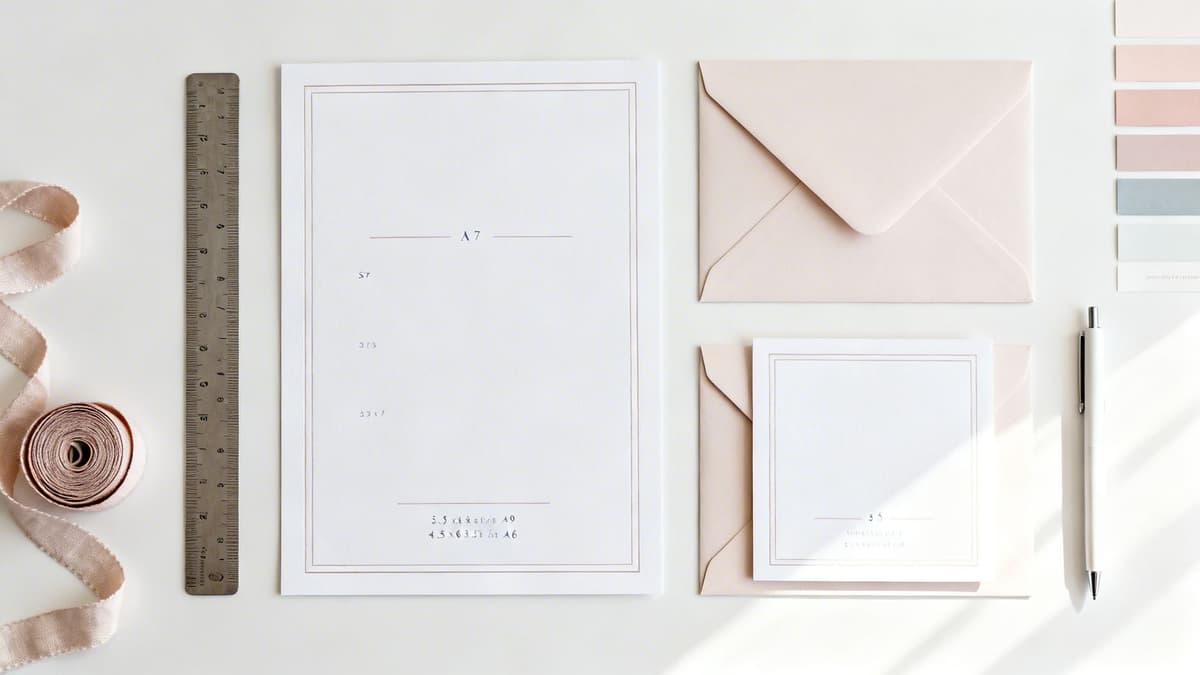
The classic, go-to invitation size is 5x7 inches. You'll often hear it called an A7. It's the most popular choice for weddings for a few simple reasons: it gives you plenty of room for a beautiful design, it slips perfectly into a standard envelope, and it almost always mails with a single stamp. It's a reliable and timeless option for a reason.
Standard US Invitation Card Sizes at a Glance
Size Name
Dimensions (Inches)
Dimensions (mm)
Matching Envelope
Best For
A7
5" x 7"
127 × 178 mm
A7 (5.25" x 7.25")
The classic choice for formal weddings, offering ample space for design.
Grand, formal events where you want to make a luxurious first impression.
A6
4.5" x 6.25"
114 × 159 mm
A6 (4.75" x 6.5")
Intimate gatherings, minimalist designs, or more casual events like showers.
A2
4.25" x 5.5"
108 × 140 mm
A2 (4.375" x 5.75")
RSVP cards, thank you notes, and other small enclosure cards.
Square (5×5)
5" x 5"
127 × 127 mm
5.25" x 5.25" square
Modern, unique designs. Note: Requires extra postage ($0.46 surcharge).
Square (6×6)
6" x 6"
152 × 152 mm
6.25" x 6.25" square
Bold modern statement. Note: Requires extra postage ($0.46 surcharge).
Slim / Tea-length
4" x 9.25"
102 × 235 mm
#10 (4.13" x 9.5")
Destination weddings, creative and formal themes.
This table gives you a great starting point, but let's break down the two main alternatives to the classic A7.
The Grand A9 (5.5 x 8.5 inches / 140 × 216 mm): If your wedding is a formal, black-tie affair, the A9 makes a statement. Its larger dimensions feel substantial and luxurious, offering more space for elaborate calligraphy or detailed artwork. It conveys a sense of grandeur from the moment your guests open the envelope. Envelope match: The A9 requires an A9 envelope measuring 5.75 × 8.75 inches (146 × 222 mm). Because this exceeds the USPS standard letter size (6.125" height max), always confirm current postage rates — you may need additional postage of $0.28 per piece for the non-standard size.
The Petite A6 (4.5 x 6.25 inches / 114 × 159 mm): For more intimate gatherings, micro-weddings, or minimalist events, the A6 is a fantastic choice. Its smaller scale feels personal and charming, and it's perfect for designs that are simple and clean. It's also a great budget-friendly option, as it uses less paper and is lighter to mail. Envelope match: The A6 pairs with an A6 envelope measuring 4.75 × 6.5 inches (121 × 165 mm). This size comfortably qualifies for a standard USPS Forever stamp ($0.73 in 2026).
Why Your Invitation Card Size Matters More Than You Think
That magical moment you get engaged quickly gives way to a flood of decisions. Instead of juggling spreadsheets, Pinterest boards, and scattered notes, you soon realize that choosing an invitation card size isn't just a minor detail, it's a foundational choice that ripples through your entire wedding stationery plan.
Think of your invitation size as the blueprint for your wedding's first impression. It sets the tone before a single word is read. Getting this right from the start brings clarity to what can be a confusing process. It helps turn your inspiration into a clear plan, breaking the next 6 to 12 months into simple, manageable steps.
Connecting the Dots from Size to Stress-Free Planning
Choosing an invitation size isn't a decision you make in a vacuum. It's directly tied to a few key planning elements that, when you see how they connect, turn potential chaos into a calm, structured plan.
Here's how that one choice impacts the bigger picture:
Budget and Postage: This is the big one. The size and weight of your invitation directly determine your mailing costs. A non-standard size, like a large square card, can easily trigger extra postage fees. That extra cost might seem small for one invitation, but it multiplies quickly across your entire guest list.
Design and Aesthetic: The dimensions you pick literally define your creative canvas. A grand 5.5x8.5 inch (A9) card feels formal and perfectly suits a black-tie affair. On the other hand, a smaller 4.5x6.25 inch (A6) card works beautifully for intimate, minimalist events. The size reinforces the vibe.
Enclosure Card Harmony: Your RSVP cards, detail cards, and accommodation info all have to fit neatly inside the main envelope without looking like a jumbled mess. Picking a standard size ensures that coordinating enclosure cards are easy to find and fit together perfectly.
By seeing your invitation size as a strategic first step, you transform it from a point of stress into a tool for organization. This approach makes sure your vision, your budget, and your timeline are all working together from the very beginning, setting you up for a confident and much more enjoyable planning journey.
Decoding the Most Popular Invitation Card Sizes
When you first dive into wedding planning, the sheer number of choices can feel overwhelming. But some choices can actually simplify everything that comes after. Understanding invitation sizes is one of those foundational decisions that brings calm to the chaos.
Think of the 5x7 inch invitation as the little black dress of the wedding world, it's timeless, elegant, and always appropriate. Known in the stationery industry as the A7 size, this has been the gold standard for decades for a reason. It strikes a beautiful balance, giving you plenty of canvas for your design without feeling oversized or, crucially, costing you extra to mail.
This is exactly why it remains the top choice for couples. In 2023, a staggering 70% of North American couples opted for this very size. The 5x7 inch card (measuring 127mm x 178mm) fits perfectly into a standard A7 envelope (5.25 x 7.25 inches). This means it qualifies for a standard US Forever stamp, saving you anywhere from $0.50 to $1.00 per invitation on postage compared to odd-shaped or oversized mailings.
The A7: The Undisputed Industry Standard
The A7's reign isn't an accident. It's the sweet spot where decades of printing and postal standards have aligned, creating a hassle-free option for everyone involved.
Its popularity means you'll find an endless supply of matching envelopes, enclosure cards (like for your RSVP), and pre-designed templates on platforms like Canva. Because it's so common, printers are perfectly set up to handle this size efficiently, which often translates into lower printing costs for you. This frees up room in your budget for those special details, like a premium paper stock or a custom wax seal, without breaking the bank on the basics.
Envelope match: The A7 invitation (5×7") pairs with the A7 envelope, which measures 5.25 × 7.25 inches (133 × 184 mm). This quarter-inch clearance on each side allows the card to slide in and out easily. A7 envelopes are available from virtually every stationery supplier and qualify for a standard USPS Forever stamp ($0.73 in 2026).
A key principle of calm wedding planning is to make foundational choices that simplify future decisions. Choosing a standard invitation card size like the A7 is a perfect example, it removes guesswork around postage, envelopes, and layout, letting you focus on the creative vision.
This one decision, your card size, has a ripple effect on your budget, design, and even your postage costs. They are all deeply interconnected.
Beyond the A7: Other Popular Choices
While the A7 is the undisputed champion, it's not your only option. Depending on the formality and style of your wedding, a couple of other popular sizes might be a better fit for your vision.
Not sure about save-the-date sizing? These are typically smaller — usually 4×6" (102 × 152 mm) or postcard-sized at 4.25×5.5" (108 × 140 mm). They follow the same envelope-pairing logic as invitations, so choosing a standard size here saves you the same postage headaches.
Ultimately, the best invitation card size is the one that aligns with your wedding's unique story. Whether you choose the classic A7, the grand A9, or the petite A6, understanding the benefits of each empowers you to make a confident, informed decision, bringing your wedding vision one step closer to reality.
While the classic 5x7 invitation is a timeless and beautiful choice, sometimes your wedding vision just demands something a little… different.
For couples who define their style and ideas with inspiration from Pinterest and Instagram, a standard size might not feel special enough. It might not capture that modern, unique aesthetic you're dreaming of. This is where non-traditional invitation sizes come into play, offering a way to make an immediate, memorable statement before the wedding day even arrives.
These unique dimensions move beyond the expected, letting you craft a first impression that is distinctively you. Whether you're planning a sleek city wedding or a bohemian destination affair, choosing an unconventional size is the perfect way to signal your event's style from the moment guests open their mailboxes.
Of course, veering from the beaten path comes with its own set of practical considerations. It's a trade-off: standout style versus potential logistical hurdles. Understanding these trade-offs is the key to choosing a size you love without adding a single ounce of stress to your planning.
The Chic and Modern Square Invitation
Among the non-traditional options, the square invitation has become a hallmark of modern, minimalist design. There's something about its perfectly symmetrical shape that feels contemporary and intentional. It creates a fresh canvas for bold typography and clean, graphic layouts.
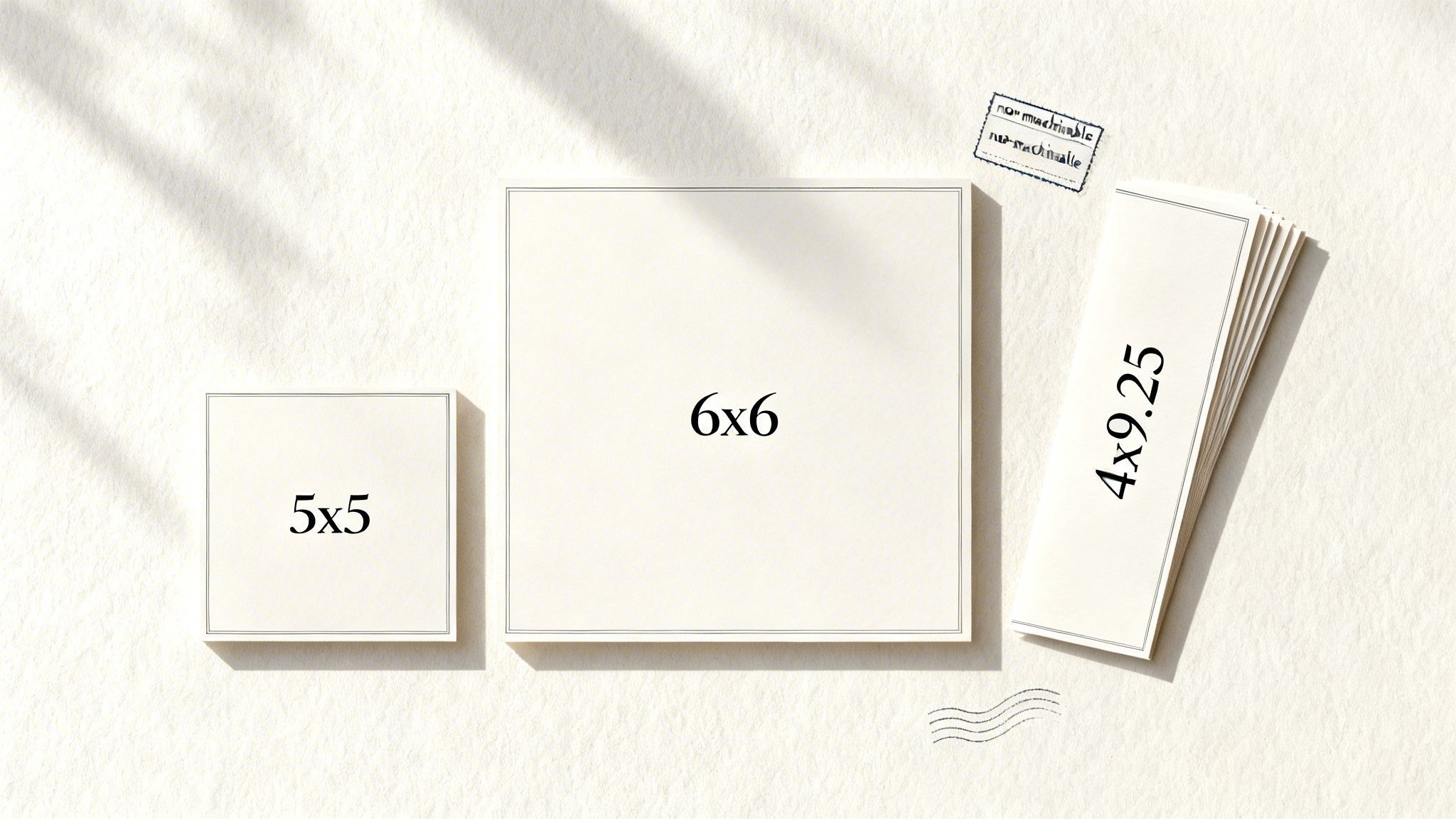
Sizes like 5x5 inches (127 × 127 mm) or the slightly larger 6x6 inches (152 × 152 mm) are incredibly popular for their striking visual impact. They're a favorite for urban, style-conscious couples, reflecting a broader shift toward more graphic, Instagram-worthy wedding aesthetics.
In fact, the use of square invitation cards has surged 45% in popularity among urban millennials since 2018. But while they are undeniably stylish, there's a critical detail to consider: the US Postal Service classifies them as "non-machinable." This means they require an extra $0.46 in postage per piece (the 2026 USPS non-machinable surcharge), on top of the standard $0.73 Forever stamp — bringing each square invitation to $1.19 to mail.
For a 100-guest wedding, that's $119 in postage vs $73 for standard rectangles — a difference of $46 you might not have planned for. For 150 guests, it's $178.50 vs $109.50. You can find more of these kinds of practical insights in Canva's wedding invitation guide.
Envelope match: A 5×5" square card fits a 5.25 × 5.25" square envelope, while a 6×6" card needs a 6.25 × 6.25" envelope. Square envelopes are less commonly found in stores — order them online from specialty suppliers like LCI Paper or Cards & Pockets. Remember these always require the non-machinable surcharge.
The takeaway? A square invitation is a stunning choice for a modern wedding, but you have to budget for the postage surcharge. This is a perfect example of how planning ahead, connecting your vision, tasks, and budget, prevents unwelcome surprises down the road.
Slim and Unique Creative Formats
Beyond the square, other creative formats offer exciting possibilities for telling your wedding story. These alternative dimensions can tie directly into your wedding's theme, creating a cohesive and immersive experience for your guests from the very start.
One popular option is the slim or tea-length card, typically around 4x9.25 inches (102 × 235 mm). This elegant, elongated shape has a sophisticated feel and is surprisingly versatile.
Destination Weddings: A slim card is the perfect shape to mimic an airline ticket or travel document, instantly setting the scene for a celebration abroad.
Formal Events: Its tall, graceful proportions also lend themselves beautifully to black-tie events, especially when paired with elegant script fonts and high-quality paper.
Envelope match: Slim 4×9.25" cards fit a standard #10 envelope (4.13 × 9.5 inches / 105 × 241 mm), commonly used for business letters. These are inexpensive and easy to source. If your card is slightly wider, look for a #10 policy envelope which has a deeper flap.
Like square cards, these non-standard sizes might require a little more planning. You'll need to source matching envelopes and confirm postage costs, as their unusual dimensions can sometimes be tricky for automated postal machines.
Another route to consider is going fully digital. If you love a modern approach but want to avoid the complexities of postage altogether, our guide on digital wedding invitations offers a complete look at this streamlined, eco-friendly alternative. Ultimately, choosing a non-traditional size is all about balancing your unique style with practical logistics to ensure your invitation suite is both beautiful and stress-free.
How to Size Your Complete Invitation Suite
A wedding invitation is rarely just one card. It's a thoughtfully curated collection of pieces that tells a story and gives your guests all the information they need. This collection is what we call an invitation suite, and sizing each component correctly is a quiet art form that transforms a stack of cards into a beautiful, organized experience for your guests.
Think of building your invitation suite like dressing in layers. Your main invitation is the stylish outer coat, but the enclosure cards, like your RSVP and details inserts, are the essential layers underneath that provide warmth and function. They all need to fit together harmoniously.
The goal is to create a delightful "unboxing" moment. When your guests open the envelope, they should find a neat, elegant stack of cards, not a confusing jumble. This is where strategic sizing and the concept of "nesting" come into play.
Mastering the Art of Nesting Your Cards
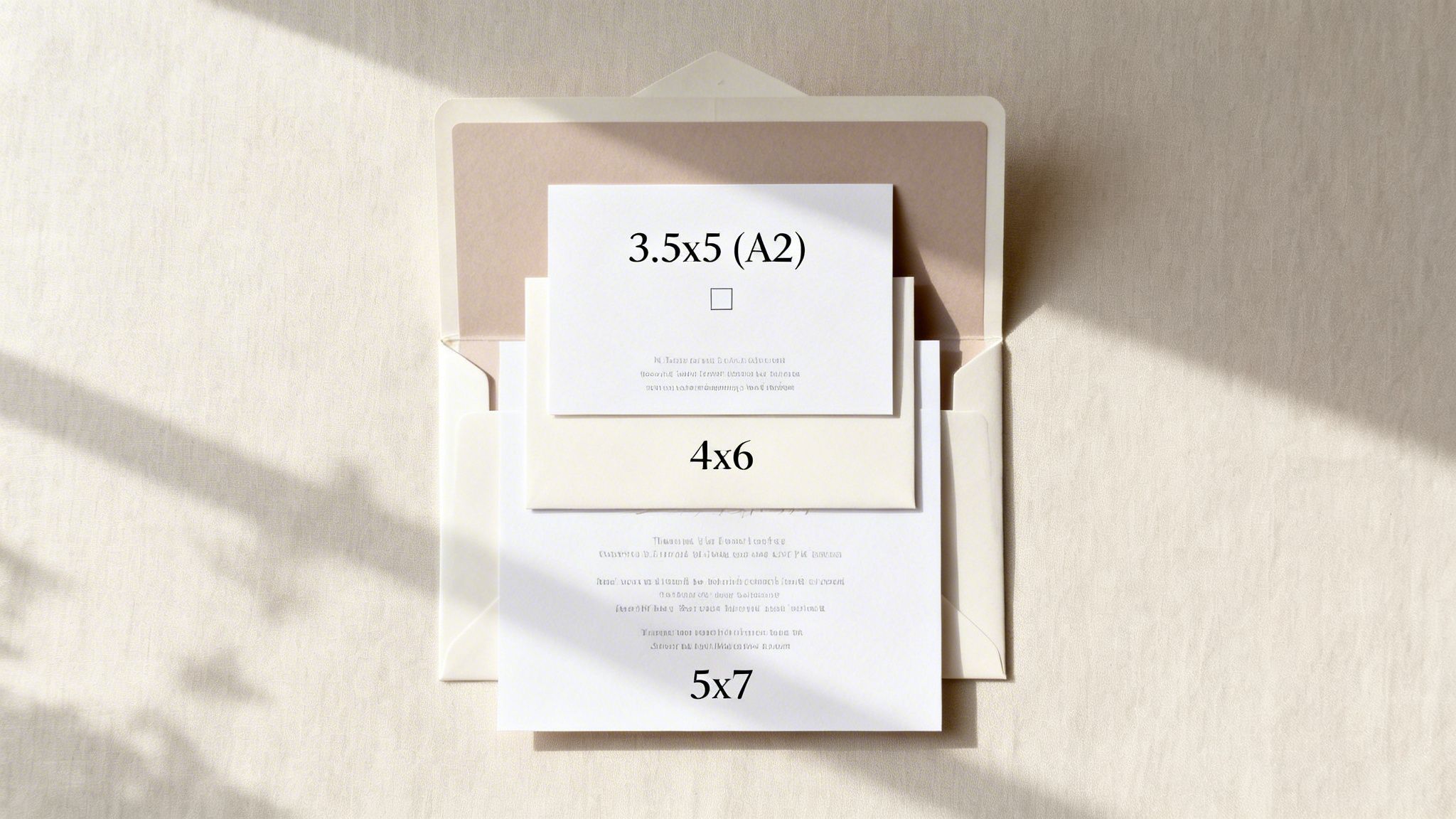
Nesting is the simple but incredibly effective technique of layering your enclosure cards from smallest to largest, with the main invitation sitting at the very back. This creates a clean, tiered effect that guides your guests through the information logically. As they lift each card, the next one is revealed, making the whole package feel intentional and well-planned.
To pull this off, each enclosure card has to be smaller than the main invitation. For a classic 5x7 inch (A7) invitation, your other cards need to be progressively smaller. This one principle is a cornerstone of great stationery design.
Before you get too far, consulting a comprehensive envelope guide is a smart move to ensure all your pieces will fit together perfectly. Now, let's break down the sizes for the most important supporting actors in your suite.
Complete Invitation Suite Sizing Chart
Here's a quick-reference table showing how every piece of your invitation suite fits together:
Suite Piece
Size (inches)
Size (mm)
Matching Envelope
Fits Inside A7?
Main Invitation
5 × 7
127 × 178
A7 (5.25 × 7.25)
—
Details / Accommodations Card
4 × 6
102 × 152
A4 (4.25 × 6.25)
Yes
Details Card (alt.)
4.25 × 5.5
108 × 140
A2 (4.375 × 5.75)
Yes
RSVP Card
3.5 × 5
89 × 127
A1 (3.63 × 5.13)
Yes
Reception Card
4.5 × 6.25
114 × 159
A6 (4.75 × 6.5)
Yes
Map / Directions Card
4 × 6
102 × 152
A4 (4.25 × 6.25)
Yes
Sizing Your RSVP Card The Right Way
The RSVP card is the workhorse of your invitation suite. Its only job is to get a response, so it needs to be clear, easy to fill out, and dead simple to return. The industry-standard invitation card size for an RSVP is 3.5x5 inches (89 × 127 mm), also known as A1 or 4-Bar size.
This compact format is the unsung hero of wedding stationery. It's used in an estimated 95% of wedding suites worldwide because it fits perfectly inside the main envelope without stealing the spotlight from the invitation itself. This size is also the USPS minimum for machine readability, so it can easily handle checkboxes for attendance, meal choices, and even song requests.
A key benefit of the 3.5x5 inch size is that it pairs with its own standard A1 envelope (3.63 × 5.13 inches / 92 × 130 mm), making it easy for guests to mail back. Remember to pre-stamp the RSVP envelope as a courtesy. it's a small touch that makes a huge difference in getting timely replies. We cover more of these essential etiquette tips in our guide to mailing out wedding invitations.
Once your RSVPs start coming back, you'll need a system to track every response. A wedding guest list app keeps RSVPs, meal choices, and plus-ones organized in one place — so your invitation suite and guest management work together seamlessly.
Sizing Details Cards and Other Inserts
After the RSVP card, your next most common insert will be a details or accommodations card. This is where you share all the extra information that would clutter up your main invitation, such as:
Reception venue address (if it's different from the ceremony)
Hotel block information and booking deadlines
A link to your wedding website
Details about a welcome party or next-day brunch
A popular and practical size for these cards is 4x6 inches (102 × 152 mm) or 4.25x5.5 inches (A2) (108 × 140 mm). These dimensions are ideal because they're noticeably smaller than a 5x7 invitation but still large enough to fit plenty of information without looking cramped. They nest perfectly between the main invitation and the smaller RSVP card, creating that beautiful, tiered effect we talked about.
Envelope match: A 4×6" details card pairs with an A4 envelope (4.25 × 6.25 inches / 108 × 159 mm), while the 4.25×5.5" version uses an A2 envelope (4.375 × 5.75 inches / 111 × 146 mm). Both fit neatly inside your main A7 outer envelope.
Pro Tip: Always stack your enclosure cards in order of size, from smallest to largest. That means the RSVP card goes on top, then the details card, with the main invitation at the very bottom. This ensures a logical and visually pleasing reveal for your guests.
From Screen to Paper: Making Your Designs Print-Ready
This is the moment of truth. All your hard work defining your style and ideas is about to become something real—something your guests can actually hold. But turning a digital file into a beautiful physical invitation involves a few technical details. Skipping this step can lead to heartbreaking (and expensive) mistakes, like your beautiful calligraphy getting sliced off or your perfect colors looking faded.
Think of it like framing a photograph. The photo is your design, all the text, colors, and images you've carefully chosen. The matting and frame are the technical print specs. They're what make sure the final product looks polished and professional, not like a home office printing job.
Decoding the Printer's Lingo
To avoid the most common pitfalls, you just need to get familiar with three key terms: the bleed, the trim line, and the safe zone. These three concepts work together to ensure your design looks perfect every time, even with the tiny mechanical variations that happen during the cutting process.
Bleed: This is the outer border of your design that extends beyond the final cut edge of the card. If your design has a background color or image that goes all the way to the edge, it absolutely must stretch into this bleed area. The industry standard bleed is 0.125 inches (or 1/8 inch) on every side.
Trim Line: This is the real deal, the actual line where the printer's machine will cut your card to its final size.
Safe Zone: This is your design's safety net. It's an inner margin where all your most critical information, names, dates, venue details, must live. By keeping everything important inside this zone, typically 0.25 inches from the trim line, you guarantee nothing gets accidentally chopped off.
Think of the bleed as a little insurance policy for your design. By extending your background past the cut line, you make sure there are no awkward white slivers along the edges of your finished invitations. It's a small detail that makes a huge difference.
Print-Ready Dimensions Quick Reference
When setting up your design file, use these exact dimensions including bleed:
Card Size
Final Size (inches)
With Bleed (inches)
With Bleed (pixels at 300 DPI)
A7 Invitation
5 × 7
5.25 × 7.25
1575 × 2175
A6 Invitation
4.5 × 6.25
4.75 × 6.5
1425 × 1950
A9 Invitation
5.5 × 8.5
5.75 × 8.75
1725 × 2625
Square (5×5)
5 × 5
5.25 × 5.25
1575 × 1575
Square (6×6)
6 × 6
6.25 × 6.25
1875 × 1875
RSVP Card
3.5 × 5
3.75 × 5.25
1125 × 1575
Details Card
4 × 6
4.25 × 6.25
1275 × 1875
The Right Tools and Templates for the Job
Here's the good news: you don't need a graphic design degree to create a gorgeous, print-ready file. Modern design tools have made this process incredibly accessible for everyone. Remember, your invitation suite is a whole collection of pieces working together, and having a simple way to create them is a game-changer. For a totally seamless experience, you might want to check out the ItsaYes AI wedding invitations generator.
Platforms like Canva are fantastic for couples wanting to take a hands-on approach. They offer a ton of pre-sized templates for every standard invitation size imaginable, from a classic A7 to a chic square card. When you start with a template, the bleed, trim, and safe zones are usually already set up for you, which takes a lot of the guesswork out of the equation.
If you're working with a professional designer or sending your own artwork to a printer, you'll likely run into specific file formats. Knowing how to open Adobe Illustrator files can be a handy skill for checking proofs or tweaking design elements yourself. When you're ready to print, always export your final design as a high-resolution PDF with the "crop marks" and "bleed" settings enabled. This gives your printer the exact blueprint they need to bring your vision to life, turning your organized plan into a stunning first impression for your guests.
Choosing the Right Size for Your Style and Budget
Alright, we've waded through all the technical specs, the A-sizes, the bleeds, the envelope pairings. Now it's time for the fun part: bringing it all together to make a decision. This is where your vision, your budget, and the experience you want to create for your guests all intersect.
Think of this as your final cheat sheet. The size you land on should feel like a natural extension of your wedding's personality. It's not just about picking a random dimension; it's about choosing the one that best communicates the feeling of your day from the moment your guests open their mailboxes.
Aligning Size with Your Wedding Aesthetic
Your invitation is your guests' very first glimpse into your wedding day. Whether you're planning a grand, black-tie ballroom affair or an intimate, charming backyard gathering, the size of your invitation helps set the stage. Let's look at how this plays out in the real world.
Timeless and Formal: For a classic, elegant event, the A7 (5x7 inches) is your trusted, can't-go-wrong choice. It's the little black dress of invitations. Want to dial up the formality? The larger A9 (5.5x8.5 inches) adds a sense of grandeur and luxury that perfectly signals a black-tie event.
Modern and Minimalist: If your style is clean, contemporary, and inspired by sharp graphic design, a square card (5x5 or 6x6 inches) makes a bold, confident statement. Its symmetrical lines are the perfect canvas for minimalist typography. Just remember to factor that extra postage cost into your budget from the start.
Intimate and Charming: For smaller weddings, elopements, or more casual celebrations, the A6 (4.5x6.25 inches) feels wonderfully personal and sweet. Its slightly smaller scale is disarming and less formal, perfectly matching the vibe of a relaxed, heartfelt gathering.
Budget-Conscious and Eco-Friendly Choices
Let's be real: your budget is a huge factor in this decision. While oversized, custom-shaped invitations on triple-thick cardstock are stunning, they carry a premium price tag for both printing and mailing. If keeping costs in check is a priority, sticking with a standard size is always your most economical move.
The A7 is a fantastic choice here, as it uses standard materials and mails with a single stamp.
For an even more budget-friendly approach, you could consider an all-in-one invitation. These clever designs often fold down to a standard A6 size and include a perforated, postcard-style RSVP, which means you don't have to pay for multiple cards and envelopes. It's a brilliant way to save money and reduce paper waste, making it a great eco-friendly option, too.
This is where a wedding planning system like ItsaYes truly shines. Instead of getting lost in scattered notes and spreadsheets, your personal AI assistant can analyze your defined style and budget from the start. It can then suggest the most suitable invitation card size options, keeping the process calm, organized, and perfectly aligned with your vision.
Need to figure out when to order and mail your invitations? Our wedding day timeline generator helps you map out every deadline — from ordering stationery to the final RSVP date.
Ultimately, the right choice is the one that feels authentic to you and your partner. By consciously connecting your wedding style and budget to your invitation size, you ensure that every single detail, starting with that very first impression, is a true reflection of your story. It transforms a simple decision into a powerful part of your planning journey.
2026 Wedding Invitation Postage Guide
Before you finalize your invitation size, it's worth understanding exactly what you'll pay to mail each one. Postage costs vary significantly based on size and shape, and they add up fast across your guest list.
Current USPS Rates (2026)
Invitation Type
Stamp Cost
Surcharge
Total Per Piece
Cost for 100 Guests
Cost for 150 Guests
Standard rectangular (A7, A6)
$0.73
—
$0.73
$73
$109.50
Square (5×5, 6×6)
$0.73
$0.46 (non-machinable)
$1.19
$119
$178.50
Oversized (A9, heavier suites)
$1.07
—
$1.07
$107
$160.50
RSVP return envelope
$0.73
—
$0.73
$73
$109.50
Important: These rates apply to invitations that weigh 1 oz or less. If your suite includes multiple inserts (RSVP + details card + map), weigh the assembled envelope — each additional ounce costs $0.28. A typical full suite with 3-4 cards often tips over 1 oz, so budget for $1.01 per standard invitation to be safe.
Money-saving tip: Before ordering your full print run, assemble one complete invitation suite and take it to the post office for weighing. This 5-minute trip can save you from $30-50 in postage due charges when your guests receive invitations with insufficient postage.
Digital Wedding Invitation Sizes: Dimensions in Pixels
More couples now send digital invitations alongside — or instead of — printed ones. Whether you're sharing a save-the-date on Instagram, emailing a formal invitation, or sending a quick reminder through WhatsApp, getting the right pixel dimensions ensures your design looks sharp on every screen.
Standard Digital Invitation Sizes
Format
Dimensions (px)
Aspect Ratio
Best For
Instagram Story / WhatsApp
1080 × 1920
9:16
Quick shares, save-the-dates, reminders
Instagram Post (Square)
1080 × 1080
1:1
Social announcements, engagement reveals
Email Invitation
1200 × 1800
2:3
Formal digital invitations via email
Facebook Event Cover
1200 × 628
~1.91:1
Event page header image
Digital RSVP Card
900 × 1200
3:4
Matching digital response card
Pinterest Pin
1000 × 1500
2:3
Sharing invitation inspiration
Printable PDF (A7 at 300 DPI)
1500 × 2100
5:7
Print-at-home invitations
Key Rules for Digital Invitations
Resolution matters: Always design at 300 DPI if there's any chance guests might print your digital invitation. For screen-only use, 150 DPI is sufficient and keeps file sizes manageable for email delivery.
Start big, scale down: If you're creating both printed and digital versions, always start with the print file (300 DPI, with bleed) and export a smaller screen version from that. Going the other direction — enlarging a screen-resolution file for print — results in blurry text and pixelated images.
File formats: Save digital invitations as PNG for maximum quality or JPEG at 85%+ quality for smaller file sizes. For email, keep the total file size under 1 MB to avoid spam filters and slow loading.
If you're designing your own digital wedding invitations, the ItsaYes AI invitation generator can create designs optimized for both print and digital formats — so you only need to design once.
Common Questions About Invitation Sizes
Once you start digging into the world of wedding stationery, the little details can feel overwhelming. You've got the basics down, but now the real questions start popping up. This is where we clear up those lingering concerns and give you the confidence to make the final call.
Think of this as your go-to guide for those last-minute, "wait, what about...?" moments that come up as you move from dreaming about your invitations to actually planning them.
What Is the Most Popular Invitation Card Size?
Hands down, the most popular and standard invitation card size is the 5x7 inch card, also known as the A7. There's a reason it's a classic. Its proportions feel elegant and offer plenty of room for a beautiful design without being too big or unwieldy.
Most importantly, it's a standard size for the USPS, so you won't get hit with surprise postage fees. That perfect blend of elegance and practicality makes it the default choice for most weddings, from black-tie affairs to casual backyard celebrations.
How Much Extra Does It Cost to Mail Square Invitations?
This is a huge one for anyone eyeing a modern, square design. Because of their shape, square invitations are considered 'non-machinable' by the USPS—meaning they can't go through the automated sorting equipment.
As a result, they need to be sorted by hand and come with a postage surcharge. As of 2026, the USPS non-machinable surcharge is $0.46 per piece, on top of the $0.73 Forever stamp. That means each square invitation costs $1.19 to mail — for 150 guests, that's $178.50 total vs $109.50 for standard rectangles, a difference of $69.
Can I Use a Custom Size for My Wedding Invitations?
Absolutely! You can definitely use a custom size to create a look that's completely unique to you. The catch? You need to be ready for higher costs for both printing and postage.
Going custom often means special paper cuts, made-to-order envelopes, and will almost certainly require your invitations to be hand-canceled at the post office. Before you fall in love with a one-of-a-kind size, have a frank conversation with your printer about their capabilities and get a postage quote directly from the post office. A little homework upfront can save you a lot of headaches later.
What Size Should My RSVP Card Be?
The most common and practical size for an RSVP card is 3.5x5 inches (89 × 127 mm). This corresponds to the A1 or 4-Bar size, and it's designed that way for a reason.
It fits perfectly inside your main A7 envelope along with the invitation without making things feel crowded. Plus, it has its own matching A1 envelope (3.63 × 5.13 inches), making it super simple for your guests to pop it in the mail and send it back to you.
What Size Should a Details Card Be?
The most popular size for a details or accommodations card is 4x6 inches (102 × 152 mm) or 4.25x5.5 inches (108 × 140 mm, A2 size). Both are large enough for venue directions, hotel blocks, and wedding website links, but small enough to nest inside your main A7 envelope.
What Size Envelope Do I Need for a 5x7 Invitation?
You need an A7 envelope, which measures 5.25 × 7.25 inches (133 × 184 mm). The extra quarter-inch on each side gives just enough clearance for the card to slide in and out smoothly. If your suite includes multiple inserts, make sure you assemble everything and test the fit — a stuffed A7 can get tight with 3+ cards.
ItsaYes is designed for couples who want clarity from the very start. Instead of juggling spreadsheets, Pinterest boards, and scattered notes, ItsaYes brings your vision, tasks, budget, and timeline into one calm, intuitive workspace. Start turning your inspiration into a fully structured plan today by visiting ItsaYes.