Your Guide To The Wedding Catering Cost Per Person
23 min
Your Guide To The Wedding Catering Cost Per Person
Author
The ItsaYes TeamAuthor
The average wedding catering cost per person hovers somewhere between $70 and $150, but let's be honest, that number is just the cover of the book, not the whole story. Think of it as the base price before you start adding the things that make your wedding yours, like a fantastic open bar or those late-night sliders everyone will be craving.
This number is the bedrock of what will likely be your biggest wedding expense. Getting your head around it is the first, most critical step to building a budget that doesn’t give you a panic attack.
A Realistic Look At Your Wedding Catering Costs
Trying to pin down your wedding budget can feel like putting together a puzzle in the dark, especially when it comes to catering. It’s almost always the largest slice of the pie, which makes that “per person” price tag the most important number to understand from day one. Nailing down a realistic estimate early on is the best way to prevent sticker shock later and feel confident in your decisions.
That initial estimate is more than just a number; it’s a powerful planning tool. Once you have a baseline, you can start playing with the variables to see how different choices, like swapping a plated dinner for food stations, impact the final bill. This is where a system like ItsaYes becomes your best friend. Instead of juggling spreadsheets and scattered notes, ItsaYes brings your vision, tasks, and budget into one calm, intuitive workspace. You can plug in those early numbers and instantly see how they fit into your complete wedding budget, turning a massive, intimidating expense into something you can actually manage.
The Three Pillars of Catering Costs
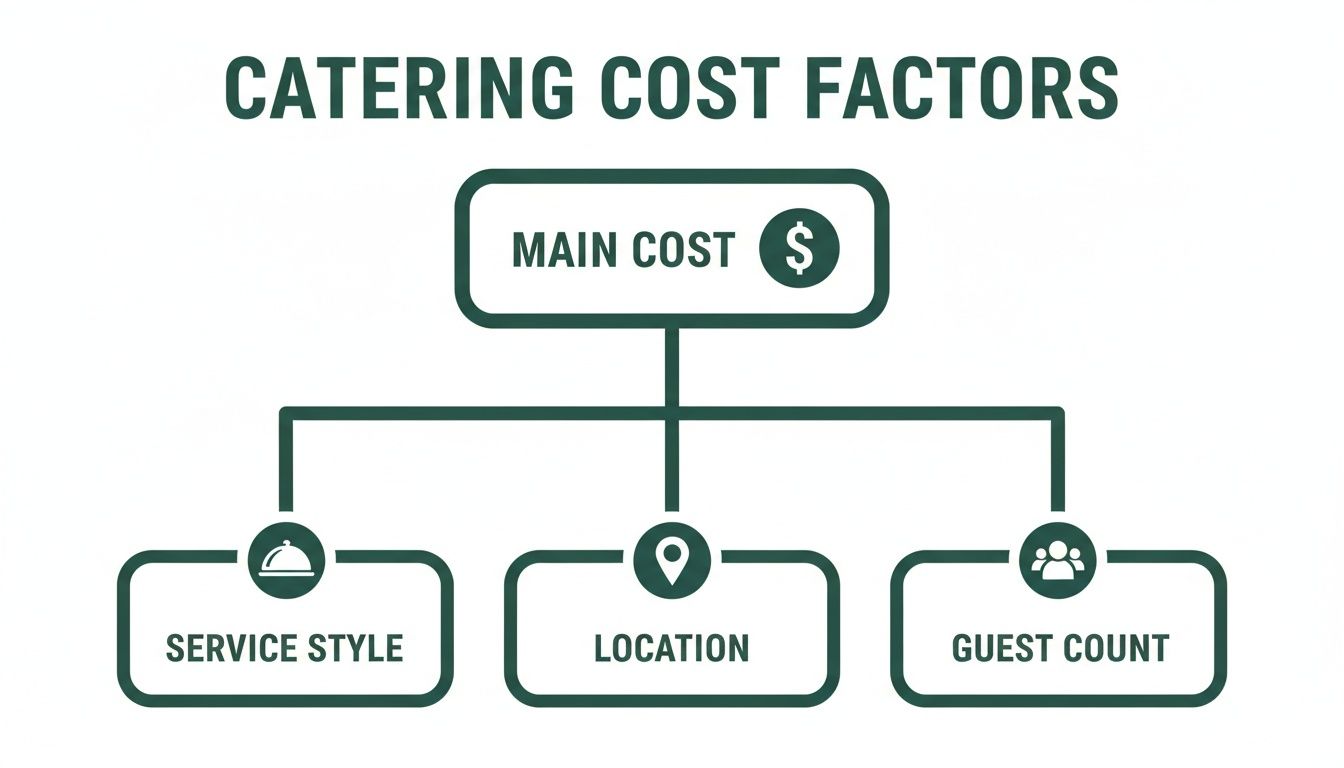
So, what actually goes into that per-person cost? It really boils down to three main things. Understanding them helps you see where you have wiggle room and where the costs are more or less set in stone.
Service Style: A formal, multi-course plated dinner is going to cost more than a casual buffet or a fun food truck setup. You're not just paying for food, but for the extra chefs, servers, and coordination required to pull it off flawlessly.
Guest Count: This one is a bit of a double-edged sword. More guests obviously means a higher total cost. But sometimes, a larger guest count can actually lower the per-person price because caterers get better deals when buying ingredients in bulk.
Location: Where you get married matters, a lot. Catering prices in a major city like New York or San Francisco will almost always be higher than in a more rural area. It’s simple supply and demand.
By figuring out your priorities early, you can spend your money where it counts most. If a gourmet, five-course meal is non-negotiable, you might balance that splurge by trimming your guest list. It’s all about these strategic trade-offs.
It’s a lot like deciding whether to hire a professional to run the show, a topic we dive into in our guide on wedding planner costs. Investing a little time upfront to understand your catering quote pays off big time.
Right now, the national average is sitting around $80 per person, but that figure is always shifting with food prices and what's trending. More and more couples are opting for unique formats like interactive food stations or cozy family-style meals, all of which come with their own price structures. Use these averages as your starting point, and you'll be on your way to building a clear, actionable plan from the get-go.
Breaking Down The Per Person Catering Price Tag
When you get that first catering proposal, the wedding catering cost per person looks like a simple, all-in number. But trust me, it’s a lot like the sticker price on a car, it’s just the starting point. That single figure is actually made up of a bunch of different costs that go way beyond the food itself.
Getting a handle on these individual line items is the key to comparing quotes fairly and avoiding any nasty surprises when the final bill arrives. Think of it as taking apart the price tag to see exactly where every dollar is going. This knowledge puts you in the driver's seat, letting you ask the right questions and feel confident about one of your biggest wedding expenses.
Beyond The Food: The Core Components
So, what’s really hiding inside that per-person price? While the menu is obviously the star of the show, a whole supporting cast of labor, rentals, and administrative costs plays a massive role in the final number.
Here’s a quick look at what’s usually bundled into that initial quote:
Food Costs: This is the most straightforward part. it’s the cost of ingredients and the chef’s time to prepare your canapés, main courses, and dessert. Your menu choices make a huge difference here; prime rib will cost a lot more than a beautifully prepared chicken dish.
Labor and Staffing: You’re not just paying for the meal, but for the army of skilled people who make it happen. This covers everyone from the chefs and kitchen assistants to the servers, bartenders, and the event captain who keeps the entire operation running smoothly on your wedding day.
Administrative Fees: This is one that often surprises couples. Typically landing between 18-25% of your food and beverage total, this fee covers the caterer's overhead, all the behind-the-scenes work like planning meetings, insurance, office costs, and the complex logistics of pulling off a flawless event.
This visual shows how the big-picture factors connect to your main cost.
As you can see, it's a balancing act. Your final price tag is a direct result of your guest count, your chosen service style, and even your venue's location.
The Often-Overlooked Extras
Now for the items that might not be in that initial per-person price but will definitely be on the final invoice. Knowing about these ahead of time helps you build a much more realistic budget. Inside the ItsaYes platform, you can actually create separate budget lines for each of these so nothing slips through the cracks.
The key to a stress-free catering budget isn't just knowing the per-person price; it's understanding the full cost of service. A lower base price might look appealing, but hidden fees can quickly erase those savings.
Keep an eye out for these line items on your proposal:
Rentals: If your venue is a "blank canvas," your caterer will likely coordinate renting everything from tables and chairs to linens, glassware, and flatware. These costs are almost always passed directly on to you.
Taxes: Don't forget Uncle Sam. State and local sales tax will be applied to your entire bill, food, labor, rentals, everything. This can add a surprisingly significant amount to the bottom line.
Gratuity: This one varies. Some caterers roll this into their administrative fee, but many will add a separate gratuity of 15-22% for the service staff. Always ask how the team is compensated so you know whether to budget for extra tips.
Your guest count is the single biggest lever you can pull to control these costs. Nailing down your guest list early on is one of the most powerful budgeting moves you can make. To get a head start, check out our complete guide to building your wedding guest list. By breaking down every potential cost, you turn an overwhelming number into a series of manageable, understandable parts.
How Your Wedding Vision Shapes The Catering Bill
The single biggest factor driving your final catering bill isn't the food itself, it's the experience you want to create. Your wedding vision, the whole look and feel you're dreaming of, dictates not just what you serve, but how you serve it. Every choice, from a formal, seated dinner to a laid-back food truck party, has a direct impact on the wedding catering cost per person.
Think of your catering style as the centerpiece of your reception's atmosphere. It sets the tone for the entire night. Does it encourage guests to sit and chat for hours? Mingle and move around? Or hit the dance floor as soon as possible? Getting this right means aligning your dining style with both your aesthetic vision and your budget. This is exactly where a planning tool like ItsaYes becomes your best friend, letting you play with different scenarios and see the real-time impact on your bottom line before you sign on any dotted lines.
Comparing Popular Service Styles
Every service style brings a unique vibe to the table, and each comes with a completely different price structure. Understanding these trade-offs is the key to making a smart decision that fits both your dream and your wallet. Let's break down the most popular options.
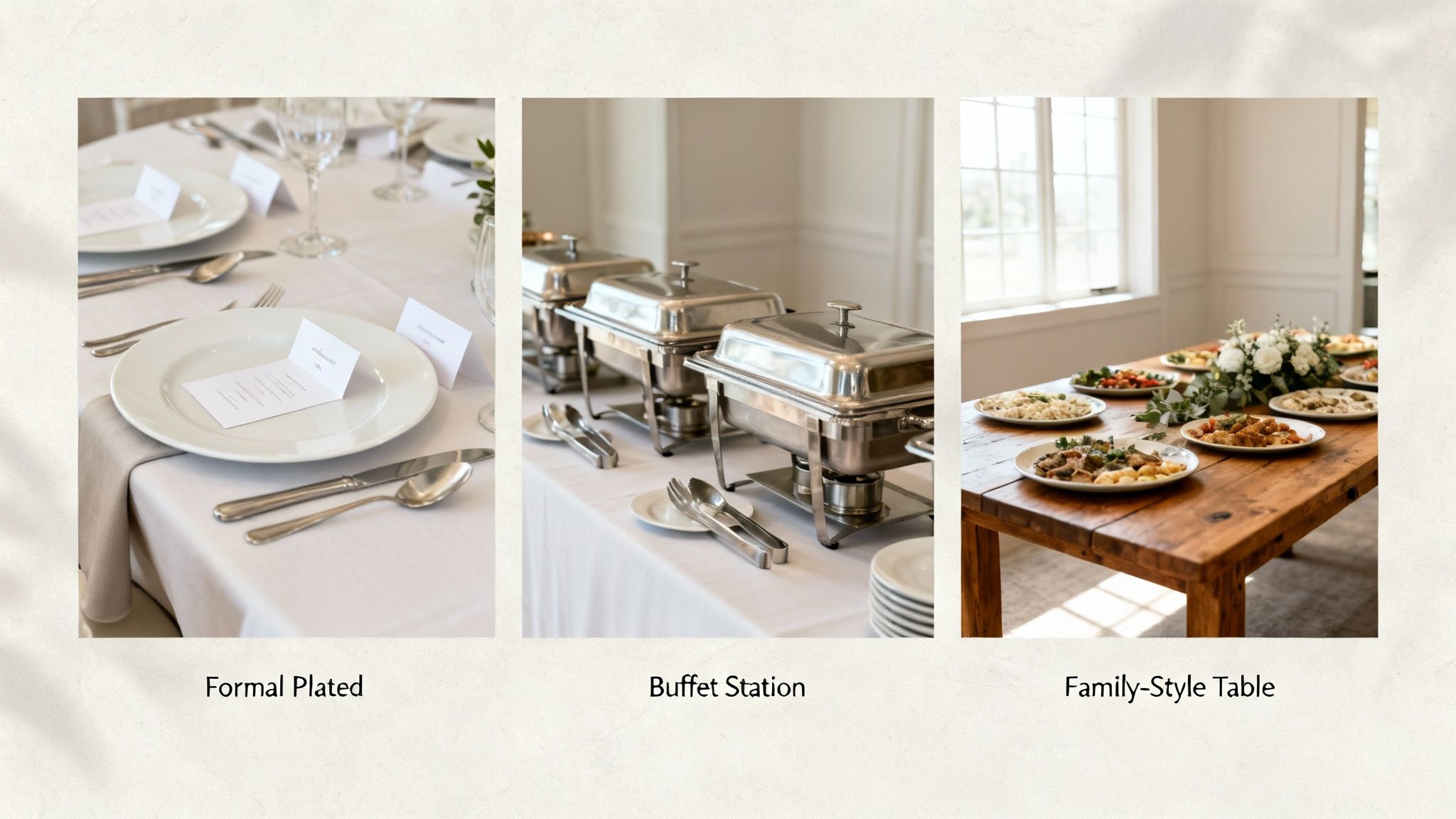
1. Plated Dinners
This is the classic, most formal option. Guests are served a pre-selected, multi-course meal right at their tables, just like in a high-end restaurant.
Atmosphere: Elegant, traditional, and structured. It creates a very polished and sophisticated experience.
Cost Impact: Plated dinners are often the most expensive style, mainly because they demand a high staff-to-guest ratio. You need a small army of servers to make sure everyone's food arrives hot and on time. On the flip side, you have perfect control over food portions, which cuts down on waste.
2. Buffet Style
A more relaxed approach where guests can help themselves from a long table showcasing a variety of dishes.
Atmosphere: Casual and interactive. It gets people out of their seats and encourages mingling. Guests love having control over what (and how much) they eat.
Cost Impact: Buffets can feel more budget-friendly at first glance, but there's a catch. To make sure the last person in line has the same great selection as the first, caterers have to prepare about 1.5 times the amount of food. This can sometimes drive the final food cost higher than a plated meal, though you will save on the number of servers needed.
Your guest count is the ultimate multiplier. Even a small $5 difference in the per-person price between a buffet and a plated dinner can add up to a $750 difference for a 150-person wedding.
3. Family-Style Service
This is the perfect middle ground. Large, beautiful platters of food are brought to each table, and guests pass them around and serve themselves.
Atmosphere: Incredibly warm, communal, and conversational. It feels just like a lively, celebratory family dinner party.
Cost Impact: The cost often lands in a similar range as a buffet. Why? Because, once again, the caterer needs to prepare extra food for those platters. Staffing needs fall somewhere between a buffet and a fully plated dinner.
4. Food Stations
A modern and interactive setup with multiple stations, each focused on a different type of food, think a taco bar, a pasta station, or a raw bar.
Atmosphere: Dynamic, fun, and super engaging. It encourages guests to move around the room and explore different culinary options.
Cost Impact: This is frequently the most expensive option of all. Each station needs its own dedicated chef and server, which drives labor costs way up. The food costs can also climb depending on how complex and high-end each station is.
How Your Guest Count Changes Everything
Your final guest count is the bedrock of your entire catering budget. It’s simple math: the more people you invite, the higher your total cost will be. A wedding with 150 guests could easily have a catering bill that's 50% higher than one for 100 guests, even if the per-person price stays the same.
That said, a larger guest count can sometimes give you a little leverage to get a better per-person price. Caterers can often get better deals when buying ingredients in bulk, and their operations become more efficient with a bigger team. This isn't a reason to invite more people to save money, your total will always go up. What it does mean is that you should lock in your headcount as early as possible to get the most accurate quotes. Getting that number nailed down is the first step to building a reliable, surprise-free budget inside your ItsaYes plan.
Where You Say "I Do" Shapes What You Pay
The price tag for your wedding catering isn’t just about the food on the plate; it’s also about the zip code where that plate is served. Just like a one-bedroom apartment costs wildly different amounts in Omaha versus Manhattan, catering prices shift dramatically based on your location. A lavish buffet in a small Midwestern town will almost certainly cost less than the exact same menu in a major coastal city.
Getting a handle on these geographic differences is one of the smartest first steps you can take. It grounds your budget in reality, preventing that awful sticker shock moment later on. This is where a planning tool like ItsaYes is so valuable, it lets you plug in your specific location to build a budget that reflects local pricing, not just a vague national average.
A Look at Costs Across the US
Think of catering prices like a rollercoaster, they have some serious peaks and valleys depending on where you are in the country. Big metro areas on the East and West Coasts almost always have higher labor costs, more expensive ingredients, and way more demand, all of which push the per-person price up.
On the flip side, you'll often find more budget-friendly options in the Midwest and South. This doesn't mean you're getting lower-quality food, but rather that the prices reflect the local economy. For example, average per-person rates in the U.S. can swing from $62 in parts of the Midwest all the way up to $123 in the pricier Mid-Atlantic. Understanding this from the start helps you build a much more accurate estimate for your wedding catering cost per person.
Your wedding's location is a cornerstone of your budget. Finalizing your venue's city and state early is one of the most powerful things you can do to get an accurate catering quote and build a budget you can actually trust.
How the US Compares Globally
If you're dreaming of a destination wedding, it’s helpful to zoom out and look at the global picture. The United States generally has one of the highest per-guest spending averages for weddings in the world. That’s a crucial piece of context when you're comparing potential locations.
For instance, while a wedding in the UK might sound expensive, the overall per-guest spending can sometimes be different from what you'd find in a major U.S. city. Projections show UK costs hovering around £272 per guest. To see how these costs compare worldwide, you can explore more insights on global wedding spending trends. Researching these international averages helps you make a clear-headed decision about whether a destination wedding is the right financial move for you.
Sample Catering Budgets By Wedding Size
To help you see how these numbers actually play out, let's walk through a few examples. These are just illustrations, of course, but they show how quickly the per-person cost multiplies with your guest count. The "Total Cost" column includes a common 20% addition for service fees and gratuity, which gives you a much more realistic final number to expect.
Guest Count
Avg. Per Person Cost
Estimated Base Food Cost
Estimated Total Cost (with 20% Fees)
50 (Intimate)
$120
$6,000
$7,200
100 (Average)
$95
$9,500
$11,400
150 (Large)
$85
$12,750
$15,300
You might notice that the average per-person cost can actually drop a little as the guest count goes up. That’s because caterers often gain efficiencies when serving bigger crowds (think buying ingredients in bulk).
This is exactly the kind of scenario you can model in ItsaYes. By easily adjusting your guest list and location, you can see the immediate impact on your overall wedding budget. It turns a complex financial puzzle into a simple, manageable plan you can feel confident about.
Smart Strategies To Reduce Your Catering Spend
Watching that catering estimate creep up can be a little nerve-wracking, but you have way more control over the final wedding catering cost per person than you might think. Cutting your spending isn't about making huge sacrifices or serving subpar food; it's about being strategic and making smart choices that line up with what you actually care about. A few thoughtful tweaks can add up to some serious savings, freeing up cash for other parts of your wedding that feel just as important.
Think of your catering budget like a puzzle. By moving a few key pieces, the menu, the guest list, or even the date, you can create a beautiful picture that fits perfectly inside your financial frame. This is where a good planning tool becomes your best friend. As you make these calls, you can track every little adjustment in a tool like ItsaYes, giving you a real-time view of your savings and keeping you firmly in the driver's seat.
Make Strategic Menu Choices
The food you choose to serve is a direct lever you can pull to adjust your budget. Sure, a surf-and-turf dinner is a classic indulgence, but opting for elegant yet more affordable proteins can dramatically lower your per-person cost, without anyone feeling like they’re missing out.
Beautifully prepared chicken, pork, or even a stunning pasta dish are often just as delicious and satisfying as prime rib or lobster, but they come in at a fraction of the cost. The same logic applies to your cocktail hour. Instead of offering five or six different complicated canapés, pick three absolutely amazing ones and make sure there are plenty to go around. Quality over quantity always wins.
Re-evaluate Your Guest List
This is it. The single most powerful way to slash your catering bill. Every single person you add to your guest list multiplies every single per-person expense, not just the food, but the drinks, the chairs, the plates, and even the size of your cake.
Trimming your guest list, even by just 10 or 15 people, can literally save you thousands of dollars. It’s always a tough conversation, but focusing on inviting only your absolute nearest and dearest not only saves money but often results in a more intimate and meaningful celebration. This is a perfect example of a high-impact decision that a smart wedding budget app can help you visualize in seconds.
Be Flexible with Your Timing
The day of the week and the time of year you get married can have a surprising impact on your catering bill. Saturdays during peak season (think late spring through early fall) are in the highest demand, and vendors price accordingly.
Choosing an off-season date or a non-Saturday wedding is a savvy move. Caterers are often more flexible with pricing on a Friday, Sunday, or during a less popular month like January or November, potentially offering discounts of 10-20%.
This flexibility can also apply to the time of day. A brunch or luncheon reception is almost always more affordable than a formal evening dinner. You’ll save on both the food and the bar tab, as guests naturally tend to drink less during the daytime.
Rethink Your Bar Service
Alcohol can easily become one of the biggest line items on your catering invoice. While a full open bar is a wonderfully generous gesture, there are several creative ways to manage those costs without looking stingy.
Consider these alternatives to a full open bar:
Offer Beer and Wine Only: This is a classic, crowd-pleasing choice that satisfies the vast majority of guests while cutting out the high cost of premium liquors.
Create Signature Cocktails: Instead of a full bar, feature two or three signature cocktails (maybe one for each of you!) alongside beer and wine. It adds a fun, personal touch while keeping liquor costs contained.
Limit the Open Bar Time: Run the open bar through cocktail hour and dinner, then switch to a cash bar for the last hour or two of dancing. This ensures everyone gets to celebrate on your dime without the bill running wild all night.
By putting these strategies into play, you’re not cutting corners, you’re planning smarter. Each decision empowers you to put your money where it will bring you the most joy, ensuring your wedding day is a perfect reflection of your vision and your budget.
Essential Questions To Ask Potential Caterers
Hiring a caterer is so much more than just picking a menu. You’re choosing a partner who will execute a huge, and hugely important, part of your wedding day vision. To make sure you find the perfect fit, you have to walk into those conversations prepared.
Think of it less as an interrogation and more as a collaborative discovery session. A solid list of questions helps you compare different proposals fairly, sniff out any hidden costs, and feel genuinely confident that your chosen pro can deliver a flawless experience for you and your guests.
This is your framework for getting the clarity you need. Inside your ItsaYes planner, you can create a dedicated note for each potential caterer, storing their quotes and answers side-by-side. It makes reviewing your options and making a decision that feels right for both your vision and your budget incredibly simple.
Questions About Cost and Contracts
First things first: let's talk money. Understanding every single line item on a proposal is absolutely crucial for building a realistic budget and sidestepping those dreaded last-minute surprises. Get specific about what's included in that wedding catering cost per person and what might be billed separately.
Can you provide a detailed, itemized quote breaking everything down?
What administrative fees, service charges, or gratuity are added to the final bill? (And are they mandatory?)
Is sales tax included in the per-person price, or is it tacked on at the end?
What’s your payment schedule, and what is the required deposit to lock in our date?
What is your cancellation policy?
Questions About Food and Service
Next, you'll want to dive into the good stuff, the food itself and how it will all be served. These questions are all about understanding the guest experience and getting a feel for the caterer’s operational style.
Do you specialize in certain types of cuisine or service styles (e.g., plated, buffet, family-style)?
Can we schedule a tasting? Is there a cost, and if so, is it applied to our bill if we book you?
How do you handle dietary restrictions and allergies? (Ask for specifics on cross-contamination protocols if this is a major concern.)
For our chosen service style, what is your staff-to-guest ratio?
What is your policy on leftover food? Can we take it home, or is it donated?
The wedding catering cost per person is a crucial starting point, but the details make all the difference. Knowing a caterer's policy on everything from leftover food to staffing ensures your expectations align perfectly with what they will deliver on your wedding day.
Questions About Logistics and Experience
Finally, you need to know if they can actually handle the unique demands of your wedding day and your specific venue. These questions are designed to confirm their professionalism, experience, and logistical prowess.
Have you worked at our venue before? (If not, do you plan to do a site visit?)
Are you licensed and insured? Can you provide a certificate of insurance for our venue?
Can you provide references from a few recent couples you've worked with?
Who will be our main point of contact on the actual wedding day?
Average wedding catering costs in the U.S. typically fall between $70 and $135 per person, but the final bill depends heavily on the answers to these questions. For a deeper dive, you can learn more about how service style impacts catering costs on bitesbybraxtons.com. Asking the right questions is the single best way to ensure the price you’re quoted reflects the high-quality, stress-free experience you deserve.
People Also Ask
Alright, let's get into the nitty-gritty. Even after you’ve got a handle on the line items and averages, some specific questions always seem to pop up. Think of this as the lightning round, quick, direct answers to the most common queries that can trip couples up.
We're here to clear up any lingering confusion so you can finalize that catering budget with total confidence.
Is $5000 enough for a wedding?
Honestly? It's a tight squeeze for a traditional 100-person affair, but it is absolutely doable if you get creative and strategic. A $5,000 budget is perfect for more intimate, modern celebrations. We're talking a gorgeous micro-wedding with your absolute favorite people, a chic city hall ceremony followed by dinner at your favorite restaurant, or a relaxed, joy-filled backyard party.
Catering will be your biggest puzzle to solve. This is where you might look at amazing food trucks, a sophisticated "cake and punch" style reception, or even self-catering if your venue gives the green light. Using a tool like ItsaYes is a lifesaver here, letting you track every single dollar so there are no surprises.
How much does catering typically cost in Singapore?
Planning a wedding in Singapore? The pricing structure is a bit different. Forget the per-person model for a moment; the wedding catering cost is almost always calculated per table, which usually seats 10 guests.
For a hotel banquet, you can expect to see prices anywhere from S$1,000 to over S$2,500 per table. That breaks down to a per-person cost of roughly S$100 to S$250+, depending on how prestigious the venue is and how lavish the menu gets. Always ask what the package includes, as many will bundle in drinks, basic decor, and other services.
How much does it cost to feed 30 people at a wedding?
Catering for an intimate wedding of 30 guests is fantastic because it opens up so many cool options. If we use a mid-range average of $95 per person, your starting food budget would be around $2,850. Once you add the standard 20-25% for service fees and taxes, your all-in total will likely land between $3,400 and $3,600.
But with a smaller group, you can think outside the box. You could book a private dining room at a high-end restaurant, which often simplifies the costs dramatically. Or you could hire a private chef for a truly unforgettable, personalized experience. Just a heads-up: the per-person price can sometimes be a little higher for smaller events because caterers don't get the same discounts on bulk food orders.
What is a realistic budget for a 100 person wedding?
For a 100-person wedding in the U.S., a realistic starting point for your total budget is generally in the $30,000 to $40,000 range. Be prepared for catering to be the biggest slice of that pie, typically eating up 40-50% of your total spend.
Let's do the math together. If your wedding catering cost per person is a solid $100, your base food and drink cost is $10,000. Tack on an average of 22% for those pesky service fees and taxes, and you're at $12,200. That number is your catering reality check, leaving the rest of the budget for your venue, photographer, music, and every other detail that makes the day yours.
Feeling your head spin with all the numbers and what-ifs? That's completely normal, and it's exactly why we built ItsaYes. Instead of juggling spreadsheets, frantic notes, and a dozen different vendor quotes, you can pull your entire wedding plan, budget, tasks, and vision, into one calm, organized space. Stop guessing and start planning with confidence today at https://itsayes.io.