A Modern Couple's Guide to Addressing Invitations Etiquette
17 min
A Modern Couple's Guide to Addressing Invitations Etiquette
Author
The ItsaYes TeamAuthor
What is proper etiquette for addressing invitations? It boils down to two things: clarity and respect. For a formal wedding, this means using guests' full names and proper titles, spelling out every part of the address, and following a few traditional rules for whose name goes first.
This isn't about being stuffy or old-fashioned. It’s about making sure every guest feels personally welcomed and gets a clear sense of your wedding's tone right from the moment that beautiful envelope lands in their mailbox.
Your Invitation Is Your First Impression
Long before the first toast is made, your wedding invitation arrives. It’s the very first tangible piece of your celebration your guests will hold, and it does much more than just share the date and time. It sets the entire mood for your wedding day. Think of it as the prologue to your story.
Getting the addressing etiquette right is a small detail that shows immense thoughtfulness. While modern weddings allow for more flexibility, understanding the classic rules helps you make intentional choices that reflect you as a couple. This is your chance to communicate the formality of the day and make every single guest feel important.
For couples using a planning system like ItsaYes, this is a perfect example of turning your big-picture vision into a manageable task. ItsaYes is an AI-powered wedding planning system designed for couples who want clarity from the very start. You begin by defining your style, and the platform helps you turn that inspiration into a clear plan, breaking the next 6 to 12 months into simple, manageable steps. Instead of juggling spreadsheets and scattered notes, you can tackle tasks like guest lists systematically, ensuring each invitation is a flawless reflection of your celebration.
The Core Principles of Addressing Invitations
Before we get into specific scenarios (like divorced parents or unmarried couples), let's cover the foundational rules. These are the reliable starting points that apply to most formal invitations.
Use Full, Formal Names: On the outer envelope, always use your guests' full names. This isn't the place for nicknamesm it's about showing respect and setting a sense of occasion.
Embrace Titles: Honorifics like 'Mr.', 'Mrs.', 'Ms.', and 'Dr.' are standard for a reason. They're a traditional sign of respect and are central to formal etiquette.
Spell Everything Out: Resist the muscle memory to abbreviate. Write out 'Street,' 'Apartment,' and 'Boulevard.' State names like 'California' and 'New York' should also be written in full.
The goal here isn't just to follow dusty old rules. It's about providing absolute clarity on exactly who is invited while honoring your guests with a gesture of formality and care.
A Quick Glance at Common Scenarios
Let’s be honest, navigating the nuances for married couples, families with kids, and single guests can feel like a pop quiz you didn't study for. To make it easier, I've put together a quick-reference table with clear examples for the most common situations you'll face. It breaks down the formal etiquette for both your outer and inner envelopes, turning a confusing task into a simple copy-and-paste job.
Quick Guide to Common Invitation Addressing Scenarios
Guest Scenario
Formal Outer Envelope Wording
Informal Inner Envelope Wording
Married Couple, Same Last Name
Mr. and Mrs. Johnathan Smith
Mr. and Mrs. Smith
Married Couple, Different Last Names
Ms. Jane Doe and Mr. John Smith
Ms. Doe and Mr. Smith
Unmarried Couple Living Together
Mr. David Chen and Ms. Emily Garcia
Mr. Chen and Ms. Garcia
Single Guest
Ms. Olivia Rodriguez
Ms. Rodriguez
Family with Children
The Miller Family
Mr. and Mrs. Miller, James and Lily
This table should help you breeze through the bulk of your guest list with confidence. For trickier situations involving doctors, judges, or complex family dynamics, we'll dive into those details next.
Navigating Names and Titles: Who Goes First?
Figuring out whose name to write first on an invitation is one of those tiny details that can surprisingly trip people up. It might feel insignificant in the grand scheme of wedding planning, but the order of names is a subtle nod to tradition and respect that many of your older guests, in particular, will notice and appreciate.
The most traditional route for a married heterosexual couple is putting the man's name first, as in "Mr. and Mrs. John Smith." This is a long-standing convention, and honestly, it's still widely used and considered perfectly correct for a formal wedding. No one will bat an eye.
Of course, plenty of modern couples are choosing different ways to address their envelopes that feel more aligned with their own values. The real key isn't about following one specific rule, but about being consistent and thoughtful across all your invitations.
Handling Married and Unmarried Couples
For married couples, you’ve got a few options that feel both respectful and current. If a couple shares a last name but you want to acknowledge both people individually, you can write out both of their full names.
Modern Traditional: "Mr. John and Mrs. Jane Smith"
Fully Inclusive: "Mrs. Jane Smith and Mr. John Smith"
What about a married couple who uses different last names? The best practice here is to list the person you're closer to first. If you’re equally good friends with both, listing them alphabetically is a great tie-breaker.
For example: Let's say your cousin Jane kept her maiden name when she married John Smith. You'd address the invitation to "Ms. Jane Doe and Mr. John Smith." This simple choice shows you respect her individual identity.
The same logic applies to unmarried couples living together. List both names on the same line, connected by "and." Again, the order can be based on who you know better or just done alphabetically. This principle of respect and thoughtfulness extends to same-sex couples, too, whether they're married or notm just list both full names.
Addressing Guests with Special Titles
This is where things get interesting. Professional or military titles add another layer to the etiquette, and here’s the rule of thumb: a distinguished title always takes precedence.
A guest with a title like "Doctor," "Judge," or a military rank like "Captain" should always be listed first, no matter their gender. It’s a sign of respect for their professional achievements.
One Doctor: "Doctor Jane Smith and Mr. John Smith"
Two Doctors (Same Last Name): "The Doctors Smith" or "Drs. Jane and John Smith"
Two Doctors (Different Last Names): "Dr. Jane Doe and Dr. John Smith"
These details really do matter. In an era of casual digital everything, a physical invitation sets a different kind of tone.
Anatomy of an Envelope: Inner vs. Outer and Everything in Between
A beautifully addressed invitation is more than just ink on paper; it’s a system. The traditional two-envelope approach, an inner and an outer, might feel a bit old-fashioned in a digital world, but there's a very practical reason it's stuck around for so long. It’s the single best way to provide ultimate clarity on exactly who is invited.
The outer envelope is the workhorse. It’s the formal, public-facing piece that has to survive the journey through the mail. This is where you’ll write the full mailing address with all the proper titles, spelling everything out. No shortcuts here.
The inner envelope, on the other hand, is like a personal note. It’s where you can be a little warmer and, most importantly, spell out precisely which members of a household are included. This little piece of paper prevents a world of awkward questions down the line.
The Formal Outer Envelope
Think of the outer envelope as the most buttoned-up part of your invitation suite. Its job is to arrive looking pristine and respectful, signaling that this isn't just another piece of mail. To get that across, traditional etiquette follows a few key rules.
Full Formal Names and Titles: This is the place for "Mr. and Mrs. Jonathan Miller," not "Jon & Jess." Always use full, formal names.
No Abbreviations: This is a crucial detail that adds a touch of elegance. Spell everything out completely. Write "Street," "Avenue," "Apartment," and the full state name, like "California," instead of "CA."
The Return Address: Traditionally, this goes on the back flap of the envelope, but the top-left corner of the front is also perfectly acceptable. This address should be for whoever is officially hosting and managing the RSVPs.
This methodical approach aligns perfectly with the ItsaYes philosophy of breaking down complex wedding tasks into calm, manageable steps. Your personal AI assistant is available 24/7 to suggest priorities, organize tasks, and keep everything moving forward without overwhelm. By following these simple rules, you ensure your invitations convey elegance from the moment they land in the mailbox.
The Personal Inner Envelope
This is where you get to be more specific and a little less formal. The inner envelope’s primary job is to eliminate any and all ambiguity about who, exactly, is invited. It’s a lifesaver for addressing families and guests with plus-ones.
For example, an inner envelope for a family might read, "Mr. and Mrs. Miller, James, and Lily." This gently and clearly lets them know their children are welcome. If the kids' names aren't on that inner envelope? The invitation is for the parents only. It’s a subtle but incredibly effective way to communicate your guest count without having to awkwardly write "no kids" on the invitation itself.
The two-envelope system is a graceful way to manage your guest list. The outer envelope speaks formally to the household, while the inner envelope speaks personally to the individuals you’re inviting.
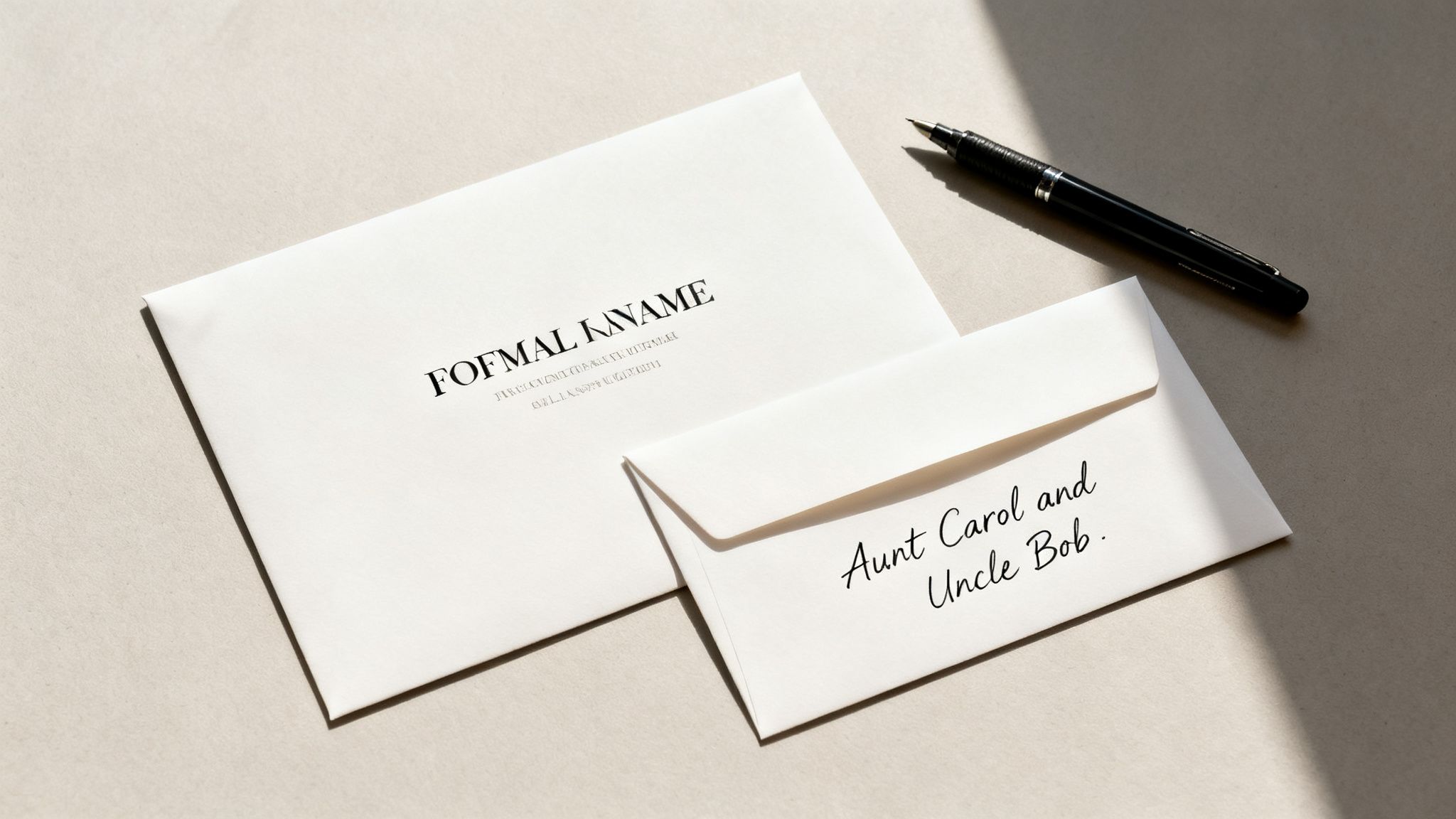
You can also relax the naming conventions here. Something warm like "Aunt Carol and Uncle Bob" feels personal and just right. If you're looking to design stationery that reflects your unique style, you can explore customizable options in tools like the ItsaYes Wedding Design Studio to make sure every last detail feels like you.
Modern Etiquette for Every Guest List
Your guest list is a beautiful mosaic of all the people you love. That also means it’s probably filled with diverse family structures and unique relationships. Figuring out how to address invitations for every modern scenario, from divorced parents to unmarried couples and families with kids, just requires a little thoughtfulness.
The whole point is to make every single person feel seen, respected, and warmly welcomed from the moment they get your invitation.
This is where the small details really shine. For instance, when inviting a family, the outer envelope can be addressed to "The Miller Family," but the inner envelope should clarify exactly who is invited by name: "Mr. and Mrs. Miller, James, and Lily." This one simple step prevents any awkward guesswork about whether children are on the list.
Handling Divorced, Widowed, and Remarried Relatives
Addressing invitations to relatives with complex family dynamics just calls for a bit of sensitivity. The key is to acknowledge each person as an individual.
Divorced Parents (Not Remarried): Each parent gets their own separate invitation, even if they happen to live at the same address. Address them individually based on their preferred title (e.g., "Mrs. Jane Smith" or "Ms. Jane Smith").
Divorced and Remarried Parent: Address the invitation to the parent and their new spouse just like any other married couple (e.g., "Mr. John Smith and Mrs. Jane Smith"). It’s a thoughtful touch to list your parent first.
Widowed Relative: Address the invitation to the individual using their preferred title. Traditionally, a widow might be addressed as "Mrs. John Smith," but many women today prefer using their own first name, like "Mrs. Jane Smith." If you’re unsure, it’s always best to ask.
When in doubt, a quick, discreet call or text to ask someone’s preference is the most respectful thing you can do. It shows you care about getting it right, which is the whole heart of good etiquette.
Inviting Unmarried Couples and Plus-Ones
For unmarried couples living together, the etiquette is pretty straightforward these days. Address the invitation to both people on the same line, connected by "and." You can either list the person you're closer to first or simply go in alphabetical order. No one’s keeping score.
Now, the "and Guest" question. It’s best to only use this phrasing if you're giving your guest a true, open invitation to bring anyone they'd like. If you know they’re in a serious relationship, you should always make the effort to find out their partner's full name and include it on the invitation. It’s just a nicer, more personal touch.
For more tips on wrangling all these details, check out our full guide on how to build your wedding guest list.
It’s also fascinating how much wedding sizes can vary, which really drives home why this all matters. The 2025 Global Wedding Report from The Knot Worldwide highlights this perfectly: weddings in India average a whopping 330 guests, while celebrations in the UK are much more intimate. With Gen Z now hosting larger events (131 guests on average), precise addressing is more than just polite, it's essential for getting an accurate headcount.
This data shows why clear etiquette isn't just about old-fashioned rules; it’s a genuinely practical tool for staying organized. You can learn more from the full 2025 wedding report.
Digital Invitations and RSVP Etiquette in a Modern World
Let's be honest, while a beautiful paper invitation has a certain magic, digital tools are a huge part of modern wedding planning. For the tech-savvy couple, the real win is blending digital convenience with classic etiquette to create a seamless experience for you and your guests. The goal here is to make your e-invites feel just as personal and intentional as their paper counterparts.
This means a generic email blast is a hard no. All the timeless etiquette still applies here: always address digital communications to your guests by their full names. Taking a moment to personalize the subject line and greeting makes a world of difference. It’s what turns a mass email into a special announcement they’re excited to open.
Mastering the Modern RSVP
Whether you're collecting replies through a wedding website or a traditional mail-in card, the RSVP process boils down to two things: clarity and convenience. Your guests need to know exactly what you’re asking for, and you need to make it incredibly easy for them to give it to you.
Online RSVPs: If you're going digital, link directly to the RSVP page on your wedding website. Make sure the form is dead simple to navigate, with obvious fields for each guest's name, their attendance status (yes or no!), and any meal choices.
Paper RSVP Cards: For the traditional route, always, and I mean always, include a pre-addressed and stamped return envelope. This is one of those small, thoughtful gestures that makes a huge impact on how quickly you get your responses back.
Deciding who gets an invite in the first place is the real first step. This flowchart can help you map out those sometimes tricky decisions.
Think of this as your cheat sheet for navigating the whole plus-one and family invitation maze, ensuring no one important gets accidentally overlooked.
The Hybrid Approach: A Modern Solution
Here’s the good news: you don't have to choose between paper and digital. In fact, a hybrid approach often works best, letting you cater to all your guests. You can send out those gorgeous, tangible invitations while directing everyone to your wedding website for RSVPs and extra details. You get the best of both worlds: the elegance of print and the organizational power of a digital backend.
This blended strategy is becoming more and more common. As WeddingWire's 2022 forecast pointed out, etiquette is definitely evolving, with a huge uptick in digital communications. This makes perfect sense when you see that 60% of people in India use WhatsApp for daily chats, yet over 75% of couples in the US and Canada still mail physical invites.
For modern couples, personalization is everything. It’s about using smart tools to manage these nuances, like sending e-invites to your college friends and beautiful paper cards to older relatives, all while keeping the process calm and organized. You can dive deeper into these invitation trend insights on WeddingWire.
A Key Takeaway: The medium might change, but the core principle never does. Make your guests feel personally invited and make it dead simple for them to respond.
To keep everything streamlined, an integrated tool like the ItsaYes wedding guest list app can be a lifesaver. It lets you track both digital and paper RSVPs in one central place, completely removing the stress of juggling multiple spreadsheets and follow-up lists.
Even with the best plan in hand, a few tricky etiquette questions always surface when it's time to actually address the envelopes. Here are the most common points of confusion couples run into, broken down with quick, clear answers.
Does the man or woman's name go first on invitations for guests?
Traditionally, for a married heterosexual couple, the man’s name came first (e.g., "Mr. and Mrs. John Smith"). For a very formal wedding, this is still considered correct.
However, modern etiquette is much more flexible. Many couples now opt to list the person they know better first. If you're friends with both equally, listing them alphabetically is a great, neutral option. The same logic applies to same-sex couples. The most important thing is to be consistent across your entire guest list.
How should an address be written on an invitation?
For a formal wedding invitation, the key is to write everything out in full to signal the elegance of your event. No abbreviations.
Here is the proper format:
Line 1: Guest's full name(s) with titles (e.g., Mr. and Mrs. Jonathan Miller)
Line 2: Street address, with words like "Street," "Avenue," or "Boulevard" fully spelled out.
Line 3: Apartment or unit number, also spelled out (e.g., "Apartment Four B").
Line 4: City, the full state name (so, "California," not "CA"), and the zip code.
This classic format not only looks beautiful but also ensures clarity for the postal service.
A Quick Tip: Before you stamp a single envelope, take one fully assembled invitation suite to the post office and have it weighed. Wedding invitations are notorious for needing extra postage, and this one simple step can save you from the nightmare of having dozens returned to sender.
Do I have to put Mr. and Mrs. on wedding invitations?
For a very casual, laid-back wedding, you can probably skip titles. But for anything leaning formal, using "Mr.," "Mrs.," "Ms.," or "Dr." is a hallmark of proper invitation etiquette. These honorifics are a traditional signal of respect and help set the tone for your wedding day.
If you're ever unsure about a woman's preference or marital status, "Ms." is always the perfect, respectful choice.
For a modern, slightly less formal feel, using full names without titles (like "Jane Smith and John Miller") is also acceptable. Ultimately, it comes down to choosing the approach that best reflects your wedding's style and sticking with it.
Nailing your invitation etiquette is just one small piece of the puzzle. ItsaYes is built for newly engaged couples who want to enjoy the process, stay organized, and feel confident, from first inspiration to a fully structured plan. When you're ready to bring your entire vision into one calm, intuitive workspace, plan smarter at https://itsayes.io.