A Modern Couple's Guide to Digital Wedding Invitations
21 min
A Modern Couple's Guide to Digital Wedding Invitations
Author
The ItsaYes TeamAuthor
Digital wedding invitations are more than just an eco-friendly trend. For modern couples, they’re a smart, efficient way to kick off the wedding experience, offering instant delivery, simple RSVP tracking, and serious cost savings compared to traditional paper.
Why Modern Couples Are Choosing Digital Invitations
Let's be honest, wedding planning can feel like a marathon of decisions, and invitations are one of the first big hurdles. For many couples today, going digital isn't about breaking tradition. It’s about embracing practical solutions that actually fit their lives.
It's about gaining back control right from the start.
Instead of juggling spreadsheets, Pinterest boards, and scattered notes, couples are turning to digital platforms to make communication genuinely simple. This isn’t just a passing trend—it reflects a deep desire for a wedding planning experience that feels calm, organized, and intuitive.
Gaining Clarity and Control
The biggest win with digital wedding invitations is the immediate clarity you get. The moment you hit "send," you can see who has opened your invitation and who has responded, all in real time. For couples needing to give vendors an accurate headcount, this instant feedback loop is a total game-changer.
Platforms like ItsaYes integrate this process directly into your larger planning workspace. Your guest list and RSVP status aren't stuck in a separate app; they're woven into your overall timeline, tasks, and budget. This creates a single source of truth, finally killing the chaos of scattered notes and conflicting spreadsheets.
Here’s what that control actually looks like:
Instant Updates: Know the second a guest opens your invitation or submits their RSVP.
Centralized Information: Manage meal preferences, dietary needs, and plus-ones all in one organized dashboard.
Automated Reminders: Gently nudge guests who haven't responded without having to send a dozen awkward individual texts.
To put it in perspective, here's a quick side-by-side look.
Traditional vs Digital Invitations At a Glance
The choice between paper and pixels often comes down to a few key factors. This table breaks down the biggest differences in cost, speed, and environmental impact.
Minimal to zero cost for sending; premium designs are affordable.
Timeline
Weeks to months for design, printing, and mailing.
Instant delivery; design can be done in hours or days.
RSVP Tracking
Manual process (mail-in cards, spreadsheets).
Automated, real-time tracking in a central dashboard.
Updates
Difficult and expensive to communicate changes.
Easy to send mass updates or reminders instantly.
Environmental Impact
High (paper usage, transportation).
Very low; a completely paperless option.
While paper has its charm, the practical advantages of digital are becoming impossible for busy modern couples to ignore.
Practical Benefits Beyond Cost Savings
While the financial perks are a huge draw, the decision often boils down to efficiency and peace of mind. The Wedding Invitations Software Market, valued at USD 150 million, is projected to nearly double by 2033. This explosion in growth shows a clear preference for ditching the delays of printing and mailing in favor of sleek, instant communication. You can read more about the wedding software market growth to see just how fast this shift is happening.
Choosing a digital invitation isn't just an eco-conscious decision; it's a strategic move that buys you time. That time can be reinvested into what truly matters—enjoying your engagement and focusing on the creative parts of your celebration.
This approach transforms invitation management from a logistical nightmare into a seamless part of your structured plan. It empowers you to feel confident and in command, setting a calm and organized tone for the entire wedding planning journey.
Designing an Invitation That Reflects Your Style
Long before the first guest arrives, your wedding invitation does the talking. It’s the very first glimpse they’ll get into the day you’re planning—the prologue to your story. It sets the stage, hints at the vibe, and, most importantly, shares a piece of who you are as a couple.
This is your chance to go beyond a simple announcement. The beauty of digital is its incredible flexibility. You're not boxed in by printing costs or paper types, giving you the freedom to play with color, animation, and personal touches in ways traditional stationery just can't match.
Setting the Visual Tone
Before you even think about templates, take a beat and define your wedding's style. Is it a romantic garden party? A chic, modern city affair? A relaxed bohemian gathering on the beach? Your answer is the compass for your entire invitation design.
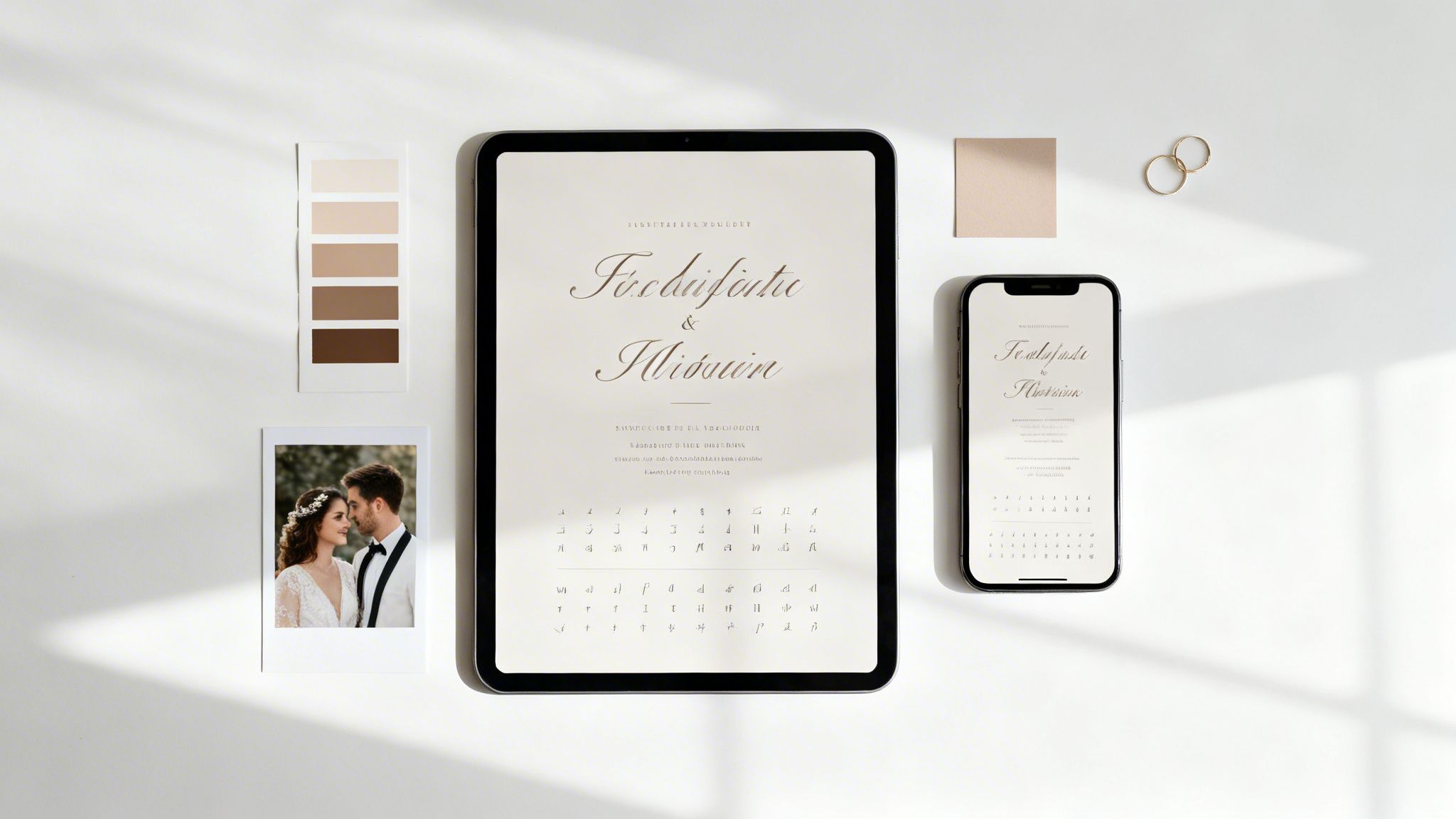
The most direct way to communicate that vibe is through your color palette. It should feel like a natural extension of your decor, florals, and even what your wedding party will be wearing.
For a romantic feel: Think soft pastels, muted greens, and creamy whites.
For a modern, bold style: Consider deep jewel tones like emerald or sapphire, paired with metallics and clean lines.
For a rustic or boho look: Earthy tones like terracotta, sage green, and warm beige work beautifully.
Once you have your colors, typography is the next crucial piece. Fonts do more than just spell out details; they carry emotion. A flowing script can feel elegant and traditional, while a crisp, sans-serif font signals a more modern, minimalist style. A great trick is to pair a statement font for your names with a simple, readable font for the rest of the info—it almost always strikes the perfect balance.
Making It Uniquely Yours
The most memorable digital wedding invitations are the ones that feel deeply personal. This is where you weave in the elements that tell your story, making guests feel like they're being invited to something truly special, not just another event.
A high-quality engagement photo is a classic for a reason. Choose one that captures your dynamic—whether it's candid and goofy or formal and romantic. With digital invites, you don't have to stress about print quality; the image will show up sharp and vibrant on any screen.
Another elegant touch is a custom monogram. Creating a simple design with your initials adds a polished, sophisticated feel. This little piece of branding can then pop up throughout your wedding, from the invitation to day-of signage and thank-you notes, tying everything together.
Your invitation isn't just a logistical tool; it's the prologue to your wedding day. Every design choice, from the font to the color palette, should be a deliberate brushstroke in the larger picture you're painting for your guests.
If you're looking for a creative launchpad, an AI-powered wedding invitation generator can be a fantastic tool. It can help turn your vague style ideas into a concrete design, suggesting layouts and font pairings that align with the vision you've already defined.
Creating a Cohesive Digital Suite
Your main invitation is the star, but it rarely travels alone. A cohesive digital suite makes every communication with your guests feel consistent and professionally managed. This collection usually includes:
Save-the-Date: The first heads-up, typically sent 6-12 months out. It should introduce your core design elements (colors, fonts) without giving everything away.
Main Invitation: The official request to attend, with all the key information front and center.
Details Page or Card: This is where digital shines. Link out to your wedding website for all the extras—travel info, hotel blocks, dress code, and your registry.
RSVP Form: A seamless, integrated form that makes it dead simple for guests to respond.
Using a single platform or template family for all these pieces is the easiest way to keep them visually aligned. It creates a smooth, intuitive experience for your guests and reinforces just how thoughtfully you've planned everything.
Prioritizing a Mobile-First Design
This is the most critical part: your digital invitation absolutely must be designed for a phone screen first. The overwhelming majority of your guests will open your email or click your link on their smartphone.
If the text is too small, if images get warped, or if the RSVP button is a nightmare to tap, the experience is immediately frustrating. A beautiful design is useless if it's unreadable.
Before you hit send, test your invitation on different mobile devices. Make sure every single element is clear, legible, and easy to navigate on a small screen. A mobile-first approach ensures your beautiful design is not only seen but also appreciated by every single guest you invite.
Crafting the Perfect Wording for Your Digital Invite
Once you've landed on a design that feels like you, it's time to find the words to match. This is where your digital invitation goes from just being a pretty graphic to a genuine, personal welcome into one of the biggest moments of your life.
The right wording doesn't just pass along information; it sets the tone. It’s the first real taste your guests get of the celebration to come, making them feel genuinely included and excited. This isn't about dusting off an old etiquette book from your grandmother's attic. It's about crafting a message that sounds like the two of you, whether that's warm and casual or elegant and formal.
Finding Your Authentic Voice
Your invitation's voice should be a direct reflection of your personality as a couple and the kind of wedding you're throwing. A formal church ceremony followed by a black-tie ballroom reception naturally calls for different language than a laid-back celebration with a food truck in a backyard.
The real key here is consistency. Think about how you talk to your friends and family. Are you laid-back and quick with a joke, or a bit more traditional and reserved? Let that be your guide.
Formal & Elegant: This style leans into classic, third-person phrasing. It’s perfect for those timeless, traditional weddings.
Example: "Mr. and Mrs. John Smith request the pleasure of your company at the marriage of their daughter, Emily Anne, to Mr. Michael David Jones."
Warm & Conversational: This feels more direct and personal, often using "we" and "us." It's a great fit for modern, relaxed celebrations where you're the hosts.
Example: "Together with our families, we, Emily and Michael, invite you to celebrate with us as we finally say 'I do'!"
No matter which route you take, the core information stays the same. You're just framing it in a way that feels true to the day you're planning.
The Must-Have Details for Your Invitation
Every invitation, digital or paper, has a very clear job to do: tell people the basics. Getting this wrong can lead to a storm of confused texts and last-minute questions. Keep it simple and direct—clarity is your best friend.
Here’s a quick checklist of the non-negotiables:
The Hosts: Who is throwing the party? Traditionally, this was the bride's parents. Today, it could be both sets of parents, the couple themselves, or a simple "Together with their families."
The Request to Attend: This is the line that officially invites everyone. "Request the honour of your presence" is traditionally for religious ceremonies, while "request the pleasure of your company" is for secular ones. A modern, warm alternative like "invite you to celebrate with us" works beautifully, too.
Your Names: State the full names of the couple getting married. No confusion here!
Date and Time: Spell out the day of the week, month, date, and year. And always, always include the ceremony start time.
Venue Name and Address: Give the full name and street address of the ceremony location. If the reception is at a different spot, you can add that on a separate line or, even better, link out to your wedding website for all the details.
The goal is zero confusion. A guest should be able to glance at your invitation and immediately know the who, what, where, and when without having to search for it.
How to Handle Those Tricky Wording Situations
Let's be honest—some of the most stressful parts of writing an invitation are about navigating the sensitive stuff. This is where thoughtful wording becomes your superpower. It’s entirely possible to be clear and firm while still being a gracious and polite host.
Communicating an Adults-Only Reception
This is a major source of anxiety for so many couples. The most graceful way to handle it is to be direct but gentle. First, address the digital invitation only to the adults invited. Then, you can add a polite note on your wedding website's FAQ page.
Graceful Wording Example: "While we adore your little ones, our wedding will be an adults-only occasion. We hope you can still join us for a relaxing evening out!"
Clarifying Plus-One Etiquette
Digital invitations make this so much easier. You can remove all the guesswork by being specific on the RSVP form itself. If a guest is invited with a plus-one, their form will have a space to add their guest's name. If they're invited solo, that option simply won't be there. It’s a clean, digital solution to an often-awkward problem.
Sharing Your Registry Information
Directly mentioning gifts on the invitation itself is still considered a bit of a faux pas. The perfect home for this information is your wedding website. Just include a simple, clean link on your digital invitation.
Example Link Text: "For more details on travel, hotels, and our registry, please visit our wedding website."
This keeps your invitation focused on what truly matters—celebrating with your favorite people—while giving guests all the practical info they need in one convenient place. It's the perfect blend of modern convenience and timeless etiquette.
Mapping Out Your Digital Invitation Timeline
Timing isn't just a detail in wedding planning—it's the bedrock of a calm, organized experience. Let’s be honest, a well-structured timeline is what separates a smooth ride from a frantic, last-minute scramble. It’s what ensures your guests have everything they need to show up and celebrate with you, stress-free.
For most couples working within a typical 9 to 18-month planning window, mapping out your digital communications is the key to feeling in control.
Unlike the slow, unpredictable pace of snail mail, digital wedding invitations offer precision and flexibility. But that power requires a plan. You don't want to send your invites so early they get buried in a cluttered inbox, but sending them too late can leave guests unable to make arrangements. It’s all about finding that perfect sweet spot.
The First Wave: Save the Dates
The first official heads-up you'll send your guests is the save-the-date. This isn't just a formality; it's a crucial courtesy, especially for anyone who needs to book flights, arrange hotels, or request time off work. Sending this out early is a small gesture your guests will deeply appreciate.
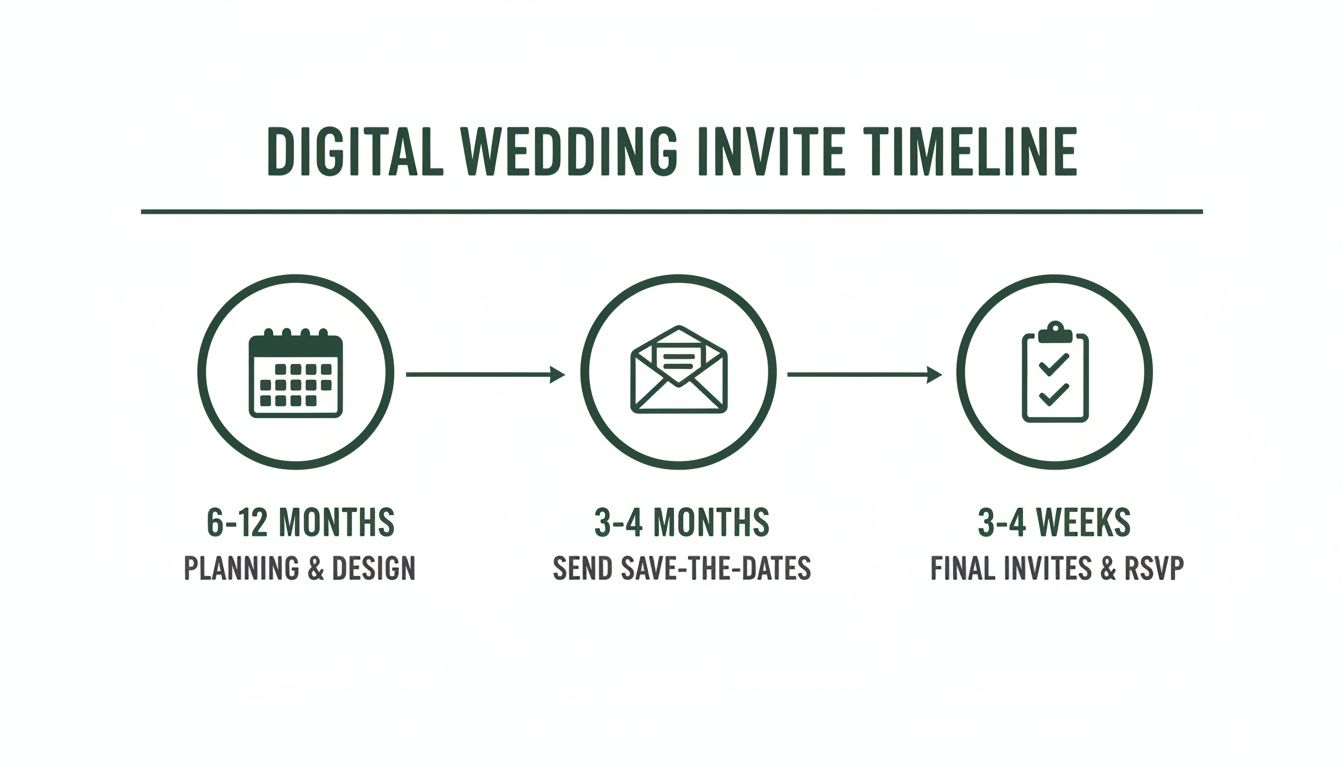
The sweet spot for sending digital save-the-dates is 6 to 12 months before your wedding day. This generous lead time gets your wedding locked into everyone's calendars and starts building excitement without the pressure of an immediate RSVP. It's the perfect, low-key way to announce your big news.
The Main Event: Sending the Invitation
With the date officially saved, the main invitation is next. This is where you'll share all the crucial details and formally request their presence. Since digital delivery is instant, you have a lot more control over the timing compared to traditional paper invites.
Plan to send your official digital invitations 3 to 4 months before the wedding. This window is ideal—it's close enough that the wedding feels just around the corner, yet it still gives guests plenty of time to finalize their plans. This timing helps avoid the "out of sight, out of mind" problem that can happen if you send them too far in advance.
This visual timeline breaks down the key stages perfectly, showing how the process unfolds from giving ample notice with save-the-dates to the focused final push for collecting RSVPs.
Setting a Strategic RSVP Deadline
Your RSVP deadline is one of the most critical dates on your entire planning calendar. Seriously. It’s the trigger for finalizing your headcount, confirming meal choices with the caterer, creating a seating chart, and ordering final quantities for everything from favors to rentals.
Setting this deadline strategically is non-negotiable for a smooth final few weeks.
A well-timed RSVP deadline is your best defense against planning chaos. It's the data point that allows you and your vendors to move from estimation to execution with complete confidence.
Request that guests RSVP 3 to 4 weeks before the wedding day. This gives you a necessary buffer to politely follow up with the inevitable stragglers while still hitting the deadlines from your vendors, which often land around the two-week mark.
Here’s a quick-glance table to help you visualize the flow for a typical 12-month timeline.
Digital Invitation and RSVP Timeline
Time Before Wedding
Action Item
Key Consideration
12 Months
Finalize guest list & collect emails
Create a master spreadsheet to track contact information.
6-8 Months
Send digital save-the-dates
Crucial for destination weddings or guests who need to travel.
4 Months
Send official digital invitations
Include links to your wedding website with all the details.
5 Weeks
Send gentle reminder to non-openers
A quick nudge can get your invite out of the spam folder.
4 Weeks
RSVP deadline arrives
Your cutoff for guest responses.
3 Weeks
Follow up & submit final headcount
Personally contact non-responders; confirm numbers with all vendors.
This schedule gives you a solid framework to build from, ensuring every communication is sent at the right moment. With an AI-powered system like ItsaYes, you can turn this timeline into an intuitive plan. The platform helps you define your style and ideas, then breaks the next 6 to 12 months into simple, manageable steps. Your personal AI assistant is available 24/7 to suggest priorities and organize tasks, keeping everything moving forward without overwhelm.
Mastering Guest Management Like a Pro
This is where the real magic happens.
Beyond the beautiful designs and heartfelt wording, the true power of digital wedding invitations is how they turn one of the most stressful parts of planning—managing your guests—into a simple, automated process.
Forget the anxiety of waiting for mail-in cards. Forget the nightmare of tracking responses in a color-coded spreadsheet that seems to multiply by the day. This is about effortless control and real-time clarity.
Setting Up a Smart RSVP System
Your online RSVP form is so much more than a simple "yes" or "no" button. It's a powerful data-gathering tool that can collect all the essential information you need to give your vendors a crystal-clear picture of the day. Modern digital platforms let you build a form that asks all the right questions in one fell swoop.
Think beyond just the headcount. Your RSVP form can effortlessly handle the details that used to require countless follow-up emails and phone calls.
Meal Preferences: Let guests choose between chicken, fish, or vegetarian options directly on the form. This information can be exported and sent straight to your caterer.
Dietary Restrictions: Include a field for guests to list any allergies or dietary needs. It's a thoughtful touch that ensures everyone is safely and happily fed.
Plus-One Details: If you've given a guest a plus-one, the form can prompt them to enter their guest's full name, which is absolutely essential for your seating chart and place cards.
Fun Extras: Want to get your guests involved? Add a question asking for a song request to help build your reception playlist. It's a great way to make them feel part of the day.
This approach transforms the RSVP from a passive response into an active planning tool, feeding crucial data directly into your wedding plan.
From Messy Spreadsheets to a Centralized Dashboard
The days of frantically cross-referencing multiple guest lists are over. The single biggest advantage of managing your guest communications digitally is having a single, centralized dashboard. This is your command center for everything guest-related.
Instead of a static document, you get a living overview that updates in real time. You can see at a glance who has opened your invitation, who has responded, and who still needs a gentle nudge. This is a core feature of planning systems like ItsaYes, which integrate guest management directly into your main workspace.
A centralized dashboard isn't just a convenience; it's a sanity-saver. It eliminates the risk of human error and gives you an accurate, up-to-the-minute picture of your guest list, empowering you to make confident decisions.
With everything in one place, you can sort and filter your guest list with a single click. Need to see how many guests chose the vegetarian meal? Or create a list of everyone staying at a specific hotel block? It takes seconds. For couples who want to feel organized and in control, exploring a dedicated wedding guest list app can show just how simple this process can be.
Automating Reminders and Updates Gracefully
One of the most awkward tasks in wedding planning is chasing down RSVPs. No one wants to feel like they're nagging their friends and family. This is another area where digital systems offer a massive upgrade in both efficiency and etiquette.
You can schedule polite, automated reminder emails to be sent to anyone who hasn't responded by a certain date. The message can be pre-written in your own voice—warm, friendly, and never pushy.
Here’s a quick example:
Subject: Can't wait to celebrate with you!
"Hi [Guest Name], Just a friendly reminder that our RSVP deadline is next Friday. We're so excited about the big day and really hope you can be there to celebrate with us! You can confirm your spot right here: [Link to RSVP]. Best, [Your Names]"
This automated nudge is often all it takes to get those final responses in, saving you from hours of making awkward follow-up calls.
The same principle applies to last-minute updates. If there's a change in the weekend schedule or a reminder about transportation, you can send a beautifully formatted email to your entire guest list—or just a specific segment—in minutes. This ensures everyone has the correct information, preventing day-of confusion and keeping the entire experience smooth for your guests.
Navigating Digital Etiquette and Accessibility
Going digital with your wedding invitations is a smart, modern move, but it doesn’t mean we leave courtesy at the door. The real art is blending the ease of technology with genuine thoughtfulness, making sure every single guest feels included, respected, and genuinely excited to celebrate with you.
Probably the biggest question that comes up is about including older relatives or friends who aren't exactly glued to their smartphones. The answer is a simple, sensitive hybrid approach. For most of your guests, a beautiful e-vite is perfect. For those who might find a digital format tricky, don't think twice about going old school.
A small batch of printed invitations or even a warm, personal phone call can make all the difference in the world. This small gesture shows you’re thinking of them specifically, making sure they get all the important info in a way that feels comfortable and familiar.
Ensuring Everyone Can Access Your Invitation
Beyond just being tech-friendly, making your digital invitations truly accessible means designing for everyone. This comes down to a few simple but critical design choices that ensure your message is crystal clear, especially for guests with visual impairments.
Think about these key elements as you design:
High-Contrast Colors: Use dark text on a light background (or the other way around) to make everything easy to read. Steer clear of things like light gray text on a white background, which can be a real headache for some people.
Legible Fonts: Choose clean, simple fonts over super decorative or complex scripts, especially for the must-know details like the date, time, and address.
Descriptive Links: Instead of a generic "click here," use clear link text like "Visit our wedding website for details." This tells guests exactly where a link is about to take them.
Making your invitation accessible isn't just a technical checkbox; it's an act of hospitality. It tells every guest that their presence is important to you and that you've considered their needs right from the start.
Ultimately, the goal is to make every guest feel seen and valued. For a deeper dive into getting the phrasing just right, check out our guide on the finer points of addressing wedding invitations with proper etiquette. A little extra thought ensures your modern invitation carries all the warmth and significance of a traditional one.
Of course, here is the rewritten section, crafted to sound completely human-written and natural, following all your specified requirements.
Still on the Fence? Let’s Talk Through It.
Even with all the clear wins for going digital, it's totally normal to have a few nagging questions before you dive in. I get it. This is your wedding, and every detail feels huge. Let's tackle the most common concerns I hear from couples, so you can make a choice that feels right for you.
Are Digital Wedding Invitations Tacky?
Absolutely not. Honestly, this is probably the most outdated worry I hear, and the perception has shifted so dramatically in the last few years. Today’s digital wedding invitations can be incredibly chic, clever, and eco-conscious—all at once.
When a digital invitation is thoughtfully designed to match the feel of your wedding—whether it's black-tie formal or backyard casual—it feels just as special as something you'd get in the mail. It's all about the quality and the story you're telling, not the medium you use to tell it.
What About Our Guests Who Aren't Tech-Savvy?
This is a really important and valid point. The last thing you want is for your most cherished guests to feel confused or left out. The best solution here is a simple hybrid approach.
Send beautiful digital invites to the vast majority of your guests, and then print a small batch of physical cards for older relatives or anyone you know isn't glued to their email. It's the best of both worlds.
A warm, personal phone call is also a wonderful touch. It’s a chance to share the exciting details and make sure less tech-savvy guests feel just as included and cherished as everyone else. Inclusivity is everything.
This strategy gets you all the efficiency of digital without sacrificing that personal connection for the people who need it most.
What if Our Invitation Goes to Their Spam Folder?
This is a common fear, but it’s largely preventable. Using a reputable, dedicated digital invitation service like Paperless Post or Greenvelope makes a huge difference. These platforms are built specifically for high deliverability, which dramatically reduces the chances of your invitation getting lost in a spam filter.
For extra peace of mind, just give your guests a heads-up. A quick note on your wedding website or a simple text saying "Keep an eye on your inbox for our wedding invitation!" works wonders. If you haven't heard back from someone after a week or so, a friendly follow-up message is perfectly fine and usually appreciated.
Feeling confident about your wedding plan shouldn't be a luxury—it should be the standard. Instead of juggling scattered spreadsheets and endless to-do lists, bring your entire wedding vision into a single, calm workspace with ItsaYes. Let our AI-powered platform turn your inspiration into a clear, manageable plan, so you can enjoy every moment of your engagement. Start planning with clarity today at https://itsayes.io.