Your Guide to Mailing Out Wedding Invitations Without the Stress
23 min
Your Guide to Mailing Out Wedding Invitations Without the Stress
Author
The ItsaYes TeamAuthor
When should you actually mail your wedding invitations? The short answer is six to eight weeks before the wedding. But like everything in wedding planning, the real answer is a little more nuanced.
If you have guests coming from another country or you're planning a destination wedding, you'll want to push that timeline up to at least twelve weeks out. It's all about finding that perfect sweet spot, giving people enough notice to get excited and make plans, but not so much time that your beautiful invitation gets lost in a pile of mail.
Crafting the Perfect Wedding Invitation Timeline
Think of your invitation timeline as the blueprint for your entire guest communication strategy. Getting it right is the difference between a smooth, exciting countdown and a chaotic scramble for RSVPs. A well-planned timeline, especially when managed in an intuitive workspace like ItsaYes, keeps everything calm and under control. This is the first major signal you send to your guests, and it sets the tone for the organized, thoughtful, and beautiful event you're planning.
While sending invitations feels like a timeless tradition, the strategy behind it has certainly evolved. Fun fact: Google Trends shows that searches for "wedding invitations" spike by 100% every January, right after engagement season, as couples start planning for summer and fall weddings. With over 2.2 million weddings happening in the U.S. each year, a smart timeline is what helps couples hit that ideal 70-80% on-time RSVP rate.
The Crucial Role of Save-the-Dates
Before a single invitation goes in the mail, your save-the-dates are the opening act. This is the official heads-up that tells your favorite people to block off their calendars.
For Domestic Weddings: Plan to send save-the-dates 6 to 8 months before the wedding. This is plenty of notice for guests to request time off work or book a hotel without feeling rushed.
For Destination or International Weddings: You need to give people a lot more runway. Mail these 8 to 12 months in advance. International mail can be notoriously slow, and your guests will appreciate the extra time to hunt for flight deals, secure accommodations, and handle passports or visas.
This early heads-up is especially critical if your wedding falls on a holiday weekend, like Memorial Day or Labor Day, when people’s calendars fill up fast.
Nailing the Invitation Mailing Window
Now for the main event: mailing the actual invitations. Timing here is everything. Send them too early, and they risk being forgotten. Send them too late, and you’ll get a wave of panicked declines.
For most local or domestic weddings, the magic window is 6 to 8 weeks before your wedding day. This gives your guests two to three weeks to decide and pop that RSVP card back in the mail before your deadline.
Of course, life requires adjustments. If you have a lot of out-of-town guests who (for whatever reason) didn't get a save-the-date, it’s wise to aim for the eight-week mark. For your friends and family living abroad, you’ll want to mail their invitations 10 to 12 weeks out to build in a buffer for any international postage hiccups.
Pro Tip: Set up two separate mailing batches in your ItsaYes plan. Batch one is for your international guests, and batch two is for everyone domestic. The platform helps break these tasks into simple, manageable steps, keeping your timeline tidy and ensuring everyone gets their invitation at just the right time.
This quick table breaks down the key milestones for you.
Wedding Invitation Mailing Timeline
Milestone
Domestic Wedding
Destination or International Wedding
Key Consideration
Save-the-Dates
6-8 Months Out
8-12 Months Out
Gives guests ample time for basic travel and work arrangements.
Mail Invitations
6-8 Weeks Out
10-12 Weeks Out
Accounts for mail delivery times and allows for thoughtful replies.
RSVP Deadline
3-4 Weeks Out
4-5 Weeks Out
Provides a buffer for you to follow up before giving final counts.
This schedule ensures your guests feel informed and you stay organized, avoiding last-minute stress.
Here’s a visual to help you map it all out, from that first save-the-date to your final RSVP deadline.
Seeing it laid out like this makes it clear how each step builds on the last, leading to a smooth process for everyone involved.
Setting a Sensible RSVP Deadline
Your RSVP deadline isn't just a random date—it's the critical piece of information you need to finalize your headcount with the caterer, create the seating chart, and lock in other venue logistics.
The sweet spot is 3 to 4 weeks before your wedding day. This timeline is strategic. It gives you a crucial buffer week to personally track down anyone who hasn’t responded before your final numbers are due.
Most caterers and venues need that final headcount about two weeks before the event, so this schedule gives you the breathing room to gather those last few replies without breaking a sweat. As you prepare, remember that a centralized system is your best friend. If you need tips, check out our guide on building and managing your wedding guest list. It’ll help you keep track of addresses and, eventually, all those RSVPs in one place.
Putting It All Together: Assembling Your Wedding Invitations
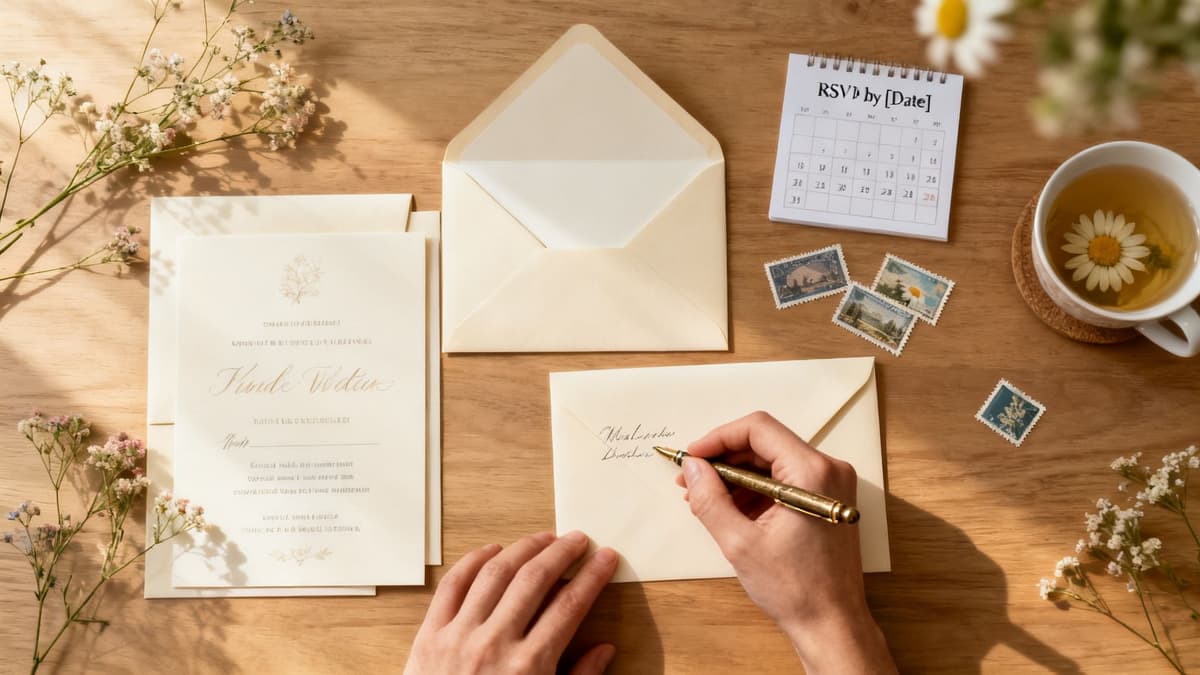
How you assemble and address your invitations is the first real glimpse your guests get of your wedding’s personality. It’s a quiet signal of the care and thought you’ve poured into your day. This isn’t about following stuffy, outdated rules; it's about creating a beautiful first impression that makes your guests feel genuinely excited and welcomed.
Think of your invitation suite as a collection of carefully chosen pieces. The way you present them matters. It's a bit like setting a formal dinner table—there's a natural order that creates a seamless, thoughtful experience for the person on the receiving end.
The Correct Stacking Order
When your guest opens that envelope, each piece should be revealed in order of importance. The main invitation, the star of the show, should always be the first thing they see in full, placed at the very back of the stack.
Here's the standard, most intuitive way to stack everything, from the bottom up:
The Invitation Card: This is the largest and most important piece. Place it at the very back with the text facing up, so it's immediately readable.
Protective Tissue Paper (Optional): If your invitations have raised ink (like thermography) or dark, saturated colors, a thin sheet of tissue paper laid over the text is a classic touch that prevents smudging.
Reception Card: If you have a separate card for the reception details, it comes next.
Directions or Map Card: This follows the reception card, as it’s a helpful but supplementary detail.
Accommodations Card: Any info about hotel blocks or travel arrangements sits on top of the map.
RSVP Card and Envelope: Finally, the RSVP card should be tucked neatly under the flap of its pre-addressed, pre-stamped return envelope. This entire little package sits right on top of the stack.
Once everything is stacked, you can either secure the bundle with a beautiful belly band or ribbon, or simply slide the whole thing into the inner envelope. It’s this level of detail that elevates the experience from just opening mail to unveiling something special.
Demystifying Inner and Outer Envelopes
The whole idea of using two envelopes might seem a bit old-fashioned, but it serves a very practical purpose. The outer envelope is the workhorse, it’s the one that gets stamped, postmarked, and handled by the mail system. You address this one formally with full names and addresses.
The inner envelope, on the other hand, is the pristine liner that protects the beautiful invitation suite inside. It’s addressed more informally, and, most importantly, it’s where you can be perfectly clear about exactly who is invited. For instance, the outer envelope might say "Mr. and Mrs. Robert Smith," while the inner envelope could say "Robert and Linda," which feels much warmer and more personal.
Why It Matters: The inner envelope is your secret weapon for clarity. It’s where you can explicitly add "and Guest" or list the names of invited children, removing any ambiguity and preventing awkward follow-up questions down the road.
Using both is a touch of classic elegance. Of course, plenty of modern couples opt for a single, high-quality outer envelope to save on costs and paper. If you skip the inner envelope, just make sure the addressing on the outer one is crystal clear about who is included in the invitation. Your personal AI assistant in ItsaYes is available 24/7 to help organize these small but crucial details, keeping your guest list accurate from the start.
Modern Addressing for Your Real-World Guests
Navigating names, titles, and relationships can feel like a minefield, but the guiding principle is simple: be respectful and be clear. Forget the stuffy, outdated rules that don’t reflect the reality of your guests' lives. For a much deeper dive, our comprehensive guide offers more examples on modern etiquette for addressing wedding invitations.
Here’s how to handle some common scenarios with modern grace:
A Married Couple with the Same Last Name:
Outer: Mr. and Mrs. David Chen
Inner: Mr. and Mrs. Chen or David and Sarah
A Married Couple with Different Last Names: List the person you're closer to first, or simply list them alphabetically.
Outer: Ms. Anya Sharma and Mr. Leo Williams
Inner: Ms. Sharma and Mr. Williams or Anya and Leo
An Unmarried Couple Living Together: Address them on the same line, just as you would a married couple with different names.
Outer: Ms. Emily Carter and Mr. Jackson Reid
Inner: Emily and Jackson
A Guest with a Professional Title (e.g., Doctor, Judge): The person with the professional title is always listed first. If both have titles, list them by rank or alphabetically.
Outer: Dr. Olivia Bennett and Mr. Samuel Jones
Inner: Dr. Bennett and Mr. Jones
A Family with Children: Only the parents' names go on the outer envelope. The inner envelope is where you specify the children by name.
Outer: Mr. and Mrs. Thomas Rodriguez
Inner: Mr. and Mrs. Rodriguez, Isabella and Noah
By focusing on respect and clarity, you can confidently address every single invitation on your list. This ensures each guest feels seen and properly invited to your celebration, a thoughtful approach that's a key part of mailing out wedding invitations without the stress.
Navigating Postage and Avoiding Post Office Pitfalls
Postage feels like it should be the easy part, right? But I’ve seen it trip up more couples than you’d think. One small misstep with stamps can mean your entire mailing gets delayed, invitations are returned, or the beautiful stationery you agonized over shows up looking like it went through a battle.
Getting this final detail right is your last mission before the RSVPs start rolling in.
The single most important rule is this: never, ever guess the postage. Before you even think about buying stamps, take one fully assembled invitation, and I mean with every insert, belly band, and wax seal, to the post office. Have them weigh it and tell you the exact cost. This tiny errand saves you from the massive headache of having a hundred invites returned for insufficient postage, which can wreck your entire timeline.
Uncovering Hidden Postage Costs
Here’s a little secret from the world of mail: weight isn't the only thing that matters. The United States Postal Service uses high-speed sorting machines, and anything that doesn't play nicely with them gets hit with a "non-machinable" surcharge. Right now, that’s an extra $0.44 per invitation.
Several common design elements can trigger this fee. Be on the lookout for:
Square Envelopes: Their shape is a no-go for the standard sorting equipment.
Wax Seals or Rigid Embellishments: Anything that creates a bump or an uneven surface can jam the machines. Think thick ribbon knots or bulky exterior charms.
Excessive Stiffness: If your invitation suite is too rigid to bend easily, it has to be processed by hand.
These details add a gorgeous, personal touch, but you absolutely have to budget for the extra cost. Your personal AI assistant in ItsaYes can help you flag these potential surcharges early in the planning process, turning your inspiration into a clear plan so there are no last-minute budget surprises.
The cost of mailing out wedding invitations is just one part of the stationery budget. The average spend on a complete wedding invitation suite is $518 in the U.S. Smart couples save significantly by ordering one invitation per household, not per guest, which can reduce quantities by up to 50%. Adding a 15-20% buffer for extras ensures you’re covered for any mistakes or last-minute additions. Learn more about how real couples budget for their invitations.
Protect Your Investment with Hand-Canceling
After all the time and money you poured into creating a stunning invitation, the last thing you want is for it to arrive scuffed, torn, or covered in thick black lines from an automated sorting machine. This is where a little-known service called hand-canceling becomes your best friend.
Instead of your envelopes being fed through a machine that prints cancellation lines over the stamp, a postal worker uses a special hand stamp to mark it. This simple act ensures your invitations are handled manually, which dramatically reduces the risk of damage.
A few tips for making this happen smoothly:
Go during off-peak hours. A quiet Tuesday morning is much better than the chaotic lunch rush.
Ask nicely. A friendly request goes a long way. Just explain that they're your wedding invitations and you'd love to keep them looking pristine.
Offer to help. If they're busy, some clerks might even let you stamp them yourself under their supervision.
Hand-canceling is usually free, though policies can vary by location. It’s a small step that makes a huge difference, preserving the beauty of your invitations and ensuring they make the perfect first impression. Think of it as the final, caring touch before they begin their journey.
Taming the RSVP Tsunami (and Following Up Politely)
The moment your invitations are in the mail, the game changes. You shift from planning what the day will be to planning who will be there. This is where your guest list spreadsheet stops being a static document and becomes a living, breathing headcount for your vendors.
How you gather these replies will shape the final, frantic weeks of planning. And while there’s a certain charm to traditional mail-in cards, today’s guests, and your own sanity, overwhelmingly lean toward speed and simplicity.
Digital vs. Old-School RSVP: Why Your Choice Matters
Choosing between paper cards and a digital platform isn't just an aesthetic decision; it's a strategic one. You’re either creating a smooth, quick experience for your guests or adding one more tiny chore to their to-do list.
The numbers don't lie. A staggering 89% of guests now say they prefer to RSVP online. This isn't a slow-moving trend; it's a tidal wave. The use of QR codes on wedding invitations has skyrocketed by 42% since 2021 alone.
For a typical wedding with 120 guests (that’s roughly 60-80 households), going digital doesn't just save you the cost of return postage. It delivers faster, cleaner data you can actually use. You can dive deeper into these global wedding trends to see just how much has changed.
Let's break down the two approaches head-to-head.
RSVP Tracking Methods Comparison
Deciding how your guests will reply is a critical choice that impacts everything from your budget to your stress levels. Here's a look at how mail-in cards stack up against a modern digital system.
Feature
Mail-In RSVP Cards
Digital RSVP Platforms (e.g., via ItsaYes)
Guest Convenience
Requires guests to fill out, find a stamp, and mail back.
Instant and easy; guests can respond in seconds from their phone.
Tracking Accuracy
Prone to lost mail, illegible handwriting, or forgotten names.
Responses are instantly recorded, eliminating errors and manual entry.
Data Collection
Limited to checkboxes for attendance and meal choice.
Can easily collect meal choices, dietary needs, plus-one names, and even song requests.
Cost
Requires printing costs for the card and envelope, plus return postage (~$0.73 per stamp in the U.S.).
Often included with a wedding website, saving on printing and postage.
Speed
Responses trickle in over several weeks, depending on mail service.
Most responses arrive within days of the invitation, giving you a faster headcount.
Ultimately, a system like ItsaYes becomes your mission control. Every "yes," "no," meal preference, and plus-one name is automatically logged in one clean, intuitive workspace. It’s the end of juggling spreadsheets and scattered notes, giving you a clear picture from day one.
The Art of the Gentle Nudge: Following Up with Grace
No matter how organized you are, I can almost guarantee you’ll have a handful of guests who miss the RSVP deadline. It happens. Chasing them down is a delicate but absolutely necessary task to finalize your plans.
The key is to be polite, direct, and assume good intentions, they probably just forgot.
Wait a day or two after your deadline has passed. Following up too soon feels pushy, but waiting too long can throw a wrench in your vendor timelines.
Here are a few simple scripts you can tweak for a quick text or phone call. They work because they’re friendly and low-pressure.
For a Close Friend or Family Member: "Hey [Name]! Hope you're doing well. We're finalizing our headcount for the caterer this week and just wanted to check if you'll be able to make it to the wedding. We'd love to celebrate with you!"
For a More Distant Relative or Friend: "Hi [Name], we're so excited for the wedding and are locking in the seating chart. We didn't want to finalize things without you! Could you let us know if you'll be able to join us by [a new, firm date, e.g., 'this Friday']? Hope to see you there!"
A Crucial Takeaway: Your tone should always be helpful, not frustrated. Frame the ask around your logistics, "We need to give our caterer the final numbers", rather than their oversight, "You missed the deadline." This simple shift makes the request feel collaborative, not demanding.
By handling this part of the process with a bit of kindness and a lot of organization, you can smoothly transition from mailing invitations to the truly exciting final stages of planning. An AI assistant in ItsaYes can suggest priorities and help you keep everything moving forward without overwhelm.
Your Essential Wedding Invitation Checklist
To pull all the moving parts together, think of this checklist as your roadmap for getting wedding invitations out the door without the stress. This isn't just a to-do list; it’s a structured plan that turns potential chaos into calm, organized clarity.
I recommend integrating these steps right into your ItsaYes workspace. The platform helps you turn inspiration into a clear plan, breaking the next few months into simple, manageable steps.
We’ll break the whole process down into four distinct phases. It makes the entire task feel so much more manageable.
Pre-Design and Finalizing
This is all about laying the groundwork. Getting these details right from the very beginning prevents costly reprints and that awful last-minute panic. It’s all about confirming every last detail before you hit "print."
Confirm Wording and Final Proofread: Read through your entire invitation suite one last time. Better yet, have two other people who aren't you proofread it. Fresh eyes will catch spelling errors, grammar mistakes, and incorrect dates you’ve read a dozen times.
Verify All Guest Addresses: Go through your spreadsheet and double-check every single address. A simple typo can mean a returned invitation, a delayed RSVP, and a guest who feels left out.
Order Extra Suites: This is non-negotiable. Always order at least 15-20% more invitation suites than you think you need. This buffer covers addressing mistakes, last-minute guest additions, and gives you beautiful keepsakes for yourselves and your photographer.
Assembly and Addressing
With your beautiful invitations in hand, it's time for the thoughtful process of putting them all together. This stage is all about precision and presentation.
Set Up an Assembly Line: Find a clean, spacious area to work. Stack each component, invitations, inserts, RSVP cards, and envelopes, into separate piles. This little bit of organization will streamline the entire process.
Correctly Stack All Inserts: Follow the proper order for your suite. Usually, the main invitation goes on the bottom, with smaller cards stacked on top, ending with the RSVP card and its envelope neatly tucked in.
Address Both Inner and Outer Envelopes: Working from your finalized guest list, address each envelope according to modern etiquette. The goal is absolute clarity on exactly who is invited.
Affix Stamps to RSVP Envelopes: This is a crucial, courteous step that makes it effortless for your guests to reply. Don't make them hunt for a stamp!
Crucial Reminder: One of the most common mistakes I see is couples forgetting to number the back of their RSVP cards. Lightly pencil in a number that corresponds to your spreadsheet. When a guest inevitably forgets to write their name, you'll still know exactly who responded.
Mailing and Tracking
You're in the home stretch! These final steps ensure your invitations arrive safely and that you stay on top of the responses as they roll in. This is where all your diligent preparation pays off.
Take a Fully Assembled Suite to the Post Office: Before you stamp anything, take one complete, sealed invitation to the post office and have it weighed. This is the single most important step to avoid a mountain of returned mail.
Purchase the Correct Postage: Once you know the exact cost, buy all your stamps at once. Be sure to ask about extra postage if your invitations are "non-machinable" (think square envelopes, wax seals, or bulky suites).
Request Hand-Canceling: When you drop off your invitations, politely ask the postal clerk to hand-cancel them. This simple request protects your beautiful envelopes from the automated sorting machines that can tear or smudge them.
Set a Calendar Reminder for Your RSVP Deadline: In your ItsaYes plan, create a task for the day after your deadline. This will be your cue to start gently following up with anyone who hasn't responded.
Track Responses as They Arrive: Update your guest list in real-time as those RSVPs come back. This keeps your headcount accurate and ready for your vendors.
By breaking the process down into these manageable phases, you can tackle each step with total confidence. If you're looking for more ways to stay organized, our simple wedding planning checklist offers a complete overview to guide your entire journey.
Even with the most airtight plan, you’re going to hit a few of those little “wait, what do we do here?” moments when mailing your wedding invitations. This is your quick-reference guide for those last-minute questions that always seem to pop up.
Here are the most common pain points couples run into, with clear, actionable answers.
How Do We Handle Guests Who Don't RSVP by the Deadline?
This is probably the most common (and frustrating) hurdle in the entire process, but you can handle it without any awkwardness.
First, give it a day or two. Mail can be slow, people get busy. Once that grace period is over, it's time for polite follow-ups. A personal touch is always best here.
A simple, friendly text or call is perfect: "Hi [Name]! Just touching base as we're finalizing our catering numbers. We were hoping to check if you'll be able to celebrate with us?" This approach is warm, non-accusatory, and gives a clear reason why you need an answer.
If you still haven't heard back after a second try a few days later, it's completely okay to mark them as a "no." You've done your part. You need to move forward with your planning confidently.
What's the Best Way to Word Invitations Regarding Plus-Ones?
Clarity is everything when it comes to plus-ones. Your goal is to make it crystal clear who is invited so nobody has to guess or ask uncomfortable questions. The most graceful way to do this is right on the envelope.
To invite a guest with a plus-one: Address the outer envelope to [Guest Name] and Guest. You can repeat this on the inner envelope for an extra layer of clarity.
To invite a guest solo: Simply address the invitation to the guest by their name alone.
This direct method sidesteps any need for clunky phrasing like "no plus-ones" on the invitation itself, which can feel a little cold. The envelope does all the talking for you.
Your guest list is your source of truth. As you address each envelope, check it against your organized list in a tool like ItsaYes. This ensures every name and plus-one status is exactly right, helping you feel confident and preventing any mix-ups down the line.
Can We Use a Mix of Paper and Digital Invitations?
Absolutely. Not only is this acceptable, but it’s becoming incredibly popular. A hybrid approach lets you have the best of both worlds, honoring tradition while embracing the convenience of modern tech.
Many couples send beautiful, formal paper invitations to older relatives and close family who will appreciate the keepsake. At the same time, they'll send digital invitations to their younger, tech-savvy friends who prefer the ease of a one-click RSVP.
The key to making a hybrid approach work is consistency. All the critical details, date, time, location, dress code, must be identical on both versions. Most importantly, make sure your RSVP tracking system can handle both paper and digital responses without causing you a headache. An AI-powered planner like ItsaYes is built for exactly this, funneling all your RSVPs into one organized, easy-to-manage space.
Should We Put Our Return Address on the Front or Back?
This is one of those tiny details that adds a final touch of polish and shows you know your stuff.
Traditionally, the return address is printed on the back flap of the main outer envelope. This etiquette keeps the front looking clean and elegant, reserving that prime real estate for your guest's address and the postage.
For the RSVP envelope that you tuck inside, your address goes right on the front. After all, that's where you want it to be mailed back to!
Stop juggling spreadsheets and scattered notes. Bring your wedding vision, tasks, and timeline into one calm, intuitive workspace with ItsaYes. Start planning with clarity today at itsayes.io.