Alright, let's talk about the big, scary number. The first question that pops into pretty much every newly engaged couple's head is, "So... what's this actually going to cost us?"
For 2026, the number you’ll see thrown around for the average US wedding is somewhere between $35,000 and $36,000. If you're in the UK, that figure is closer to £21,990.
Take a breath. Before you close this tab and elope, let’s unpack what those numbers really mean for you. Because honestly, the story behind them is what actually matters for your budget.
A Realistic Look at 2026 Wedding Budgets
Seeing that national average for the first time usually comes with a healthy dose of sticker shock. I get it. But that single number can be seriously misleading.
Think of it like the average price of a car. That figure gets calculated using both budget-friendly hatchbacks and six-figure supercars. The average wedding cost works the same way, it’s heavily skewed by ultra-luxe celebrations in places like New York and Los Angeles, which pulls the whole number way, way up.
That’s exactly why you need to know the difference between the and the cost. It's a small distinction that makes a huge difference.
The average cost is just the total spent on all weddings divided by how many weddings happened. Like we said, a few massively expensive events can inflate this, making it feel out of reach for most people.
The median cost, on the other hand, is the true middle ground. It's the number where half of all couples spent more, and the other half spent less. This figure paints a much more relatable, realistic picture of what a typical wedding actually costs, without being skewed by celebrity-style blowouts.
Think of it this way: The average tells you what's possible at the high end of the market. The median tells you what's probable for most real-world couples. Looking at both gives you the full story.
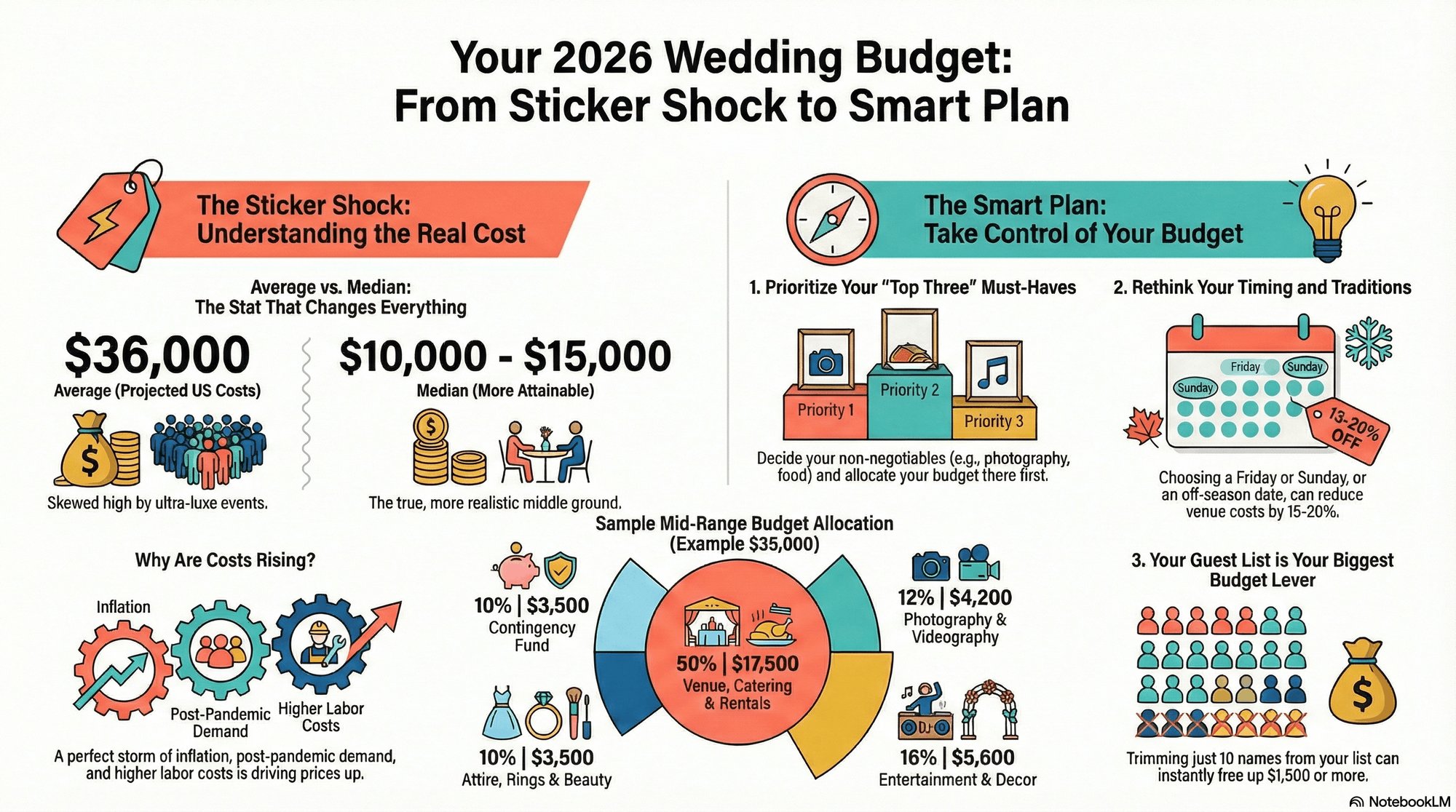
To give you a clear financial snapshot, let's look at the data. We've seen a steady climb in wedding expenses over the past few years. The Knot's Real Weddings study, a great industry benchmark, tracked the US national average going from $30,000 in 2022 up to $35,000 in 2023. Other sources are pointing to a 2025 average of $36,000, but with a much more telling median cost of just $10,000.
That massive gap between $36,000 and $10,000 is everything. It shows that while big budgets get the headlines, plenty of couples are planning incredible celebrations for far less.
For a quick reference, here’s a breakdown of the key numbers you should know for 2026.
Projected 2026 Wedding Costs At a Glance (US & UK)
Region
Projected Average Cost
Projected Median Cost
Key Takeaway
United States
$36,000
$10,000 - $15,000
The gap is huge. Most couples spend closer to the median, so don't let the average scare you.
United Kingdom
£21,990
£12,000 - £15,000
A similar trend, with the average pulled up by high-end London weddings. The median is more grounded.
Ultimately, remember that these are guideposts, not rules. Your wedding budget isn't about hitting some national statistic; it's about building a day that reflects what's important to you.
The goal is to move from feeling buried in spreadsheets and scattered notes to feeling totally in control. That's where clarity from the start makes all the difference. A tool like ItsaYes helps you bring your vision, tasks, and budget into one calm, intuitive workspace, turning that swirl of inspiration into a simple, structured plan so you can enjoy the process.
So, Why Are Weddings in 2026 So Expensive?
You just saw the average wedding cost for 2026 and you're probably thinking, "Wait... what?" Let me assure you, you're not going crazy. Prices are climbing, and it’s not just one thing, it’s a perfect storm of economic and social shifts that are completely reshaping what couples spend.
Getting a handle on these forces is your first step toward building a budget that feels smart and intentional, not just a reaction to sticker shock.
Inflation Isn't Just for Groceries
Think about planning a big dinner party. A few years back, you knew what the ingredients would cost. Today, inflation means everything from the chicken to the flowers costs your suppliers more. That price hike gets passed from the wholesaler to your caterer and florist, and eventually, right to your bottom line.
This isn't about vendors suddenly getting greedy; it's the ripple effect of a tough economy. Persistent inflation is a huge reason the average wedding cost is what it is in 2026. It touches nearly everything, from the gas your photographer uses to get to the venue to the cotton in your table linens.
The Great Wedding Backlog
Another massive piece of the puzzle is the sheer, overwhelming demand for good venues and experienced vendors. The entire industry is still playing catch-up from a wave of pandemic-era postponements, creating a traffic jam of couples all trying to book the same prime dates.
When you have hundreds of couples fighting over the same amazing photographer or that one perfect barn venue for a Saturday in October, prices do what they always do: they go up. Vendors can be choosier, and their calendars fill up at lightning speed. This scarcity means that nabbing your first-choice team often requires both a bigger investment and a much earlier decision.
A wedding is one of the most complex live events a vendor will ever pull off. Their price reflects so much more than their time on your wedding day, it's the countless hours of prep, the years of expertise, the insurance, and the weight of responsibility to make it all happen flawlessly.
Knowing this gives you power. If you have some wiggle room, choosing an off-season date or even a Friday can unlock huge savings simply because you’re stepping out of that peak-demand frenzy.
The True Cost of Talent
Finally, let's talk about labor. Beyond the raw materials, the cost of skilled, professional labor has gone up. From the chefs in the kitchen to the musicians setting up their amps, wages have risen to keep pace with the cost of living. These are pros who invest thousands in their equipment, training, and business insurance, all very real costs that get factored into their pricing.
Take a professional wedding band, for example. You're not just paying for a few hours of music. Their fee actually covers:
Top-Tier Gear: We're talking professional-grade sound systems, instruments, and lighting rigs that cost a small fortune.
Rehearsal Hours: All the time they spend behind the scenes perfecting their setlist and learning your special requests.
Business Overheads: Liability insurance (which most venues require), marketing, and all the other unglamorous costs of running a business.
Logistics: The time and effort it takes to haul all that gear to your venue, set it up, sound check it, and break it all down at the end of the night.
When you hire a pro, you’re paying for reliability and expertise. Many couples bring on a wedding planner to help juggle all these moving parts, and it’s smart to understand the average cost of a wedding planner to see where their fee fits into the big picture.
Once you see what's happening behind the price tags, you can shift from feeling overwhelmed by the cost to making empowered, confident choices for your day.
So, you've got your magic number, the total you're aiming to spend on your 2026 wedding. But right now, it's just a big, slightly intimidating figure. The real game-changer is figuring out where all that money actually goes. How do you slice up the pie in a way that feels intentional and reflects what you two actually care about?
Breaking it down is the key to taking back control. It transforms that overwhelming number into a practical, step-by-step roadmap. Instead of feeling like you're juggling a dozen different spreadsheets and quotes, you start to see a clear path forward. This is where planning stops feeling like a chore and starts feeling like you’re making real, meaningful choices for your day.
The Foundational 50 Percent: Venue and Catering
Let's start with the biggest slice of the pie, because it's the one that anchors everything else. For most couples, the venue and catering will eat up a solid 40% to 50% of the entire budget. This is the absolute foundation of your wedding day, it's the roof over your heads, the food everyone will rave about, and the drinks they'll toast you with.
Because it's such a massive chunk of the budget, your decisions here have the biggest ripple effect. The final cost for this category hinges on a few key things:
Your Guest Count: This is the big one. Every single person adds a "per-head" cost for food and drinks.
The Menu: A formal, three-course plated dinner is going to hit the wallet differently than a more relaxed buffet or trendy food stations.
The Bar Situation: An open bar is the priciest option by far. You can find major savings with a limited bar (just beer and wine) or a cash bar.
What's Included?: Some venues are practically all-inclusive, providing tables, chairs, linens, and even staff. Others are a blank slate, meaning you'll have to rent every single fork and napkin separately.
Capturing the Memories: Photography and Videography
Long after the cake has been eaten and the flowers have wilted, your photos and videos are what you'll have left. They're the tangible memories. That's precisely why so many couples make it a priority to hire incredible creative talent. As a rule of thumb, expect photography and videography to account for 10% to 15% of your total budget.
Remember, you're not just paying for someone to show up with a camera for eight hours. You're investing in their years of experience, their artistic eye, the countless hours they'll spend editing, and their high-end gear. A seasoned pro knows how to command a room, wrangle a chaotic family photo session, and find the perfect light, all while making you feel completely at ease.
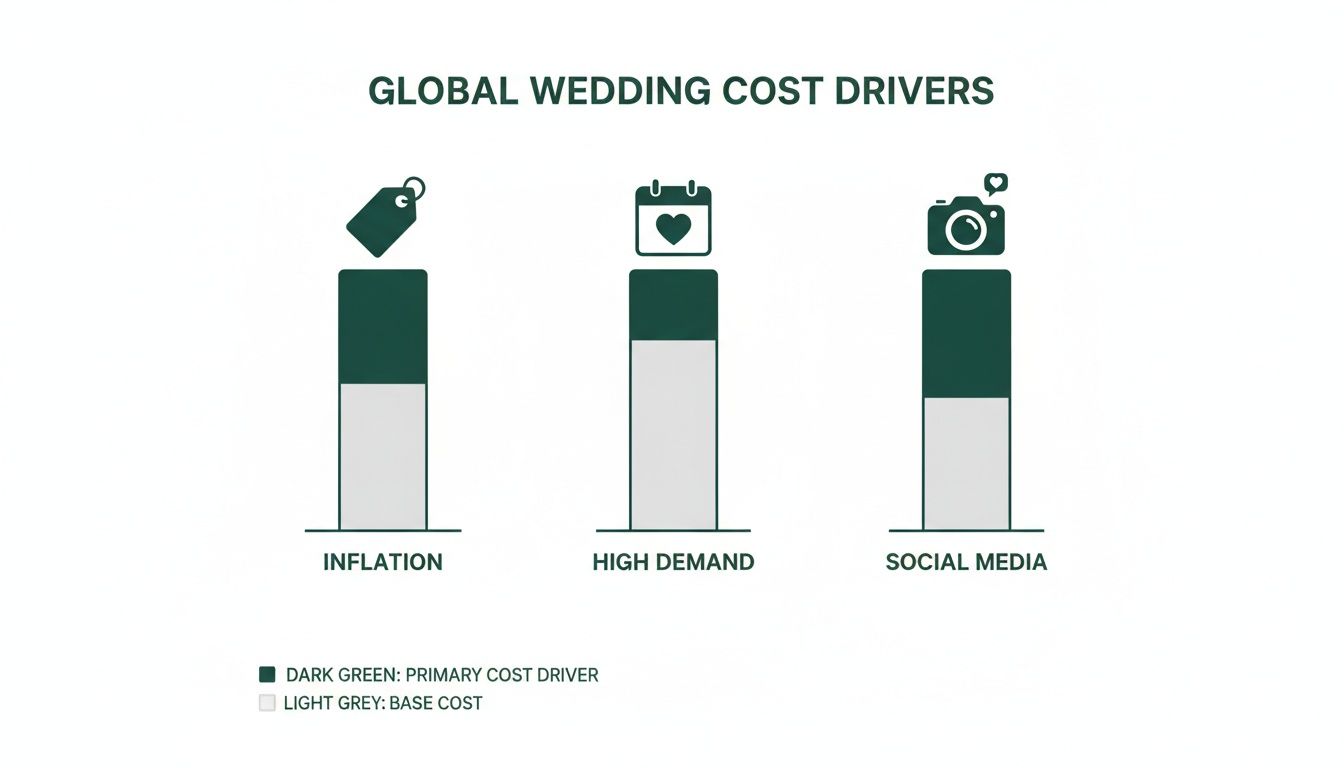
The chart below shows some of the major forces driving up vendor prices in 2026, from plain old inflation to the sky-high demand for top-tier professionals.
This really brings it home: the quotes you receive aren't pulled out of thin air. They're a direct reflection of broader economic trends and the simple reality of supply and demand for the best in the business.
The Vibe and Ambiance: Entertainment and Decor
This is where you bring the personality. Creating the right atmosphere is all about the music that gets people dancing and the decor that makes the space feel like you. Together, these categories typically make up another 15% to 20% of the budget.
For entertainment, you're usually choosing between a DJ and a live band. In 2026, a great wedding band is a significant investment. In the UK, for example, a quality four-piece band will likely run you £1,600 to £1,900. A fantastic DJ might be closer to the £1,056 mark. The right choice depends entirely on the vibe you're chasing.
Florals and decor are where your personal style truly comes to life, and the cost can swing wildly. A simple package with beautiful, seasonal flowers might start around $1,500. But if you're dreaming of a custom floral arch or dramatic ceiling installations, that number can easily climb past $7,000.
The Big Picture: Think of your budget less as a set of rigid rules and more as a reflection of your priorities. If having an epic live band is non-negotiable, you might decide to go with simpler floral arrangements to make it work. It's all a balancing act.
Attire, Rings, and All the Finishing Touches
The final 10% to 15% of your budget is reserved for all the other important details that pull the day together. This slice typically covers:
Attire and Beauty: This includes the wedding dress, suits or tuxedos, all the necessary alterations, plus professional hair and makeup.
Wedding Rings: The bands you'll wear for a lifetime.
Stationery: The full suite, save-the-dates, invitations, menus, and thank-you cards.
The "Just in Case" Fund: This is non-negotiable. Always, always set aside 5% to 10% of your total budget as a contingency. An unexpected cost will pop up, and having this buffer is the ultimate stress-reducer.
To help you visualize how this all comes together, we've put together a sample budget breakdown.
Sample 2026 Wedding Budget Allocation
Think of this table as a starting point, not a strict mandate. It shows how a typical $35,000 budget might get allocated based on standard industry percentages. Use it to guide your own planning, but feel free to adjust the numbers to better reflect what's most important to you.
Wedding Category
Percentage of Total Budget
Example Cost (on a $35,000 budget)
Cost-Saving Tip
Venue, Catering & Rentals
50%
$17,500
Opt for a Friday or Sunday wedding date for lower venue fees.
Photography & Videography
12%
$4,200
Hire a photographer for fewer hours (e.g., 6 instead of 10).
Entertainment/Music
8%
$2,800
Choose a talented DJ over a multi-piece live band.
Flowers & Decor
8%
$2,800
Repurpose ceremony flowers for the reception decor.
Attire & Beauty
7%
$2,450
Look into sample sales or non-traditional bridal shops.
Stationery
2%
$700
Use digital RSVPs and save-the-dates to cut printing costs.
Wedding Rings
3%
$1,050
Consider alternative metals like tungsten or palladium.
Contingency Fund
10%
$3,500
Protect this! It’s your safety net for unexpected expenses.
Seeing the numbers broken down like this makes everything feel so much more manageable, right? Instead of staring at one giant number, you now have a clear target for each vendor category.
Of course, tracking all of this can be a headache. Using a dedicated wedding budget app can streamline the entire process, helping you monitor spending in real-time, adjust allocations as you go, and keep your whole financial plan in one calm, organized space from day one.
How Location and Guest Count Drive Your Final Wedding Cost
Once you’ve got your budget percentages mapped out, it’s time to zoom in on the two factors that will stretch or shrink those numbers more than anything else: where you get married and who you invite.
These aren't just minor details. They're the core decisions that dictate the entire scale, complexity, and ultimately, the final price tag of your wedding. Grasping their power is how you gain real control over your spending and move from just reacting to vendor quotes to proactively building a wedding that fits your budget and your vision.
The Geographic Price Tag
Think of your wedding budget a lot like real estate, it’s all about location, location, location. A wedding for 150 guests in a major city like New York or London will cost dramatically more than the exact same event in a quieter, more rural area. And this isn't just about the venue fee. It touches everything.
Vendors in high-cost-of-living areas simply have higher overheads, from their studio rent to their insurance, and their pricing has to reflect that. A photographer in a bustling city might charge 30-40% more than a peer with similar talent in a less expensive region. This same logic applies right down the line, from your caterer to your florist.
This effect gets even more interesting with destination weddings. While they often mean a smaller guest list, the logistics can add new layers of cost. For instance, a traditional French wedding for 100 people might range from $25,000–$50,000. But, according to these insights on destination wedding costs, an event in Italy for the same number of guests could be anywhere from $43,650 to $92,850. Planning an event abroad requires a completely different financial playbook.
Your Guest List is Your Budget’s CEO
If your location sets the baseline cost, your guest list is the single most powerful dial you can turn to manage your spending. Every single person you invite isn't just one more meal; they're a direct, per-person expense that ripples through your entire budget.
Each guest is a multiplier. They don't just add one plate to the catering bill. They add a chair, a set of linens, a slice of cake, a favor, and a share of the open bar. This is where your budget can either spiral out of control or where you can find massive savings.
Let’s put some quick numbers to it. Say your all-in per-person cost for food and drinks is $150. Trimming just 10 names from your list instantly frees up $1,500. Cut 20 names, and you’ve suddenly got an extra $3,000, more than enough to upgrade your photography package or book that live band you've been dreaming about.
A Tale of Two Weddings: Seeing It in Action
To really see how this plays out, let's compare two different paths for a couple with a starting budget of $35,000.
Wedding A: The Big Local Celebration
They invite 150 guests at a per-person cost of $150. Their catering and bar tab alone eats up $22,500, or a whopping 64% of their total budget. This leaves just $12,500 for the venue, photographer, attire, music, flowers, and everything else. It’s certainly possible, but it means making some tough compromises.
Wedding B: The Intimate, Experience-Focused Affair
By thoughtfully trimming their list to 75 guests, their catering and bar total drops to just $11,250. This move instantly frees up $11,250, giving them a total of $23,750 to spend on securing their dream vendors and elevating the guest experience. Now, they can afford a more unique venue, a top-tier photographer, and incredible decor without feeling the financial pinch.
This shows a crucial truth of wedding planning: a smaller guest list doesn’t have to mean a smaller celebration, it means a more focused one. It gives you the freedom to pour your resources into the elements that truly matter most to you.
We know crafting this list is one of the most personal and challenging parts of planning, which is why we created a complete guide to building your wedding guest list to help you navigate it with confidence.
Making these big-picture decisions early, defining your ideal location and guest experience from the very start, is the secret to a calm, organized, and genuinely enjoyable planning process. It’s about building a solid plan from your inspiration, not just chasing quotes.
Alright, let's get down to the brass tacks. Seeing the average wedding cost for 2026 is one thing, but figuring out how to wrangle that number is a whole different ball game. The good news? You’re in the driver's seat.
Slashing your wedding budget isn't about sad, empty corners or giving up on the day you’ve been dreaming of. It’s about being smart. It's about making intentional choices that funnel your money toward what actually matters to you.
These aren’t your parents’ cost-cutting tips. We're talking about modern, clever ways to throw an incredible party that feels completely authentic without giving you a financial hangover.
Prioritize Your Top Three Non-Negotiables
Before you sign a single contract or put down a deposit, stop. Sit down with your partner and figure out your "Top Three." These are the three things that, if you nail them, will make the entire day a win.
Is it a jaw-dropping photographer, a live band that keeps everyone on the dance floor, and a top-shelf open bar? Or maybe it's securing that dream venue, serving unforgettable food, and finding a dress that makes you feel like a rockstar.
Once you know what they are, you have full permission to dedicate a real chunk of your budget to them. This single act of clarity makes everything else so much easier. Suddenly, you're not agonizing over every little decision. If a great DJ is perfectly fine instead of that 10-piece band, you just freed up thousands of dollars for that top-tier photographer you've been stalking on Instagram.
This isn't about restriction; it's about focus. Your budget stops being a rulebook and starts telling the story of what you value most.
Rethink Timing and Tradition
Some of the biggest savings are hiding in plain sight: on your calendar. The wedding world has its peak seasons and off-seasons, and a little flexibility can pay off, big time.
Choose an Off-Peak Date: Most couples get married between May and October. Venues and vendors know this, and their prices reflect the demand. A cozy winter wedding or a vibrant early spring celebration can be just as magical and way friendlier to your wallet.
Avoid Saturday: Saturday is the premium, prime-time slot for weddings. Just by shifting your day to a Friday or a Sunday, you can often see your venue rental fee drop by 15-20% or more. That's a huge win for a simple change.
Question Every Tradition: You have permission to skip any tradition that doesn’t feel like you. If you couldn't care less about elaborate wedding favors or a five-tiered cake, don't do it! Redirect that money toward something you're actually excited about, like hiring a late-night food truck or extending your bar service for an extra hour.
This is the key to planning a wedding without the stress. It’s not about having a cheaper wedding; it’s about having a smarter one, where your budget is a tool to build the exact experience you want.
Be Smart with Your Guest List and Vendors
Here’s a hard truth: your guest list is the most powerful lever you can pull to control your budget. Every single person you invite adds a per-head cost for catering, drinks, rentals, and more. Trimming your list, even by just a few tables, is the fastest way to slash your bottom line.
Let's be real, economic pressures are a major factor for anyone planning in 2026. A recent survey of over 600 engaged couples in the US found that roughly 8 in 10 said the economy has impacted their wedding plans. In response, couples are getting smarter. About 4 in 10 are actively tweaking their celebration, with 33% cutting back on décor and 30% spending more time comparing vendor quotes. For those who did trim their guest list, the average reduction was 29 guests, a move that can easily save thousands. You can dive deeper into how couples are adapting to 2026 wedding trends and economic factors.
Beyond the guest count, get savvy with your vendor hunt. Look for talented up-and-coming photographers or caterers who are still building their portfolios. Their rates might be lower, but their passion and skill are often just as high as the established players. Using a calm, intuitive workspace like ItsaYes makes it easier to track quotes and manage communications, so you can feel confident you’re making the best choice without the overwhelm.
Plan Your Wedding with Clarity and Confidence
Okay, let's pull all of this together. Think of the average wedding cost 2026 figures as a map, not a mandate. They show you the landscape, but you get to choose the destination. The perfect budget for your wedding is the one that actually feels like you, a reflection of your priorities, your guest list, and your story.
Here's a secret: avoiding financial stress isn't about magically finding more money. It’s about getting crystal clear on your vision and staying organized from the very beginning.
Instead of juggling spreadsheets, Pinterest boards, and scattered notes, imagine bringing your vision, tasks, budget, and timeline into one calm, intuitive workspace. This is where having a unified system can completely change the game, helping you move from inspiration to a structured plan.
From Inspiration to a Structured Plan
You begin by defining your style and ideas. The right platform helps you turn that inspiration into a clear plan, breaking the next 6 to 12 months into simple, manageable steps.
This simple shift moves you from scrambling to react to vendor quotes to proactively building a day that makes sense for you. Instead of just collecting prices, you’re building a budget that tells a story about what truly matters. You start making decisions with confidence, not just reacting to sticker shock.
The goal is to spend less time managing documents and more time actually enjoying your engagement. When your plan is clear, you feel in control. You feel organized. And you feel confident in every single choice you make.
This is the modern way to plan a wedding. Tools like ItsaYes are built for newly engaged couples who want to enjoy the process, stay organized, and feel confident, from first inspiration to a fully structured plan.
Your Personal AI Planning Assistant
Imagine having a personal AI assistant available 24/7 to suggest priorities, organize tasks, and keep everything moving forward without overwhelm. It's the engine that helps you nail down your vision and then breaks down the next six, twelve, or eighteen months into simple, manageable steps.
This kind of system gives you the clarity you need to genuinely enjoy the process. You can relax knowing your wedding plan is built on a solid foundation, freeing you up to focus on the actual joy of getting married.
Still Have Questions? Let's Clear Things Up.
Diving into the numbers can feel like you're trying to solve a puzzle with half the pieces missing. It's totally normal to have a few lingering questions. Here are some straight answers to the things couples are asking most about 2026 wedding costs.
How Much Should We Actually Plan to Spend in 2026?
Okay, let's talk real numbers. While you'll see the national average thrown around, hovering at about $35,000, that figure can be misleading. A more down-to-earth starting point for many couples is the median cost, which sits closer to $15,000.
Ultimately, the best budget isn't about hitting some magic number. It's about building a plan that feels right for you, reflecting your priorities, your city, and your guest list. The goal is to create something that lets you enjoy this season without constantly worrying about money. Start by figuring out your vision and guest count; those two decisions will steer your budget more than anything else.
Is It Really Cheaper to Get Married on a Weekday?
Yes, one hundred percent. Shifting your wedding to a Friday, Sunday, or even a weekday can unlock some serious savings. Venues and vendors have way more demand for Saturdays, so they often offer lower rates for off-peak days to fill their calendars.
This simple change isn't just a few bucks here and there, it can sometimes slice 15-20% or more right off the top of your biggest expense, the venue.
What Are the Biggest "Gotcha" Wedding Costs?
Every couple has them, those surprise expenses that weren't on the initial spreadsheet. Here are the most common culprits to watch out for:
Taxes and Service Fees: These are the big ones. Expect them to add an extra 20-30% on top of your final catering and venue bills. Always ask if they're included in initial quotes.
Alterations: That perfect dress or suit often needs a little tailoring to be truly perfect. This can easily tack on several hundred dollars.
Vendor Meals: Your hardworking team, photographer, planner, DJ, etc..will need to eat, too. Plan on providing a meal for each of them.
Postage: It seems small, but mailing out save-the-dates, invitations, and thank-you notes adds up, especially if you opt for custom stamps.
The single best defense against surprise costs is a contingency fund. Seriously. Setting aside 5-10% of your total budget for the unexpected is the smartest thing you can do to protect your peace of mind.
Can We Honestly Plan a Great Wedding for Under $10,000?
Absolutely. A beautiful, meaningful wedding for under $10,000 is completely possible, but it requires a shift in mindset. The key is ruthless prioritization.
This usually means a much smaller guest list (think intimate gathering), choosing a non-traditional venue like a favorite restaurant or a scenic public park, and getting creative with things like florals and decor. When you focus on creating an amazing experience for a smaller group of people, you can throw an unforgettable party that doesn't break the bank. It just takes a clear, organized plan to make every dollar count.
Feeling like you're drowning in spreadsheets and scattered notes? That's a sign you're doing it the hard way. ItsaYes brings your entire wedding plan—from the big vision and budget to the tiny tasks and timelines—into one calm, intuitive space. Turn your inspiration into an actual plan and start enjoying your engagement. Start planning with clarity at itsayes.io.