How much should a wedding photographer cost - A Practical Guide
22 min
How much should a wedding photographer cost - A Practical Guide
Author
The ItsaYes TeamAuthor
When you start looking at wedding photographers, the price tags can feel all over the place. The national average sits around $4,400, with most couples spending between $3,500 and $5,300. But that number is just a starting point. What really matters is understanding why those numbers are what they are, so you can build a clear, confident plan from the very start.
A Practical Guide to Wedding Photographer Costs
Why does one photographer quote a price that seems wildly different from another? Think of it like buying a car. You could go for a reliable, no-frills sedan, or you could invest in a luxury SUV with all the bells and whistles. Both are great, but they’re built for different experiences and budgets. Wedding photography works the same way.
A photographer's fee isn't just for the hours they spend with you on the wedding day. It’s an investment in their artistic eye, years of experience, professional gear, and the painstaking hours they'll spend editing your photos into perfect, timeless memories. For every single hour they're on their feet shooting, they'll likely spend another three to five hours in post-production.
Understanding the Investment
Your wedding photos are one of the few tangible things you'll have left after the big day is over, making them one of your most important investments. For couples using a platform like ItsaYes to bring their vision, tasks, and budget into one calm workspace, it helps to know that photography typically accounts for about 9% of the total wedding budget. This benchmark helps you set aside a realistic amount from the get-go.
This chart gives you a quick visual on the spending ranges you can expect to see.
As you can see, while the average is a useful guide, your final cost really hinges on the photographer's experience and the specific services you need.
Wedding Photographer Costs by Experience Level
The single biggest driver of a photographer's price is their experience. A talented newcomer still building their portfolio will cost less than a seasoned pro with a decade of weddings under their belt and a signature style that's in high demand.
To help you get a feel for the market, we've put together a table breaking down what you can generally expect to pay for different levels of experience. This should give you a solid baseline for what an 8-hour day of coverage might cost.
Experience Level
Typical Price Range (8 Hours)
What's Usually Included
Emerging/New Talent
$1,500 - $3,000
Basic coverage (6-8 hours), one photographer, and a digital gallery of edited high-res images.
Experienced Pro
$3,500 - $6,000
Full-day coverage (8+ hours), an engagement session, a second shooter, and a digital gallery.
Luxury/High-End
$7,000+
Bespoke coverage, multiple shooters, a high-end custom wedding album, and a premium client experience.
Ultimately, finding the right photographer is about striking a balance between your budget and the artistic vision you have for your day. By understanding these tiers, you can start your search with a clear head, focusing on professionals who are a perfect fit for both your style and your wallet.
Decoding the Price Tag of Your Photographer
So you've started getting quotes back. One photographer is $3,000, another is $10,000, and a few are somewhere in between. It's easy to get sticker shock and wonder what could possibly justify that massive difference.
Let's be clear: the price isn't arbitrary. It’s a reflection of experience, the actual work involved, and the final product you'll hold in your hands. Understanding what goes into that final number helps you see past the price tag and appreciate the real value you’re getting.
Think of it like commissioning a custom piece of furniture. The final cost depends on the quality of the wood, the artisan's skill, the complexity of the design, and the hours of labor. Your wedding photography is no different, it's a custom service built from several key components.
The Foundation of a Photographer's Fee
The easiest part to understand is hours of coverage. This is the literal time your photographer is on-site, camera in hand. Most packages are built around a standard 8-hour day, which usually gets you from the final stages of getting ready through the main reception events.
But here’s the part most couples don’t see: for every single hour they spend shooting your wedding, a professional photographer will spend another three to five hours in post-production. This is the painstaking process of culling thousands of images, color-correcting, and editing each photo to perfection in their signature style.
This is where the real magic happens. It’s what transforms a simple snapshot into a piece of art that tells the story of your day. So, that "one day of work" is actually a 40-60 hour commitment for a single wedding.
Experience and Expertise
A huge chunk of a photographer's fee comes down to experience. And just like you'd pay more for a seasoned surgeon, you invest more in a photographer who has navigated hundreds of weddings and honed their craft to a fine point.
What does that experience get you?
Anticipating the Shot: A veteran pro knows exactly where to be and when. They anticipate the tear rolling down a parent's cheek or the burst of laughter during a speech, capturing those fleeting moments an amateur would completely miss.
Technical Mastery: They are masters of light. Whether it's a dimly lit church or a harsh, sun-drenched beach, they know how to get the shot without fumbling with their gear. They just know.
Calm Under Pressure: Weddings are live events with zero do-overs. Things run late, weather changes, and timelines get chaotic. A seasoned photographer is a calming force, expertly managing the flow and navigating hiccups with grace.
This level of expertise is built over years and backed by a serious investment in professional-grade equipment, often upwards of $20,000 worth of cameras, lenses, and lighting.
Your Final Deliverables and Add-Ons
The final price is also shaped by what you actually receive after the wedding. A digital gallery of high-resolution images is pretty standard, but many packages include tangible keepsakes or extra services that add to the cost.
A second photographer, for example, is one of the most valuable add-ons you can get. They offer a completely different perspective, capture moments happening simultaneously (like both partners getting ready), and provide way more coverage of your guests and venue details.
Other common factors that influence how much a wedding photographer should cost include:
Heirloom Wedding Albums: These aren't your drugstore photo books. Custom-designed, high-quality albums are a significant investment in both materials and the photographer’s design time.
Engagement Sessions: Often bundled into larger packages, these shoots are a fantastic way to get comfortable in front of the camera and get to know your photographer before the big day.
Travel and Accommodation: If your wedding is outside the photographer's local service area, their quote will need to factor in travel time, gas, and any necessary lodging.
Knowing these components empowers you to have a much clearer conversation with potential photographers. Instead of just looking at the bottom line, you can discuss what’s included and build a package that truly fits your vision and budget, a process you can track and manage easily inside the ItsaYes platform.
Location, Location, Location: How Geography Affects Cost
You know that old real estate mantra? "Location, location, location." Well, it applies just as much to wedding photography as it does to buying a house.
The price a photographer in downtown Manhattan quotes you will look wildly different from one in rural Kansas, and for good reason. It’s not arbitrary. A photographer’s business expenses, their insurance, studio rent, marketing, even their groceries, are all tied directly to the local cost of living.
Think of it this way: to run a sustainable business, their pricing has to reflect the economic reality of where they live and work. A higher cost of living means higher overhead, and that inevitably shapes the final price you see on their packages. Understanding this from the start is the key to setting a realistic budget and avoiding that dreaded sticker shock.
Regional Price Variations Across the US
The wedding photography market isn't one-size-fits-all; it's a patchwork of local economies. Data consistently shows that couples in some parts of the country spend significantly more than others. For example, budgets in the Mid-Atlantic and Northeast are often the highest, while couples in the Southwest tend to find more budget-friendly options. You can explore more about these regional pricing trends and see how your area stacks up.
To give you a clearer picture, let's break down what you can generally expect to invest in different parts of the country.
Average Wedding Photography Costs by US Region
This table gives you a snapshot of the average investment for wedding photography across the United States. Use it as a guide to see if the quotes you're getting are in line with what’s typical for your wedding's location.
US Region
Average Cost Range
Key Market Characteristics
Northeast (e.g., NY, MA, NJ)
$5,500 – $12,000+
Sky-high demand, a major hub for luxury photographers, and a very high cost of living.
Mid-Atlantic (e.g., PA, VA, MD)
$5,000 – $10,000+
A super competitive market with tons of historic, high-demand venues that drive prices up.
West Coast (e.g., CA, WA, OR)
$4,500 – $9,000+
Major cities like LA and San Francisco command top dollar, with more moderate prices as you move away from urban centers.
Midwest (e.g., IL, OH, MI)
$3,500 – $7,000
Costs are highest in big cities like Chicago but become much more affordable in smaller towns and rural spots.
South (e.g., GA, FL, TX)
$3,500 – $7,500
A huge, diverse market where pricing can vary dramatically from one city to the next.
Southwest (e.g., AZ, NM, UT)
$3,000 – $6,500
Often the most budget-friendly region, offering incredible value for those stunning desert and mountain backdrops.
This isn't just about knowing what to expect; it's about seeing the full picture. A $7,000 package in Chicago might get you something very different than a $7,000 package in Phoenix, purely because of what it costs each photographer to operate their business.
Using Location to Your Advantage
Knowing this doesn't just prepare you for local prices, it opens up some smart budgeting strategies.
For instance, if you live in a high-cost city but are planning your wedding in a more affordable region, you might find your photography budget stretches way further. You could potentially afford a more experienced photographer or a more comprehensive package than you could back home.
On the flip side, if you're planning a destination wedding in a pricier spot like New York or California, you need to factor that into your financial plan from day one. This is where a tool like ItsaYes becomes invaluable.
When you begin by defining your style and ideas, the platform helps you turn that inspiration into a clear plan. It can then break the next 6 to 12 months into simple, manageable steps, ensuring your budget is grounded in the reality of your chosen location and giving you the confidence to build your dream team without the stress.
Building a Smart Photography Budget
Knowing the national averages for photography is a great start, but the real work begins when you have to make those numbers fit your wedding. Building a smart photography budget isn't about hitting some magic number; it's about making sure your spending actually reflects what’s important to you. This is where abstract figures become a real, actionable plan.
The very first step is to get a solid baseline. A good rule of thumb in the wedding world is to set aside between 9% and 15% of your total wedding budget for photography. This simple percentage gives you a realistic starting point and ensures your photo investment makes sense in the context of your overall spend.
Translating Percentages into Dollars
Okay, but what does that percentage actually look like in the real world? Let’s break it down with two common wedding budget scenarios. Seeing the numbers side-by-side really helps connect the dots between your total spend and your photography fund.
Here’s a practical look at how this plays out:
For a $30,000 Wedding: Applying the 9-15% rule, you’re looking at a photography budget between $2,700 and $4,500. This range is a fantastic sweet spot, often covering talented up-and-coming photographers or solid, experienced local pros. You can typically expect essentials like 8 hours of coverage and a full digital gallery.
For a $70,000 Wedding: At this level, your photography budget jumps to between $6,300 and $10,500. This opens the door to high-end and even luxury photographers, giving you access to comprehensive packages that might include a second shooter, a beautiful heirloom album, and an engagement session.
These examples show that figuring out "how much a wedding photographer should cost" is less about finding a single price tag and more about what’s proportional to your unique celebration. The goal is to land on a number that feels intentional and balanced.
A well-structured budget is your roadmap to a stress-free wedding plan. It allows you to make confident decisions, knowing every dollar has a purpose and aligns with your vision for the day.
What if Photography Is Your #1 Priority?
For many couples, the photos are everything. They're the one tangible thing you’ll have to look back on for the rest of your lives. If that sounds like you, then it’s more than okay to adjust your budget to reflect that priority.
This doesn't mean you have to magically find more money. It’s all about strategic allocation. If you decide to dedicate 20% or even 25% of your budget to lock in that dream photographer, you can balance the books by making thoughtful cuts elsewhere.
Think about where you can be more flexible:
Florals: Could you opt for gorgeous, in-season flowers instead of pricier, out-of-season blooms?
Stationery: Would elegant digital invitations achieve the same goal as an elaborate paper suite?
Favors: Could you choose a simple, heartfelt favor or make a donation to a charity you love in your guests' names?
Making these kinds of trade-offs is a deeply personal decision, and it’s all about what matters most to you. The whole point is to feel empowered by your budget, not restricted by it.
This is where a good tool becomes your best friend. For instance, the ItsaYes wedding budget app lets you play with these numbers in real-time. You can slide money from one category to another and instantly see how it impacts your overall plan, ensuring every choice supports your main goal: getting the stunning, timeless photos you've always wanted.
Key Questions to Ask Before Signing the Contract
That first call with a potential photographer is so much more than a price check. Think of it as an interview for one of the most important roles on your wedding day. You're not just hiring another vendor; you're choosing an artist and a partner who will be right there with you through all the intimate, emotional, and fast-paced moments.
Trust is everything. To make sure you’re making a confident choice, you need to dig deeper than just their package prices. Asking the right questions helps you understand their professionalism, what they’ll do if things go wrong, and exactly what to expect after the confetti settles. This checklist is designed to get those crucial details out in the open and prevent any misunderstandings down the road.
Clarifying Logistics and Style
Before you even glance at a contract, you need to be sure their working style and practical approach actually fit your vision. These first questions establish a baseline for how they'll operate on the day.
Have you shot at our venue before? If the answer is no, don't panic. The follow-up is what matters: "How do you prepare for a new location?" A pro will scout it out beforehand, either in person or by doing some serious online research to map out lighting and find the best spots.
How would you describe your shooting style? Are they a fly on the wall, capturing moments as they happen (photojournalistic)? Or do they prefer to direct and pose shots for that perfect composition (traditional/fine art)? Make sure their answer matches the vibe you're going for.
What’s your plan for bad weather? Rain happens. A seasoned pro won't flinch. They'll have a solid backup plan ready to go, complete with specific indoor locations, creative ideas for rainy-day shots, and the gear to handle it.
These aren't just checkbox questions. They're about building confidence that this person can handle the unique circumstances of your wedding, no matter what the day throws at them.
Understanding the Deliverables and Timeline
This is where you get into the nitty-gritty of what you'll receive and when. Vague answers here can lead to major frustration later, so now is the time for absolute clarity.
The post-wedding excitement is real, and knowing exactly when and how you'll get to relive your day through photos is huge. A clear delivery timeline isn't just a nice-to-have; it's the hallmark of a professional.
Get specific answers to these questions:
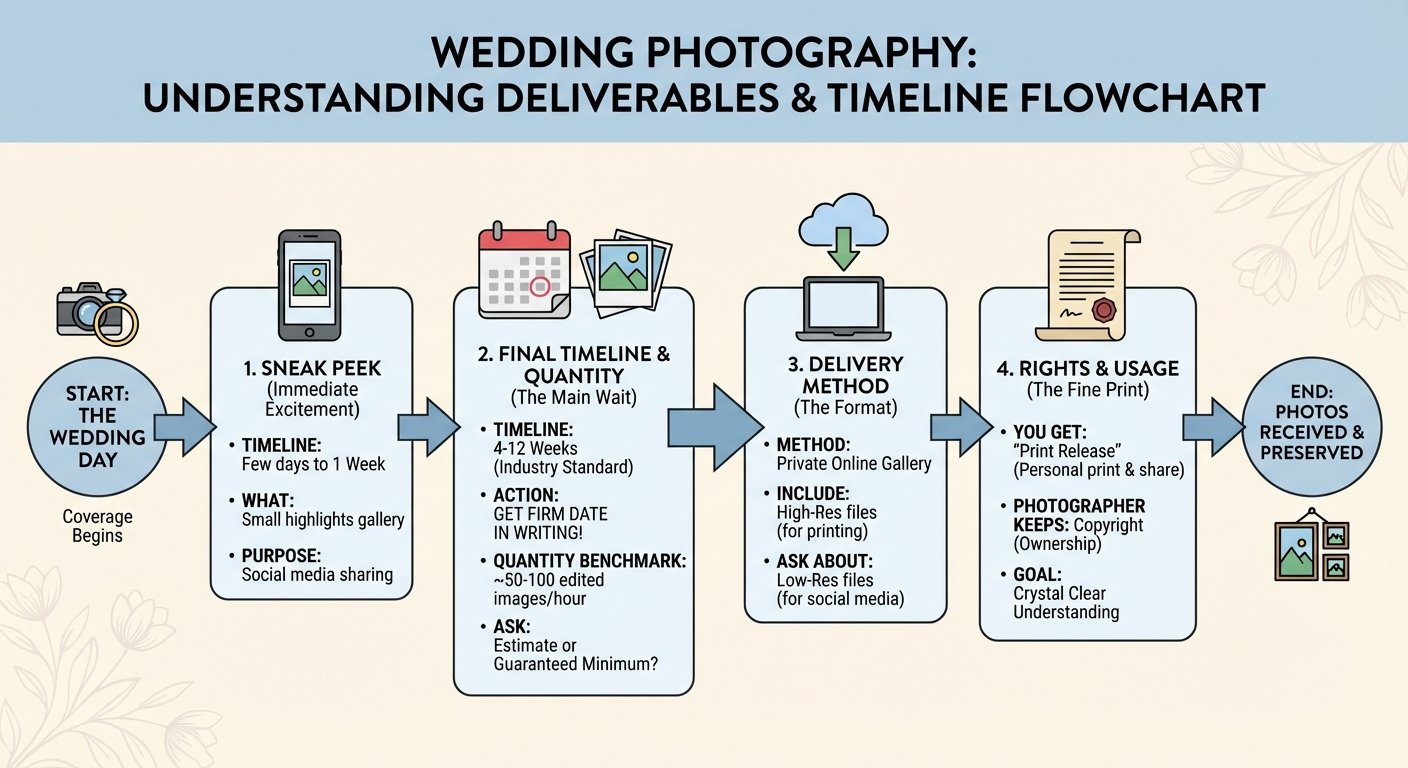
When will we receive a sneak peek? Most photographers will send a small gallery of highlights within a few days to a week. This is perfect for sharing on social media while the excitement is still fresh.
What is the final delivery timeline for the full gallery? The industry standard is anywhere from 4 to 12 weeks, depending on the season and their workload. Get a firm date or timeframe in writing.
How many edited images can we expect? This number varies wildly, but a good benchmark is around 50-100 images per hour of coverage. Ask if this is a rough estimate or a guaranteed minimum.
How will the photos be delivered? You should expect high-resolution digital files (for printing) through a private online gallery. It's also worth asking if they include low-resolution files specifically for social media.
What are our rights for printing and sharing? You’ll almost certainly get a "print release," which lets you print and share the photos for personal use. The photographer, however, retains the copyright. Make sure you're crystal clear on what this means.
This is also the perfect time to talk about how the photography schedule will flow with the rest of your day. For more on that, check out our complete wedding photography timeline guide.
Navigating Contracts and Contingencies
The contract is your safety net. It protects both you and the photographer by making sure everyone is on the same page. Don't ever feel shy about asking for clarification on a clause you don’t fully understand.
Here are the key things to look for:
What is your cancellation or postponement policy? Life is unpredictable. Understand the financial implications if you have to change your date or, in a worst-case scenario, cancel.
What happens if you're sick or have an emergency? A true professional has a plan B. They should have a network of trusted photographers they can call on to cover for them, ensuring you're never left scrambling.
Do you have liability insurance? This is non-negotiable. Many venues now require it, and it's a clear sign you’re working with a legitimate business.
By asking these questions, you move beyond just figuring out a price and into a real understanding of the value, security, and peace of mind a great photographer provides. A little preparation now ensures you book a true partner for your wedding day.
Streamlining Your Photographer Search with ItsaYes
Let's be honest. Juggling vendor spreadsheets, chasing down contracts, and deciphering endless email threads is where the joy of wedding planning goes to die. It’s overwhelming, messy, and the fastest way to turn a creative process into a logistical nightmare.
Imagine, instead, a single, calm workspace that does the heavy lifting for you. That’s exactly what ItsaYes was built for. Instead of scattered notes and Pinterest boards, it brings your vision, tasks, budget, and timeline into one intuitive hub.
We help you turn your inspiration into a clear plan, breaking the next 6 to 12 months into simple, manageable steps so you can enjoy the process and feel confident. Forget frantically updating spreadsheets; with ItsaYes, you can drop photographer proposals directly into your financial plan and instantly see how each option stacks up. No calculators, no surprises.
Turning Chaos into Clarity
Once you've defined your style and ideas, your personal AI assistant steps in. It's available 24/7 to suggest priorities, organize tasks, and keep everything moving forward without the overwhelm. It takes the mountain of "find a photographer" and turns it into a structured, step-by-step path.
Here’s how ItsaYes keeps you on track:
Centralized Communication: All your messages with potential photographers live in one spot. No more frantic inbox searches to find that one specific quote.
Automated Reminders: We’ll set up automatic nudges for deposits and final payments. You'll never miss a critical deadline again.
Contract Hub: Every vendor contract is stored securely in one place, ready for you to review whenever you need peace of mind.
The whole point is to get you from first inspiration to a fully structured plan without the stress. We handle the logistical grunt work so you can focus on what actually matters—your vision for the day.
Your Personal AI Planning Assistant
Think of your AI assistant as your 24/7 planning partner. It helps you figure out what to do next, suggests smart questions to ask photographers based on your budget, and keeps the entire process moving forward. This is especially powerful when you’re trying to figure out how much a wedding photographer should cost for your specific wedding.
By connecting your vision, your to-do list, and your budget, ItsaYes makes sure every decision you make is clear and confident. Instead of drowning in details, you get to actually enjoy building your dream team of vendors.
You can see exactly how our platform helps you organize everyone with our wedding vendor manager feature. It’s all about making the journey to your wedding as beautiful as the day itself.
Your Photographer Questions, Answered
The world of wedding photography has its own language and unwritten rules. It's totally normal to have a few lingering questions as you get ready to book. Let's clear up the common ones so you can sign that contract with total confidence.
Think of this as the final check-in before making one of your most important wedding decisions.
Is an Engagement Session Usually Included?
Often, yes especially with mid- to upper-tier packages. Most experienced photographers love including an engagement session because it’s their chance to build a real rapport with you. It’s basically a practice run that helps you both get comfortable in front of the camera before the high-stakes moments of the wedding day.
For more basic or entry-level packages, you'll likely see it offered as an optional add-on. Just be sure to double-check the package details so you know exactly what you’re getting for your money.
Will I Have to Pay for the Photographer's Travel?
It all comes down to their travel policy and your venue’s location. The vast majority of photographers will include travel within a certain radius of their home base, often around 50 miles, right in their base price.
If your wedding is further afield and requires a flight, a long drive, or an overnight stay, you should plan on covering those expenses. This should always be spelled out clearly in your contract, so there are absolutely no last-minute surprises.
What Is a Print Release Versus Copyright?
This is a huge one, and it's critical for every couple to understand the difference. You will almost always get a “print release.” This gives you the legal permission to download your photos, print them wherever you like, and share them on social media with friends and family for personal use.
The photographer, however, almost always retains the “copyright.” This means they are the legal owner of the images and have the right to use them in their portfolio, on their blog, or for marketing their business. A full copyright transfer is incredibly rare and usually comes with a very steep price tag.
How Much Should I Tip My Wedding Photographer?
Tipping isn't a hard-and-fast rule, but it’s always a thoughtful gesture of appreciation. This is especially true if the photographer owns their own business and truly went above and beyond for you.
A tip of $100-$200 for the main photographer is a common and generous way to say thank you. If they brought a second shooter or an assistant who was also amazing, $50-$100 for them is a kind gesture they'll definitely appreciate. That said, one of the best "tips" you can possibly give is a glowing online review, it helps their small business more than you know.
Planning a wedding involves countless details, but it doesn’t have to feel like a second job. With ItsaYes, you can turn all that inspiration into a clear, structured plan. Our AI-powered system helps you manage your budget, tasks, and vendors in one calm workspace, giving you the confidence to enjoy the journey from engagement to your big day. Start planning with clarity at https://itsayes.io.