TL;DR: A 3-tier wedding cake typically costs $284 to $605 in the U.S. and usually serves 50 to 150 guests, based on 2025 national pricing data. That range gives most couples a solid planning starting point, but your final total depends on choices like guest count, finish, and decoration style.
You’ve probably already seen it happen.
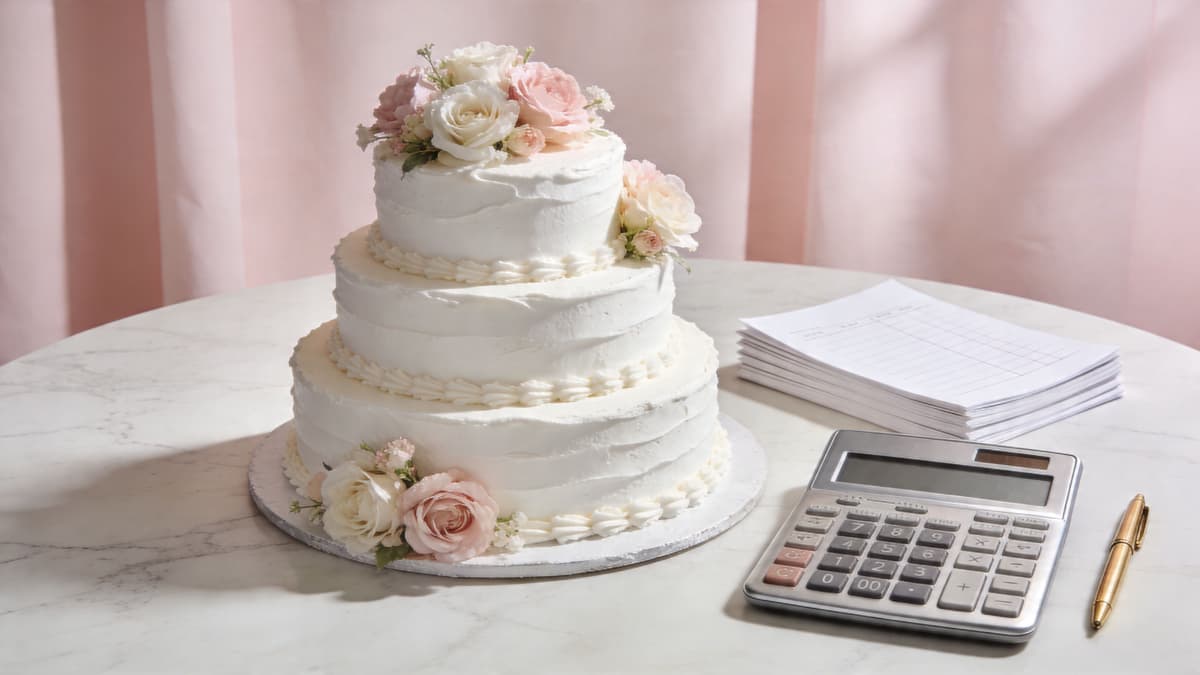
You save a few cake photos. One is smooth white buttercream. One has soft floral piping. One has sugar flowers trailing down every tier. They all look like “wedding cake” in your mind, so you assume they live in roughly the same price range.
Then the bakery quote lands in your inbox, and suddenly cake feels confusing.
Some couples think they’re paying for flour, sugar, and frosting. Bakers price something very different. They’re pricing servings, hours of labor, decoration work, transport, and the risk of delivering a fragile centerpiece on one of the most important days of your life. That’s why 3 tier wedding cake prices can feel so unpredictable at first.
The good news is that the cost usually becomes much clearer once you stop looking for one magic number and start looking at a few choices you can control. Size matters. Design matters. Guest count matters. A lot of the stress comes from not knowing which decision changes the budget the most.
Your First Taste of Wedding Cake Sticker Shock
A couple books their tasting after a week of pinning elegant cakes online. They walk in expecting a straightforward choice: vanilla or chocolate, buttercream or fondant, three tiers because that feels classic.
The confusion usually isn’t about whether a wedding cake is worth paying for. It’s about why one 3-tier cake seems reasonable and another jumps so quickly in price. To a newly engaged couple, both may look beautiful. To a baker, they can represent very different amounts of work.
Why the first quote feels so surprising
Pinterest can flatten price differences. A cake with a clean buttercream finish and a cake covered in hand-crafted sugar flowers may appear equally attainable when you’re scrolling quickly.
That’s where sticker shock starts. You’re not comparing ingredients. You’re comparing labor, detail, and serving size, even if you don’t realize it yet.
A wedding cake quote often makes more sense once you read it like a custom design invoice, not a grocery bakery price tag.
What most couples are actually trying to figure out
Usually, the actual question isn’t “How much is a 3-tier cake?” It’s this:
Can this serve our guest list
Can it match the style we saved
Can it fit our budget without creating stress elsewhere
Those are good questions. They’re also much easier to answer when you break the cake into decisions instead of treating it like one giant expense.
If you’re newly engaged, this is a normal place to feel unsure. Cake pricing isn’t random, and it isn’t a secret. Once you understand what bakers are charging for, the numbers stop feeling arbitrary and start feeling usable.
The Average Price of a 3 Tier Wedding Cake
The clearest starting point is the national average.
In the U.S., the national average cost for a 3-tier wedding cake ranges from $284 to $605, according to Thumbtack’s wedding cake pricing data. That same pricing guidance places a 3-tier cake in the middle of the tiered-cake market and notes that it typically serves 50 to 150 guests.
That range matters because it answers two questions at once. First, it gives you a realistic planning benchmark. Second, it tells you that a 3-tier cake is often a practical fit for many weddings, not just a visual choice.
What that average really includes
Averages don’t describe one exact cake. They describe a band of possibilities.
A cake near the lower end of the range is usually simpler in design, easier to produce, and less labor-heavy. A cake near the higher end often reflects more customization, more decoration time, or a bakery in a more expensive market.
Thumbtack’s broader wedding cake average is $379, while The Knot’s 2024 average for wedding cakes is $540, so a 3-tier cake often lands in a familiar mid-range budget zone rather than sitting in a category by itself.
Why guest count changes how that average feels
For some couples, a 3-tier cake sounds large. For others, it sounds modest. The difference usually comes down to guest count.
A 3-tier cake serving 50 to 150 guests can be right-sized for a smaller reception, a medium-sized wedding, or a larger gathering depending on how the baker portions it. That’s why two couples can both order a 3-tier cake and still receive very different quotes.
A simple way to think about it:
Cake size
Typical role in planning
1 tier
Best for a small event or display-style use
2 tier
A step up for modest guest counts
3 tier
A classic middle ground for many weddings
4 to 5 tier
More visual impact and often more servings
The average helps. It just shouldn’t be treated like a guarantee. If you remember one thing, let it be this: 3 tier wedding cake prices usually start with serving needs, then move up or down based on design.
Breaking Down Your Cake's Price Tag
Most bakers don’t start with “three tiers” and assign a flat fee. They usually start with servings.
Wedding cake pricing primarily follows a per-serving model, with bakeries charging $3 to $8 per slice on average, according to Zola’s guide to wedding cake costs. Zola also notes that a 3-tier cake for 100 guests at $6 per serving starts at a base cost of $600 before complex design fees are added.
That’s the part many couples miss. The base price is only the beginning.
Start with the servings
Think of cake pricing the way you’d think about ordering a custom meal for a crowd. More guests means more portions, more batter, more filling, more frosting, and often larger tiers that are harder to stack and decorate.
That’s why guest count is the most direct cost driver.
If your guest list changes, your cake budget usually changes with it. Not always dramatically, but predictably.
Then add the custom work
After the servings are set, bakers layer on the rest of the price.
Here’s what usually shapes the final quote:
Ingredients: Standard flavors and finishes are typically simpler to price than specialty combinations.
Labor and expertise: Baking, leveling, filling, stacking, frosting, smoothing, and decorating all take time.
Delivery and setup: Transporting a tiered cake safely to a venue is part logistics, part nerves of steel.
Business overhead: Equipment, kitchen costs, staffing, and admin time are built into professional pricing.
Why this helps you ask better questions
When you understand the quote structure, bakery conversations get much easier.
Instead of asking, “Why is this cake so expensive?” you can ask:
What serving count is this quote based on
Which design elements are adding the most labor
Would a simpler finish keep the overall look but lower the total
Is delivery and setup included
Practical rule: If you want to control the budget early, tighten the guest count before you refine the decoration details.
That one shift helps because servings create the base. Design builds on top of it.
A calmer way to read a quote
A wedding cake isn’t priced like an off-the-shelf product. It’s closer to custom furniture. Two tables may both seat six people, but one is plain oak and one is hand-carved with specialty finishes.
The same goes for cake.
Once you read the quote in layers, the total becomes easier to understand. You’re not paying for “three tiers.” You’re paying for a cake that serves your people and matches your style, built by someone whose work has to look flawless in photos and survive delivery.
How Design Choices Multiply Your Costs
If guest count sets the base price, design is often what changes the number fastest.
Cake design complexity acts as a multiplier, not just a small add-on. According to Nikoo Cake’s 3-tier wedding cake guide, elaborate details like hand-crafted sugar flowers or fondant decorations can increase prices by $100 to $500+, which amounts to a 25 to 75% premium over the base price. The same guide notes that a simple buttercream design might take 2 to 3 hours of labor, while intricate artisan work can take over 8 hours.
That labor difference is why two cakes with the same number of servings can end up in very different budget categories.
Simple design versus labor-heavy design
A smooth buttercream cake with restrained decoration can be elegant and efficient. A fondant-covered cake with detailed piping, metallic accents, and sugar flowers asks much more from the baker.
Those details don’t just add material. They add time.
Here’s how that usually plays out in real decision-making:
Design choice
Budget effect
Smooth buttercream
Lower labor demand
Textured frosting or detailed piping
More finishing time
Fondant covering
More technical work
Handmade sugar flowers
High labor and artistry
Painted or metallic details
Specialty finish work
How to read your inspiration photos
Your saved images can tell you a lot about likely pricing.
If most of your cake photos feature crisp fondant edges, realistic flowers made of sugar, monograms, lace effects, or hand-painted details, you’re probably looking at a design-forward cake. If your board leans toward soft buttercream, fresh flowers, and minimal decoration, you’re often in a more flexible budget zone.
That doesn’t mean one style is better. It means each style asks for a different level of craft.
The fastest way to underestimate cake cost is to treat decorative labor as if it’s a small finishing touch.
If you’re also comparing larger statement cakes, this visual guide to a four-tier cake can help you see how extra scale and formal presentation often shift both look and budget expectations.
The best question to ask yourself
Before you send a bakery inquiry, ask this: What part of this cake matters most to me?
Maybe it’s the silhouette. Maybe it’s the flowers. Maybe it’s having a clean, classic centerpiece that photographs well. Once you know that, it’s easier to simplify everything else.
That’s where many couples save money without feeling like they settled.
Sample Pricing Scenarios for 3 Tier Cakes
Real numbers become easier to understand when you can picture the couple making the choices.
The Knot’s 2025 guest-based pricing shows that cakes for 1 to 50 guests average $315, cakes for 51 to 100 guests average $487, and cakes for 101+ guests average $631, according to The Knot’s wedding cake cost guide. That guest scaling gives us a useful base for understanding how style choices push a 3-tier cake quote up or down.
Below are three ways a 3-tier cake for roughly 100 guests can take shape.
The classic and chic couple
They want something timeless. White buttercream, soft texture, and clean tiers. They care more about the overall look than intricate detail work.
This type of cake usually stays closer to the base pricing logic for that guest count. The design is polished, but it doesn’t ask the baker for highly specialized decorative labor.
A quote in this zone often feels manageable because the couple has made one important decision early: keep the finish simple.
The modern and custom couple
They want stronger styling. Maybe a more refined finish, some fondant work, or a more personalized visual direction.
A quote can move upward even if the cake still serves the same number of guests. The cake isn’t necessarily bigger. It’s just more customized.
The cost difference comes from time and precision. More refinement means more hands-on work.
The luxury and lavish couple
They want the cake to be part centerpiece, part showpiece. Think sugar flowers, metallic details, or extensive handcrafted decoration.
At that point, the design starts to drive the number as much as the serving count. The cake becomes a decorative focal point, not just a dessert service item.
A useful planning habit is to separate “feeds our guests” from “creates visual impact.” Once you know which one matters more, pricing gets easier to shape.
Side-by-side scenario table
Style Tier
Design Details
Estimated Per-Slice Cost
Total Estimated Price
Classic and Chic
Smooth or lightly textured buttercream, minimal décor
$3 to $8
Around the guest-count average, with the final total often staying closer to the lower end when design remains simple
Modern and Custom
More tailored finish, selected custom details, moderate labor
$3 to $8 plus added design costs
Often higher than the average for 51 to 100 guests because customization increases labor
Luxury and Lavish
Fondant work, sugar flowers, or other intricate artisan details
$3 to $8 plus more substantial design premiums
Frequently rises well above base guest-count pricing because decoration becomes a major cost driver
How to use these examples
The point of sample scenarios isn’t to predict your exact quote. It’s to show why broad averages can still lead to very different real totals.
If your wedding cake vision is simple, the guest-count average may be a strong planning anchor. If your vision is more decorative, use the average as the floor, not the ceiling.
That mindset prevents one of the most common budgeting mistakes: assuming all 3 tier wedding cake prices are mostly about size. They aren’t. A lot of the variation comes from the style choices attached to that size.
Smart Strategies to Save on Your Wedding Cake
The easiest way to save on cake isn’t to strip away everything you like. It’s to choose the parts that matter most and simplify the rest.
Save on labor before you sacrifice style
Most cake savings come from reducing labor-heavy design choices.
That’s why these moves often work well:
Choose buttercream over fondant: A smooth buttercream finish can still look refined while avoiding some of the extra labor that fondant designs often require.
Use fresh flowers from your florist: If your baker allows it, fresh blooms can create a romantic look without the time involved in making sugar flowers by hand.
Stick with standard flavors: If your priorities are appearance and guest experience, a classic flavor can keep the quote simpler.
Limit highly detailed accents: One statement element usually has more impact than multiple intricate techniques layered together.
For couples trying to keep the full celebration in balance, this guide to wedding planning on a budget is useful because cake savings usually work best when they’re part of an overall spending plan, not a last-minute cut.
Pick one feature to be the hero
A cake can be memorable without doing everything at once.
If you love sugar flowers, maybe skip metallic detailing. If you want a sleek fondant silhouette, maybe keep the tiers otherwise minimal. If you care most about flavor, keep the finish cleaner.
That approach tends to produce a stronger design anyway. It looks intentional.
Here’s a helpful visual refresher on what refined cake styling can look like in practice:
Ask your baker where simplification helps most
Bakers usually know exactly which choices are driving the quote. Ask them what they’d change if your goal were to keep the same overall feel while making the design more efficient.
You might hear suggestions like:
Keep the same shape but remove hand-modeled details.
Use texture instead of custom appliqué.
Decorate the front-facing side more heavily and simplify the back.
Focus the detail on one tier instead of all three.
Those changes often preserve the look guests notice while trimming the parts that create the biggest labor load.
Integrating Your Cake into Your ItsaYes Wedding Plan
Cake decisions get easier when they sit inside the rest of your planning process instead of floating around as a separate stress point.
Start by creating a dedicated cake line in your budget. Use your guest list as the anchor, then compare that baseline against the style direction you want. That gives you a working number before you ever request a quote.
A budget tool matters here because cake isn’t an isolated purchase. It connects to florals, reception design, and dessert service. If you’re mapping all of those pieces together, a structured tool like the ItsaYes wedding budget app helps you keep the cake number visible as other choices evolve.
Add cake tasks to your timeline
Once your budget line exists, turn the cake into a sequence of tasks rather than one vague item.
A simple planning flow looks like this:
Collect inspiration images
Confirm approximate guest count
Research bakers
Schedule tastings
Request quotes
Book your baker
Finalize design closer to the wedding
That timeline matters because cake design often overlaps with broader reception decisions. If you’re also working through venue flow, dessert display, and guest experience, this article on planning your wedding reception can help you think through how cake fits into the event as a whole.
Keep the visual choices tied to the budget
Inspiration boards are useful. They become much more useful when each image is paired with a note about what you like in it.
Is it the shape? The flowers? The piping? The simplicity?
That small habit prevents expensive misunderstandings. It also helps you communicate clearly with your baker when it’s time to narrow down the design.
Common Wedding Cake Pricing Questions
A few questions tend to come up after couples understand the basics.
How far in advance should you book your cake baker
Book once you’ve chosen your venue, date, and a working guest estimate. Popular bakers can fill up quickly, especially in busy wedding seasons.
You don’t need every decorative detail finalized on day one. You do need your date secured with the baker you want.
Are cake tastings free
It varies by bakery.
Some include tastings as part of the consultation. Others charge a tasting fee, and some may apply that fee toward your final order if you book. Ask before scheduling so there are no surprises.
Do dummy tiers save much money
Sometimes, but not always as much as couples expect.
Dummy tiers may reduce the amount of edible cake needed, but they don’t automatically remove the decorative labor. If the outside still requires the same finish and styling, the savings may be smaller than expected.
What should you ask in a cake consultation
Keep your questions practical. Ask what the quoted serving count is, which design features are increasing the price, whether delivery and setup are included, and how they prefer you to share inspiration images.
A vendor question list helps here. This roundup of questions to ask wedding vendors is a useful starting point if you want your consultations to feel organized instead of improvised.
If you want one calm place to organize your cake budget, guest count, vendor tasks, and design ideas, ItsaYes helps you turn scattered inspiration into a clear wedding plan from the start.