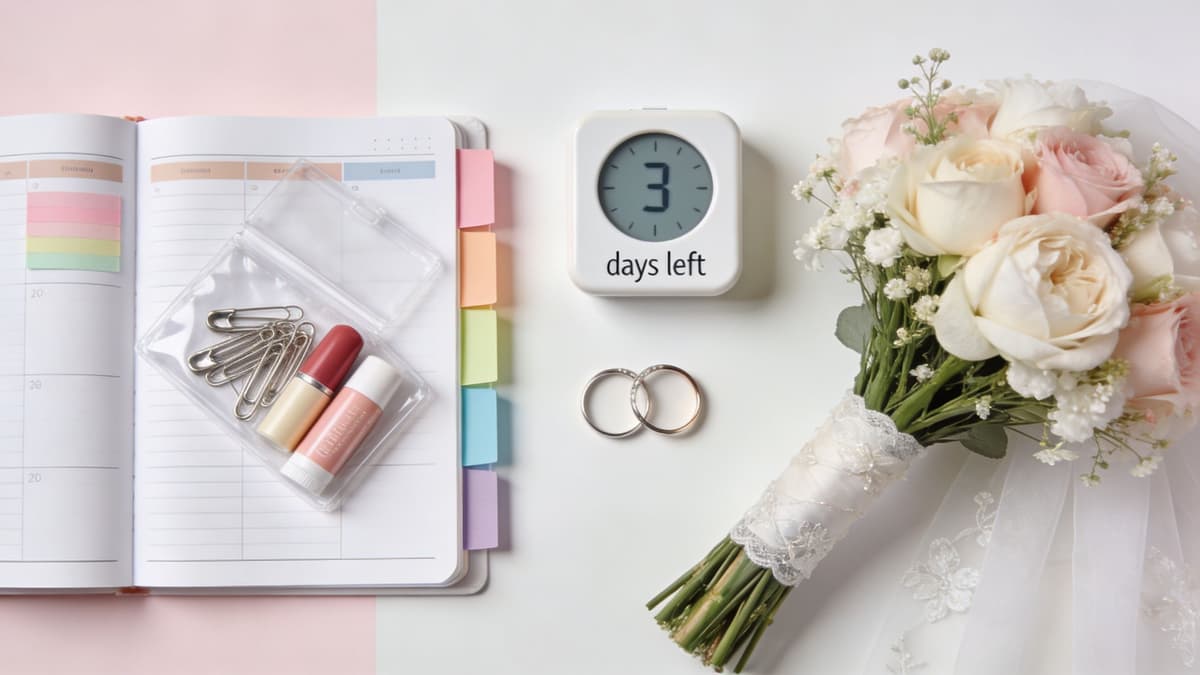
Your Last Minute Wedding Checklist: From Chaos to Calm
19 min
Your Last Minute Wedding Checklist: From Chaos to Calm
Author
The ItsaYes TeamAuthor
The week before a wedding has a way of turning small details into loud problems. A cousin adds a plus-one after the seating chart is printed. A vendor asks for the final headcount. You check three drawers before you find the marriage license, or realize you have not set one place to keep it. If your brain is jumping between ten unfinished tasks, that reaction makes sense.
What helps now is a triage plan built around time. Seven days out, you isolate anything that could disrupt the ceremony, timeline, guest experience, or payments. At 48 hours, you stop editing and start locking decisions. At 24 hours, you hand off responsibility. On the wedding day, you follow a short action plan and protect your attention.
That structure matters because the final stretch is not a normal planning phase. It is crisis management with a deadline. The goal is not to make every detail perfect. The goal is to make sure the right people are informed, the right items are in the right hands, and nothing important depends on your memory while you are getting dressed.
If you need help mapping the flow of the day, keep an expert wedding timeline template open while you work. Use it as a control sheet, not inspiration.
ItsaYes follows the same practical principle. Keep your information in one place, set a clear order of operations, and decide now who takes over when the wedding day starts.
1. The 7-Day Triage Isolate and Execute Critical Tasks
Seven days out, stop asking, "What else should we do?" Ask, "What would break this wedding if we ignored it?" That question clears the fog fast.
Most last-minute stress comes from three buckets: people, timing, and money. Guest count affects seating, catering, rentals, and often the floor plan. Timeline affects every vendor arrival and every transition. Payments affect who shows up relaxed and who starts texting on the wedding morning.
Build one master control document
Open one shared Google Doc, Notion page, or ItsaYes workspace and label it clearly: WEDDING MASTER DOC. Put only live, decision-ready information in it. If you have details buried across texts, email threads, screenshots, and Pinterest notes, consolidate them now.
Include these sections:
Final headcount status: confirmed guests, maybes, children, vendor meals
Vendor contact sheet: name, cell number, arrival time, setup notes
Payment tracker: what's paid, what's due, who hands it over
Day-of authority list: point person, paymaster, license keeper, transport contact
If a task doesn't affect money, people, or timing, move it to a "Post-Triage" list. That might include reprinting signage, changing candle placement, or tweaking favors. Nice if it happens. Not mission-critical if it doesn't.
Practical rule: If a task won't change whether the ceremony can legally happen, whether guests can be fed, or whether vendors can do their jobs, it drops below the line.
Make two calls before anything else
Call the venue and caterer first. Give them your final count, or your best defensible count, and ask for the exact deadline for any last edits. Don't assume those dates are the same.
Then send one final vendor email with a clear subject line like: FINAL TIMELINE | Alex + Jordan | June 14. Attach the run-of-show and tell vendors this is the working version unless they hear otherwise.
Couples often lose time by spending hours fussing over decor bins while the caterer still doesn't know if they're serving 84 or 94 meals. Triage works because it forces the big decisions first.
2. The Communication Blitz Final Vendor Confirmations and Scripts
Don't rely on memory. Don't rely on "they probably have it." Assumptions are what create silent gaps in the final week.
A short, structured confirmation with each vendor does more than reassure you. It reveals missing information while there's still time to fix it. A 2025 survey by The Knot found that 81% of last-minute planners rated vendor coordination as their top pain point, according to this wedding planners' advice checklist article.
Use the same two-minute script every time
Call or email every paid vendor, including the obvious and the easy-to-forget ones. That means not only florist, photographer, and DJ, but also transportation, hotel contact, officiant, rental company, and anyone handling setup or delivery.
Use a script so you don't ramble:
Hi [Vendor Name], it's [Your Name] calling for a final confirmation for our wedding on [Date]. This will only take two minutes.
Then ask only what matters:
Arrival and location: Confirming you're arriving at [time] to [location]?
Final balance: Is your final payment settled, or will someone hand it to you on the day?
Day-of contact: If you need anything, your contact is [point person name] at [number]. Correct?
Deliverables: You're bringing or setting up [specific items]. Correct?
Exit point: Before you leave, who should you check in with?
If you're still choosing vendors for any remaining gaps, keep this list of questions to ask wedding vendors close. It helps you avoid vague conversations that leave too much open.
Get the paper trail
After every phone call, send a follow-up email that starts with: "As per our call, just confirming..." Then summarize the arrival time, location, payment status, and day-of contact. Keep it boring. Boring is good because boring is clear.
A real-world example: if your florist says, "We'll be there in the afternoon," that's not a confirmation. You need, "Arrival between 1:30 and 2:00 PM at the ceremony entrance, with bouquets delivered to Suite 402." That's the level of detail that prevents problems.
3. The Delegation Doctrine Assign Day-Of Roles and Authority
You can't be the person getting married and the person solving logistics all day. Those are two different jobs, and trying to do both ruins your experience.
The fastest way to calm a wedding week is to assign names to problems before they happen. Not general help. Specific responsibility.
Appoint the people who will run the day
Choose one point person who is calm, reachable, and not emotionally overloaded. If possible, don't make this your maid of honor or best man if they're already occupied with ceremony duties. The point person handles incoming questions, small surprises, and vendor redirection.
Then assign a few narrow roles:
Point person: receives all vendor and guest issues
Paymaster: carries envelopes and handles final handoffs
License keeper: protects the marriage license before and after signing
Gift and card collector: makes sure cards, gifts, and guest book leave safely
Setup checker: confirms signage, favors, and personal items land where intended
Write each assignment on an index card or text it in one clean message. If you tell people verbally in a noisy rehearsal dinner, half of it disappears.
If someone brings a problem to you on the wedding day, your answer should be, "Please find Sam. They're handling that for us."
Give authority, not just tasks
Delegation fails when helpers feel like they need permission for every decision. Your point person needs authority to approve a minor change, call a vendor, move a table item, or solve a small payment issue without hunting you down.
A simple example: the transportation company is waiting at the wrong entrance. If your point person is authorized, they redirect the driver and update the timeline. If they don't, that issue travels all the way to your phone while you're in hair and makeup.
Give your lead helper cash for minor emergencies and tell them what falls within their discretion. The less they need you, the more present you'll be.
4. The Legal Lock-In Secure and Store the Marriage License
There are many beautiful details in a wedding. This is the piece of paper that makes the marriage legal.
Some couples spend hours deciding on welcome-sign fonts and then realize, two days before the ceremony, that nobody knows where the license is or who has to hand it to the officiant. That's upside-down priority. A 2025 WeddingWire Industry Report said 42% of couples planning within six months forgot at least one critical confirmation or item such as marriage licenses and seating charts, according to this Markel article on a last-minute wedding checklist.
Put the license in one protected place
Find the marriage license now. Don't assume it's where you last saw it. Put it in a large labeled folder or document sleeve that won't get bent, damp, or lost in a tote bag.
Then answer these questions in writing:
Who has it right now: one named person
Who brings it to the ceremony: one named person
Who hands it to the officiant: one named person
Who takes it back after signing: one named person
Where it goes after the wedding: one named place
Those may all be the same person. That's often the safest choice.
Before the day, confirm with your officiant whether they want the license before the ceremony or immediately after. Also confirm witness requirements and any instructions for returning or filing it. If you're marrying in a destination or unfamiliar jurisdiction, review the local process with a step-by-step wedding legal requirements guide.
Create a visual backup for reference
Take clear phone photos of the front and back. Those images won't replace the document, but they can help if someone needs to verify a detail quickly.
One practical scenario: your officiant asks for the full legal name exactly as listed, and someone isn't near the folder yet. A photo in your phone can prevent last-minute confusion while the actual document stays protected.
5. The Financial Fix Prepare Final Payments and Tip Envelopes
Nothing feels worse than being half dressed, late for photos, and suddenly asked whether the DJ was paid. Money should be settled before the wedding day starts.
Last-minute oversights often become expensive. A 2024 WeddingPro study found that 62% of weddings overrun budgets by 15 to 20%, with last-minute oversights like unconfirmed headcounts and unpaid vendor balances among the main causes, as summarized in this wedding day essentials article from The Knot.
Turn every payment into a labeled handoff
Review each contract and make a simple payment sheet. Use columns for vendor, amount due, payment method, due date, and who delivers it. Then prepare separate envelopes.
Write directly on the outside of each envelope:
Vendor name: photographer, band leader, venue captain
What's inside: cash, check, or note that payment was already sent
When to hand over: on arrival, after ceremony, end of night
Who hands it over: point person, parent, planner, or paymaster
If you need help deciding etiquette and categories, use this guide on how to tip wedding vendors. What matters most in the final week is consistency. One source of truth, one bundle, one person managing it.
Don't carry the envelope bundle yourself
Couples often make a predictable mistake. They create the envelopes, then keep them in a purse or garment bag they can't find when needed. Hand the full bundle to one trusted person with written instructions.
Money rule: If a payment must happen on the wedding day, you shouldn't be the person physically carrying it.
A practical example: the band arrives during your first-look photos. If the paymaster knows the band envelope is delivered after soundcheck, nobody interrupts you. The transaction happens, the music starts on time, and you stay out of operations.
Keep one blank envelope with emergency cash for small surprises. Parking, a last-minute errand, a tipped helper. It prevents a minor issue from becoming a chain reaction.
6. The Go Bag Assemble Your Wedding Day Emergency Kit
Your emergency kit is not a cute extra. It's a working tool kit for the problems that happen when clothing, weather, adrenaline, and long hours collide.
The strongest kits are boring and practical. They solve friction fast. A headache. A hem issue. Lipstick that disappeared after photos. A phone at 8% battery while the pickup car is trying to find the side entrance.
Pack three small kits, not one giant junk bag
One overstuffed tote becomes impossible to use quickly. Pack by problem type instead.
The most commonly missed item in practice is a charged power bank. Pack two if multiple people will be coordinating rides, photos, and location changes.
Stock the kit for real use, not for fantasy
A realistic example: someone steps on the hem of your dress during cocktail hour. A tiny sewing kit may help, but gaffer tape often solves the immediate problem faster and more discreetly. That's the mindset to use for every item. Fast fix first.
Another common one is food. Couples often think they'll snack naturally, then never do. The result is shakiness, irritability, or a crash during photos or speeches. Pack easy, non-messy food that can be eaten in three bites.
If someone in your circle is detail-oriented, make them the keeper of the kit. They should know where it is, what is inside, and how to bring it to you without turning every touch-up into a production.
7. The Personal Prep Finalize Attire Vows and Mindset
Two days before the wedding, stress usually shifts. The big vendor questions are mostly handled, but small personal issues can still throw off the day. A shoe rubs after 20 minutes. A clasp keeps slipping. Your vows sound right in your head and awkward out loud. This phase is about catching those problems while there is still time to fix them.
Treat personal prep like a 48-hour lockdown. Stop making style changes. Stop testing new products. Use this window to confirm that what you plan to wear, say, and carry into the day works under real conditions.
Do one full wear test
Put on the complete outfit. Shoes, undergarments, jewelry, shapewear, veil, jacket, cufflinks, watch, backup shirt, whatever applies. Then move like a real person, not like someone standing in front of a mirror for two minutes. Sit down. Walk stairs. Raise your arms. Practice fastening everything without help, then with the person who will help you on the day.
That test reveals the problems that matter. Heels that are fine for photos but not for six hours. Earrings that catch on lace. A shirt collar that looks sharp but feels tight once nerves kick in.
If you're wearing a custom-fit suit, review this practical grooms' guide to tailored suits and do one last fit check with your full wedding shoes and shirt.
Read the vows out loud and print backups
Silent editing misses weak spots. Reading out loud shows you where a sentence drags, where you will naturally pause, and where emotion might hit harder than expected. Trim anything you keep stumbling over. Shorter usually sounds stronger.
Print two clean copies. Give one to the officiant or your point person. Save a phone copy, but do not rely on your phone as the only version. If you want help tightening the wording without making it sound generic, these examples of personal wedding vows are a useful reference.
"Your vows do not need polished perfection. They need honesty and a pace you can actually speak."
Protect your energy on purpose
The final 48 hours are physical. Eat meals with protein and salt. Drink water early, not just when you remember. Keep alcohol light if it affects your sleep, skin, or anxiety. If you are getting beauty services, stick with the products and timing you already know work for you.
Give yourself one protected block of time with no wedding talk. Thirty minutes helps. An hour is better. The trade-off is simple. You can spend that time checking tiny details you already handled, or you can arrive steadier, kinder, and more present. In practice, the calmer option usually serves the day better.
8. The 24-Hour Hand-Off Go Offline and Trust Your Plan
The last move is the hardest because it feels passive. It isn't passive. It's disciplined.
At some point, more checking stops helping. It starts feeding anxiety. The day before your wedding, your role has to change from manager to participant. If you don't make that switch intentionally, you'll keep monitoring every detail until the ceremony starts.
Make the hand-off official
Set a specific time. Tell your point person, "At 8 PM, I'm done managing." Then hand over the master doc, contact sheet, payment bundle, transport details, and any access instructions they need.
If you're someone who checks email reflexively, remove the temptation. Log out. Silence vendor threads. Change your voicemail if needed. If something is urgent, people should contact your designated person, not you.
A practical hand-off briefing should sound like this:
You have the documents: master doc, timeline, vendor list, payments
You have authority: solve small issues without checking with me
You know escalation: only interrupt me for true emergencies
You know key locations: license, rings, attire, emergency kit, gifts
Trust the plan you already built
A calm wedding day doesn't happen because nothing goes wrong. It happens because the right people know what to do when something does.
This is also where organized planning systems help. ItsaYes is designed to keep tasks, timeline, budget, and priorities in one place, which mirrors exactly what couples need in the final hand-off. Not more information. Clear information, already sorted.
One last mindset shift helps here. Perfection is no longer the assignment. Presence is. If a candle gets moved, if a shuttle runs five minutes late, if the programs sit at a slightly wrong angle, none of that changes the reason everyone came.
8-Point Comparison: Last-Minute Wedding Checklist
Strategy
🔄 Implementation Complexity
⚡ Speed / Efficiency
Resources Required
📊 Expected Outcomes (⭐)
💡 Ideal Use Cases / Key Advantages
1. The 7-Day Triage: Isolate and Execute Critical Tasks
Medium, focused decision-making and prioritization
High, concentrates effort on deal‑breaking items
Master document, vendor contacts, phone/time for calls
⭐⭐⭐⭐, final guest counts, timeline, and payments locked
Best when time is short and scope must be reduced to essentials
2. The Communication Blitz: Final Vendor Confirmations & Scripts
Best for reducing small crises that can derail comfort or timing
7. The Personal Prep: Finalize Attire, Vows, and Mindset
Low, personal rehearsal and mental preparation
Moderate, improves presence rather than logistics
Attire, vows, hydration plan, downtime, overnight bag
⭐⭐⭐⭐, increased comfort, confidence, and emotional readiness
Use 48 hours out to ensure you're physically and mentally ready
8. The 24‑Hour Hand‑Off: Go Offline & Trust Your Plan
Low, procedural and symbolic hand‑off
Immediate, enables being present and enjoying the day
Master doc, Point Person, OOO/voicemail, set hand‑off time
⭐⭐⭐⭐⭐, restores calm and preserves the guest‑of‑honor experience
Final step to relinquish control and prevent last‑minute micromanaging
From Checklist to I Do Your Final Step Is to Let Go
You don't need a flawless wedding week. You need a controlled one. That's what this last minute wedding checklist is really for. It takes the swirling mental load and turns it into a sequence of decisions, assignments, and handoffs that real people can execute.
The pattern is simple because it works. First, cut ruthlessly. Handle the tasks that affect legality, guest experience, vendor timing, and payment. Next, confirm everything in brief, clear language. Then hand responsibility to people who can carry it without dragging you back into management mode.
That structure matters because wedding stress is often less about volume and more about uncertainty. When nobody knows the final count, people panic. When nobody knows who has the license, people panic. When nobody knows whether the photographer has been paid, people panic. The checklist calms you because it replaces ambiguity with ownership.
There are trade-offs in the final week, and it's better to name them plainly. You may not finish every decorative detail you hoped to. Some ideas will stay in the group chat and never make it to the venue. A few tiny imperfections will make it through. That's normal. In practice, couples remember how the day felt far more than whether every small visual choice landed exactly as imagined.
What does work is one master document, one final vendor confirmation cycle, one designated point person, one payment bundle, one protected legal folder, and one deliberate hand-off before the wedding begins. Those moves create breathing room. Breathing room lets you eat, sleep, get dressed without chaos, hear your vows, and look around long enough to register that the day is happening.
If you're early in the planning process, that's where a system like ItsaYes can be useful. It brings tasks, budget, ideas, and timeline into one workspace so you're not trying to assemble your own control center in the final week. If you're already in the sprint, the same principle still applies. Centralize. Prioritize. Delegate. Then stop.
You've already done the hard part. You've made hundreds of decisions, coordinated with a crowd of people, and carried an emotional project for months. Now the list has served its purpose. Let other people hold the logistics. Let the timeline run. Let the tiny imperfections exist without trying to chase them down.
Your only remaining job is the one that matters most. Show up. Look at your person. Say the words. Stay there for it.
If you want a calmer planning process before the final-week scramble, ItsaYes gives you one place to organize your wedding vision, checklist, budget, and timeline with AI-guided support. It can help you build the structure early, so the last minute feels a lot less last minute.