You've done the flower shopping, cleared off the table, and built the bouquet itself. The blooms look right. The color story feels like you. Then you look down and realize you're still holding a handful of loose stems.
That moment catches a lot of DIY brides off guard. Wrapping sounds like a finishing detail, but on a wedding day it carries more weight than people expect. The wrap affects how the bouquet feels in your hand, how well it travels, how polished it looks in photos, and how calmly you'll move through the day when everything else is already asking for your attention.
Knowing how to wrap a bouquet well is less about fancy folds and more about making smart choices. A wedding bouquet has to survive movement, warm rooms, car rides, venue handoffs, family photos, and the part of the day where someone sets it down somewhere slightly wrong. A good wrap helps the bouquet hold together and still look intentional hours later.
Your Final Touch Before 'I Do'
A bride usually reaches this stage late in the process. The flowers are arranged. The playlist is on. Someone is asking where the vow books went. And there you are, holding the bouquet and thinking, “I really need this to look finished.”
That feeling is normal. Wrapping the bouquet can seem like a tiny task, but it's often the last hands-on detail before the wedding day becomes fully scheduled. I've found that treating it as a practical finishing step, not a craft test, changes the whole mood. You're not trying to impress a florist. You're making the bouquet secure, comfortable to carry, and visually consistent with everything else you planned.
There's also a real function behind the pretty part. A bouquet wrap isn't just decorative. Research from FloraLife's bouquet wrap update says specialized bouquet wraps are designed to keep flowers fresh and hydrated for at least 48 hours. On a wedding day, that matters. The bouquet may need to stay camera-ready far longer than most gift bouquets ever do.
The wrap is where the bouquet becomes an accessory instead of a bundle of stems. It's the point where your florals start speaking the same visual language as your dress, shoes, stationery, and tablescape.
A few examples make the difference obvious:
Soft silk ribbon gives a bouquet a bridal finish and moves beautifully in outdoor photos.
Kraft paper and twine feel grounded and relaxed, but they need a cleaner stem bundle to avoid looking messy.
Structured paper folds add shape and drama, but they're less forgiving if the bouquet will be handled all day.
A bouquet wrap should solve two problems at once. It should make the bouquet look finished, and it should help it behave well.
What to keep in mind from the start
Before you choose a ribbon color or paper shape, ask three simple questions:
Question
Why it matters
Will you carry this for hours?
Comfort and grip matter more than elaborate bulk.
Will it travel in a car or across venues?
The wrap needs to resist slipping and crushing.
Will the bouquet spend time out of water?
Freshness protection matters as much as appearance.
If you start there, the rest becomes calmer. The wrap stops being a last-minute stress point and becomes what it should be: the final, personal touch that makes the bouquet feel complete.
Choosing Your Bouquet Wrapping Supplies
Supplies shape the result before you even make the first fold. If the materials fight you, the bouquet will show it. If they cooperate, wrapping becomes much easier and the bouquet reads as polished instead of improvised.
Paper is still the workhorse material for good reason. In the biodegradable cut flower packaging market, paper and paperboard are expected to hold a 42% share of material demand, according to the market context cited in the verified brief. That tracks with what works in practice. Paper folds well, gives shape fast, and can look clean, romantic, modern, or rustic depending on finish and color.
The materials that do the heavy lifting
Start with the outer material, then build inward.
Kraft paper works for relaxed, garden-style, or rustic weddings. It holds a crease well and gives you structure. It can feel too casual for a very formal ballroom look unless you soften it with ribbon.
Matte florist paper is the most versatile option for a wedding bouquet. It creates crisp lines without looking stiff.
Tissue paper is useful as a soft inner layer or accent, but not as the main support. It tears too easily under pressure.
Fabric wrap such as linen or soft cloth can look beautiful, especially for editorial or heirloom-inspired bouquets. It's best when the stem bundle is already very secure because fabric won't create shape on its own the way paper does.
Ribbon matters just as much because it controls the finish.
Ribbon choice changes the mood
A quick way to narrow your options is to match the ribbon to the kind of movement you want.
Material
Best for
Watch out for
Satin ribbon
Formal, classic, clean
Can slip if tied over slick paper
Silk or chiffon ribbon
Romantic, airy, photo-friendly
Frays softly, so cut neatly and allow for movement
Velvet ribbon
Autumn, winter, moody weddings
Adds weight and can feel too heavy on petite bouquets
Twine or jute
Rustic, simple, organic
Can read too rough against refined flowers
Lace overlay
Vintage, heirloom styling
Best used as an accent, not your only securing method
Practical rule: If the bouquet is heavy, let tape or floral binding create security first. Let ribbon provide beauty second.
The tool kit worth having on the table
You don't need a huge kit. You do need the right few items.
Sharp floral shears for clean stem trimming
Waterproof floral tape or a secure binding to hold the hand-tied shape
Double-sided tape for neat paper joins
Straight scissors for ribbon and paper trimming
Pins or decorative fasteners only if they're stable and won't snag fabric
A clean towel to dry stems before wrapping
A simple checklist helps avoid the classic last-minute scramble:
Outer wrap picked: paper or fabric that suits the wedding style
Inner support ready: tape, tie, or binding to hold stems together
Finishing layer chosen: ribbon, twine, or fabric strip
Cutting tools tested: sharp enough to avoid ragged edges
Backup supplies nearby: extra ribbon, tape, and one spare sheet of wrap
The best supply choice is rarely the most elaborate one. It's the one that gives you the look you want without becoming fragile the second the bouquet leaves the table.
Prepping Your Stems for a Long Day
Most bouquet problems start before the wrap goes on. If stems are uneven, wet in the wrong places, crowded, or poorly conditioned, no ribbon in the world will make the bouquet feel professional.
A wedding bouquet needs prep that accounts for time out of water. Expert guidance from The Party Teacher's bouquet wrapping tutorial recommends a moisture barrier with damp paper towels and plastic wrap around the cut stems before the decorative layer goes on. That point matters because wrapping paper alone is not a hydration system.
The prep sequence that helps flowers hold up
Do these in order. It makes the final wrap cleaner and stronger.
Remove lower foliage and thorns
Strip anything that would sit below the tie point or touch the moisture wrap. Leaves trapped low in the bundle create bulk and mess.
Trim stems at an angle
Give each stem a fresh cut so the bouquet starts fully conditioned. Try to get the bundle to a comfortable, even base rather than leaving random lengths.
Build the bouquet shape before wrapping
Don't rely on paper to hide poor structure. Make the flowers sit well in your hand first, then secure the stems lightly.
Dry the outside of the stems
The cut ends need moisture. The handle area does not. If the stems are slick, ribbon and paper will slide.
The moisture trick that actually helps
Once the bouquet is built, wrap the cut stem ends with a damp paper towel. Then cover that with a moisture barrier such as plastic wrap. Keep it neat and compact so it protects hydration without turning the base into a bulky lump.
That inner layer is especially useful if the bouquet will be wrapped ahead of photos, carried between locations, or left waiting during setup. It buys you margin.
Wrapping paper protects shape. The inner moisture layer protects freshness. They do different jobs.
What to avoid before you start styling
A few mistakes show up again and again:
Overstuffing the handle: too many crossing stems make the bouquet hard to bind and uncomfortable to carry.
Leaving stems wildly uneven: the wrap won't sit flat and the bouquet base will wobble.
Squeezing the bundle too hard: compressed stems can kink, and bloom heads can shift out of place.
Skipping the dry-off step: damp stems often lead to slipping ribbon and loose paper.
If you want the bouquet to last from first look through late-night photos, this prep is the quiet part that makes everything else work.
The Classic Hand-Tied Wrapping Technique
This is the most reliable method for a wedding bouquet because it looks elegant and adapts well to different bouquet sizes. It also gives you control. That matters more than complexity.
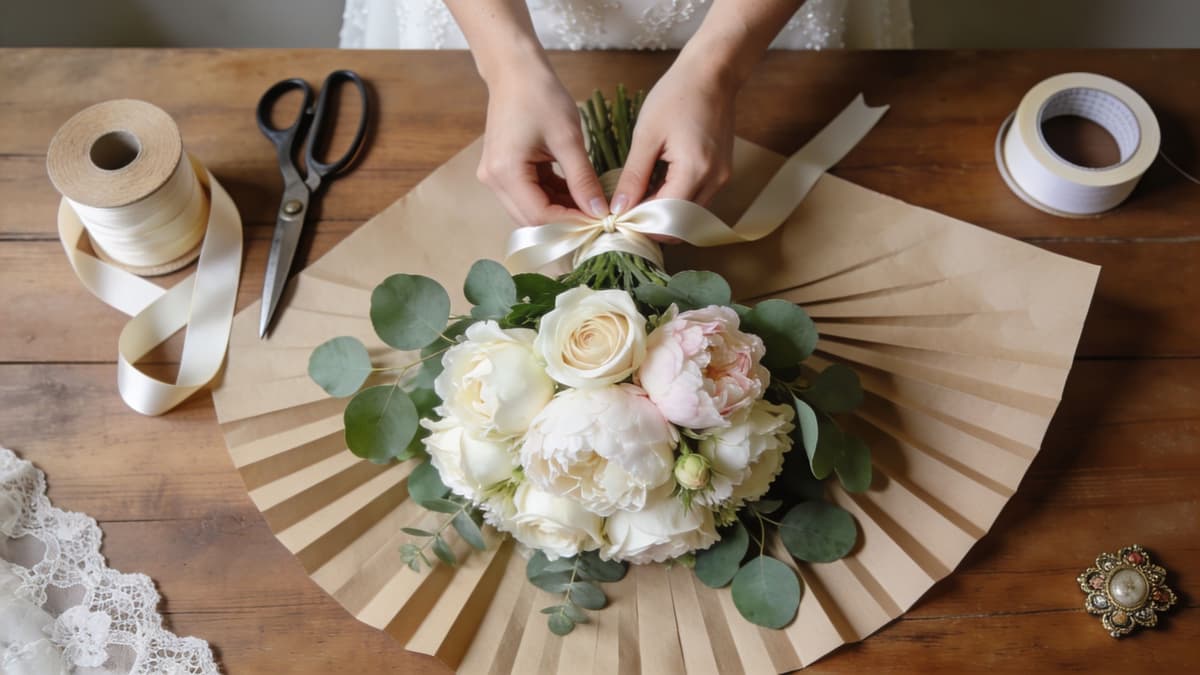
For presentation-quality wrapping, the key is controlled layering and angle management. Floristry guidance from Floral Concepts Houston's wrapping guide describes placing the bouquet diagonally on the paper so the fold line sits just below the bloom heads. That placement creates the clean cone or fan shape you see in modern hand-tied bouquets.
Set the paper before you touch the bouquet
Lay your paper on the table in a diamond or diagonal orientation. If you want a fuller look, use two sheets slightly offset so the edges don't stack exactly on top of each other.
Put the bouquet on the paper diagonally, not straight up and down. The flower heads should sit high enough that the paper frames them rather than swallowing them. The stems should extend past the lower edge enough to create a comfortable handhold.
If the paper reaches too far above the blooms, the bouquet starts to look buried. If it sits too low, the wrap feels skimpy and unfinished.
Make the first fold do the hard work
Bring one side of the paper across the bouquet first. Let it follow the natural flare of the flowers instead of forcing a tight cylinder. Then bring the opposite side over with a slight overlap.
That overlap is where the bouquet starts to look intentional.
Use a small piece of double-sided tape or discreet clear tape to hold the join. You only need enough to keep the paper from springing open. Too much tape makes later adjustments harder.
How tight should the wrap be
Snug at the base, open at the top. That's the feel you want.
If you pull the paper too tightly around the shoulder of the bouquet, you compress the flowers and lose the airy shape. If you leave the base too loose, the whole thing rotates in your hand and the wrap reads sloppy.
A quick tension check helps:
Area
What it should feel like
Near the bloom heads
Light and open
Around the middle
Supportive, not compressed
At the handhold
Firm enough to carry comfortably
If the paper crackles and fights back when you fold it, stop and reset. Good wrapping usually looks smooth because the bouquet is cooperating, not because the wrapper is forcing it.
Secure the handle cleanly
Once the paper shape is right, bind the stem area with ribbon, twine, or another finishing tie. Start where your hand will naturally rest. That usually lands just above the lower stem ends and below the widest part of the bouquet.
You can wrap the ribbon around the handle area several times for a polished band, or tie it once and let the tails trail if that suits the style better. For weddings, I usually prefer a stable band first, then a softer decorative finish over it.
A few details make the difference between handmade and polished:
Trim excess paper so the lower edge looks balanced
Cut ribbon tails at an angle for a neater finish
Check the front view before you call it done
Hold it at arm's length to catch any lopsided folds
The best hand-tied wraps don't look fussy. They look settled, balanced, and easy to carry.
Styling Your Wrap to Match Your Wedding Vibe
The wrap isn't an afterthought. It's part of the bouquet's design language. If the flowers are soft and airy but the wrap is stiff and harsh, the whole piece feels disconnected. If the bouquet and wrap speak the same aesthetic, even a simple arrangement looks more refined.
Historically, bouquet wrapping has reflected regional taste as much as function. As noted in Ohara Florist's discussion of bouquet wrap styles, European wrapping often stays minimal because the wrap mainly protects flowers in transit, while Japanese and Korean styles lean more heavily into layered paper structures as part of the presentation itself. That's useful for a bride because it gives you permission to decide what role the wrap should play.
If you want the flowers to lead
Choose a restrained wrap. Let the bouquet stay central.
Good options include:
one clean paper layer in ivory, soft white, or muted taupe
a narrow satin or silk ribbon in a tone close to the dress
a slim handle wrap with little to no bulk around the blooms
This works beautifully for classic weddings, city venues, and bouquets with strong flower texture already doing the visual work.
If you want the wrap to feel expressive
Go further on shape and texture. Layered ribbon, structured folds, or fabric details earn their place at this stage.
A few combinations I like:
Wedding feel
Wrap direction
Romantic garden
matte paper with silk or chiffon ribbon tails
Modern editorial
crisp paper folds with a minimal monochrome tie
Rustic refined
kraft or textured paper softened with lace or silk
Moody evening
deep velvet ribbon over a simple paper base
The bouquet wrap can echo your wedding style the same way shoes or earrings do. It doesn't need to match everything. It needs to belong.
Personal details that don't feel gimmicky
The prettiest styling choices are often small. A family charm, a tiny locket, a brooch, or a ribbon tone pulled from your invitation suite can add meaning without making the bouquet feel overloaded.
Use embellishments carefully. If they swing, snag, or add awkward weight, they stop feeling sentimental and start feeling annoying. Attach them where they won't interfere with your grip.
A good test is to hold the bouquet naturally and move around with it. Walk. Sit. Turn. If something catches on your dress or pokes your hand, remove it.
The strongest wraps feel edited. They don't need ten ideas at once. They need one clear point of view.
Your Wedding Day Bouquet Game Plan
The bouquet wrap that looks best at noon isn't always the one that survives until dancing. Wedding-day wrapping needs a plan, not just a pretty finish.
Most tutorials focus on looks and skip the actual pressure points. They don't spend enough time on heat, travel, venue handoff, or the long stretch between getting ready and the reception. In practice, bouquet integrity often matters more than decorative complexity, especially when the day includes multiple stops and lots of handling.
Decide when to wrap it
There isn't one perfect answer. There is a smart answer for your schedule.
If your bouquet needs to travel early, or you're trying to reduce morning stress, do the structural prep ahead of time and keep the bouquet as hydrated as possible. Add the final outer wrap closer to when you'll carry it if the paper or ribbon is delicate.
If the bouquet is sturdy and your timing is tight, a full wrap the night before can work. Just avoid trapping dampness where it can soften paper or loosen ribbon. Store it carefully and keep the handle area clean.
A practical split often works best:
The day before: condition stems, build the bouquet shape, secure the stem bundle
Wedding morning: add the outer wrap, ribbon finish, and final styling details
Plan for transport, not just photos
The prettiest bouquet can get crushed in the back seat in minutes. Keep it upright, sheltered, and away from direct heat. Don't wedge it under a bag, next to a garment steamer, or on a seat where it can roll.
Use a transport approach that protects the shape:
Support the base so the stems stay steady
Keep air around the blooms instead of pressing them into a box
Avoid slick surfaces where the bouquet can slide during turns
Assign one person to handle it during transitions
A sturdy, simpler wrap usually outperforms a sculptural one once the wedding day actually starts moving.
Build a small rescue kit
This is what saves you when something shifts right before photos.
Pack:
Extra ribbon in the exact material and color
Floral tape
Double-sided tape
Small sharp scissors
A few paper towels
A spare sheet of wrap material if your outer layer is paper-based
Quick fixes that take under a minute
Problem
Fast fix
Ribbon comes loose
Retie over the existing band instead of unwrapping everything
Paper softens or creases
Trim the worst edge and re-fluff the open side
Bouquet rotates in hand
Add one hidden tape point at the handle
Stems feel wet and slippery
Dry the grip area with paper towel before retying
One bloom shifts forward
Tuck it back and tighten the stem binding, not the outer paper
The goal isn't to preserve a bouquet in showroom condition. It's to keep it beautiful, secure, and easy to carry through a full wedding day. When you plan for movement, time, and minor mishaps, you stop treating the wrap like a fragile decoration and start using it as the support system it should be.
ItsaYes helps newly engaged couples turn scattered ideas into a clear wedding plan. If you want one place to organize your style, tasks, budget, and timeline, ItsaYes gives you a calm, AI-powered workspace that keeps everything moving without the spreadsheet chaos.